Çatalhöyük
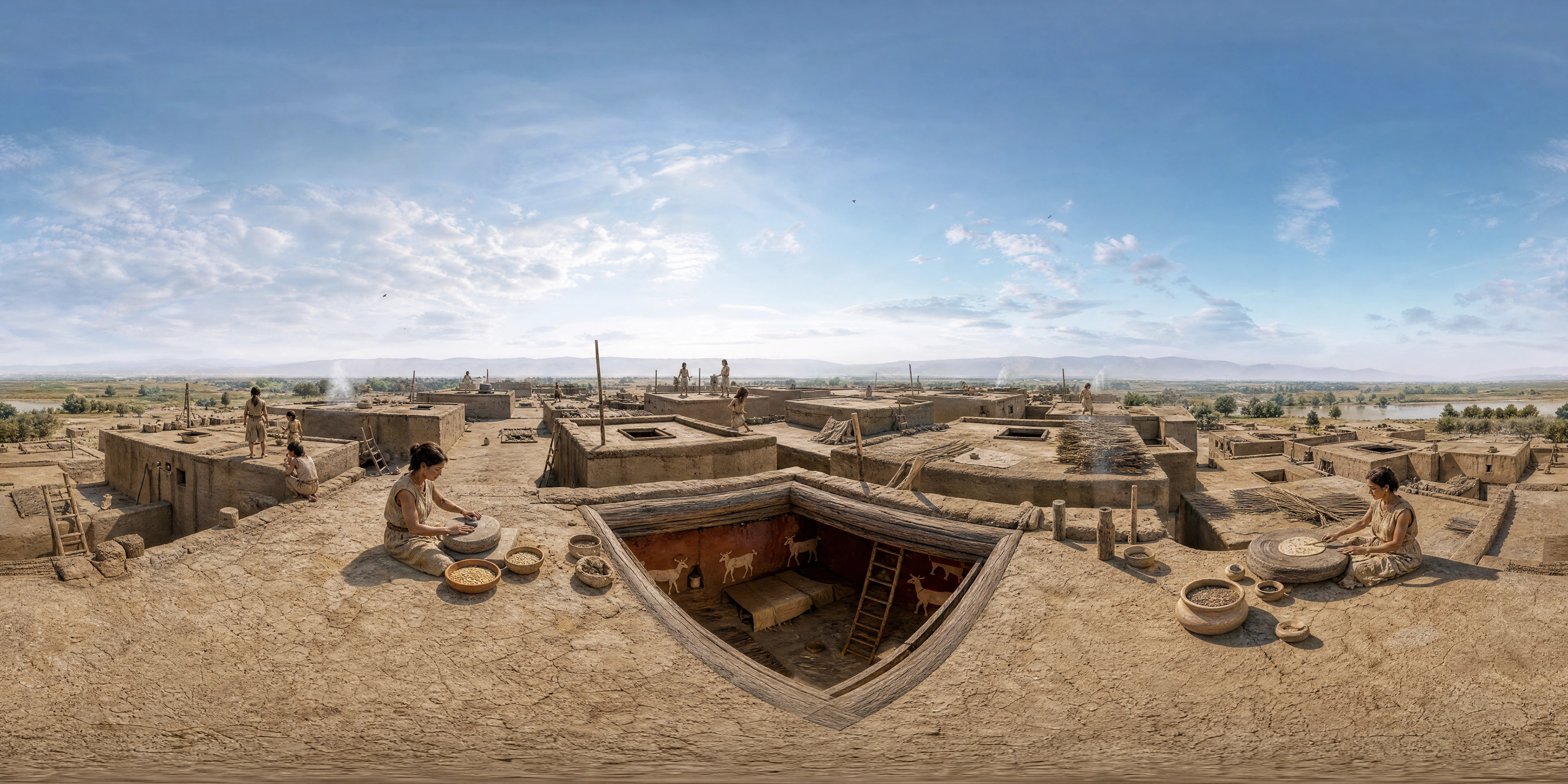
Around 7000 BC in central Anatolia, the densely packed houses of Çatalhöyük are entered only through hatches in the roof: there are no streets, only rooftops.
- Year
- 70th century BC
- Where
- Konya Province, central Anatolia · TR
- Era
- Prehistoric
- Coordinates
- 37.666, 32.828
The moment
A town with no streets
Çatalhöyük lay on the Konya plain in central Turkey from roughly 7 100 BC to 5 700 BC. At its peak it housed perhaps eight thousand people, the densest settlement of its date anywhere on Earth.
It had no streets.
The houses were built wall-against-wall. The only way in or out of any house was a hatch in the flat mud-brick roof, with a wooden ladder descending to the floor inside. The roofs were the streets. People walked, traded, ground grain and gossiped on the rooftops; the doors were under their feet.
Bulls on the walls
The interior decoration is unlike anything else in Neolithic Anatolia. Plastered wall niches hold bucrania: actual aurochs (wild cattle) skulls embedded in the plaster, the horns painted with red ochre. Some houses have full wall murals: leaping deer, vultures stooping on headless human figures, and what may be the world's earliest landscape painting, a townscape with what looks like the eruption of Hasan Dağ volcano in the distance, controversially dated to about 6 600 BC.
The dead were not buried outside. They were interred beneath the floor of the living-room platform, sometimes after the skull had been removed, plastered, and painted to be kept above ground for ritual use.
A community without hierarchy
The remarkable feature of Çatalhöyük is what archaeologists do not find.
No palaces. No rich graves with disproportionate goods. No temples standing apart from the dwellings. Every house is approximately the same size, every burial roughly equivalent. For more than a thousand years, eight thousand people lived together in apparent material equality.
James Mellaart, who first excavated the site in 1958, called it "the first city". Subsequent work has suggested it is more accurately a very large village that resisted the inequalities urban life elsewhere produced.
The diffusion
Around 5 700 BC the inhabitants began to spread out into smaller settlements with detached houses and ground-level doors. The rooftop- entry tradition was abandoned across the Konya plain. No catastrophic ending is visible in the archaeology: no destruction layer, no famine, no invasion. The town simply diffused.
The mound was inhabited intermittently for another five centuries and then left alone for seven thousand years.
Further reading
Tagged
- prehistoric
- neolithic
- anatolia
- urban
- mudbrick
Published
See also

25th century BC
Stonehenge
Around 2500 BC on Salisbury Plain, Neolithic Britons heave the first sarsen monoliths into vertical position, building what will become Stonehenge.

2560s BC
Giza
Around 2560 BC, tens of thousands of paid workers build Khufu's pyramid at Giza, already three-quarters complete in this scene, the largest stone structure in the world for the next four millennia.

1323 BC
Valley of the Kings
In 1323 BC, the funeral procession of the young pharaoh Tutankhamun arrives at the cliff face of the Valley of the Kings to deposit him in tomb KV62, where he will lie undisturbed until 1922.