Summit of Mount Everest
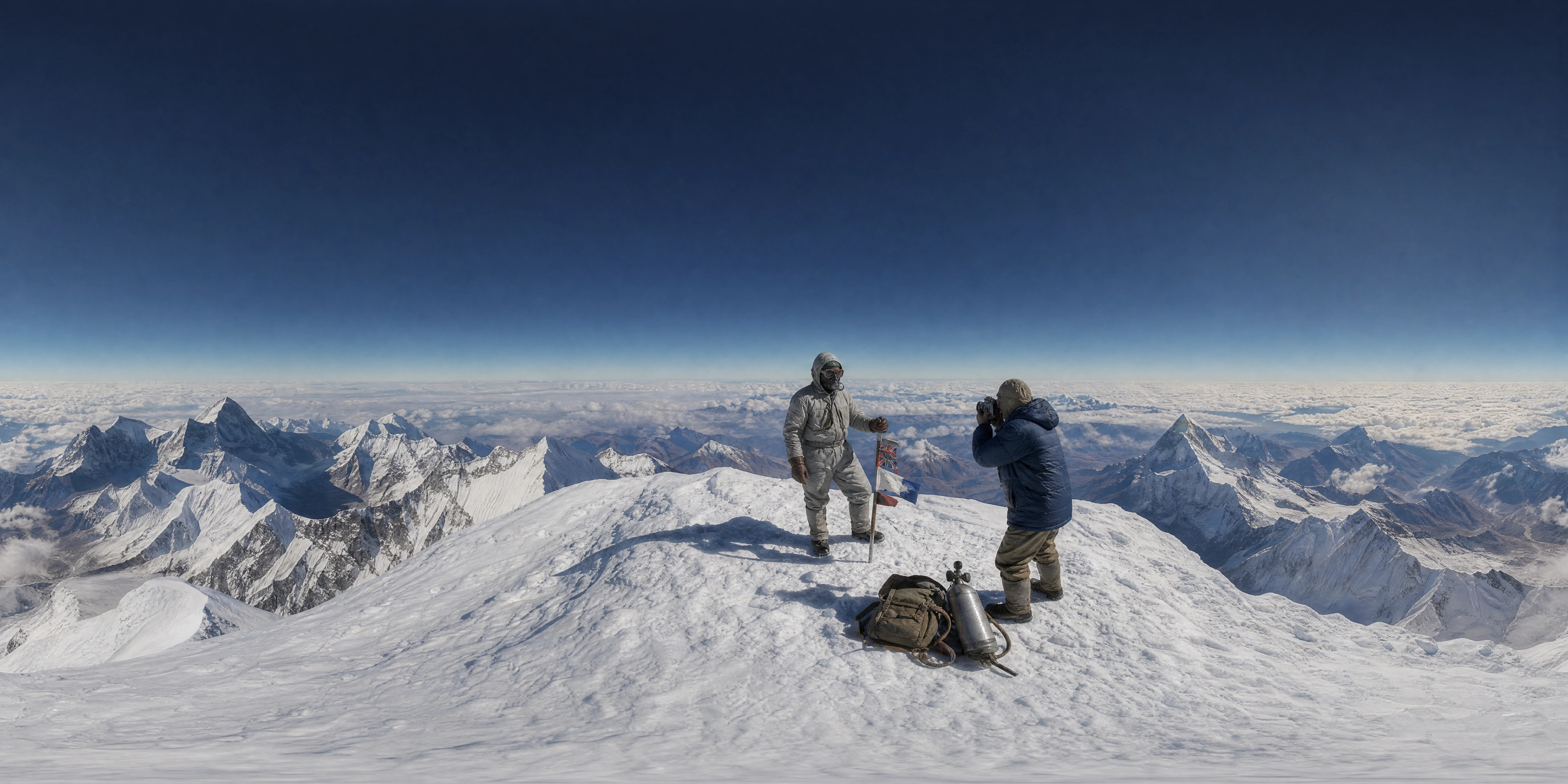
At 11:30 on 29 May 1953, the New Zealand beekeeper *Edmund Hillary* and the Nepalese Sherpa *Tenzing Norgay* stand on the 8 849-metre summit of *Mount Everest*: the first humans confirmed to reach the highest point on Earth.
- Year
- 1953
- Where
- Sagarmatha (Mt. Everest), Solukhumbu · NP
- Era
- modern_postwar
- Coordinates
- 27.988, 86.925
The moment
Eighteen attempts in thirty-two years
Between 1921 and 1953, eighteen separate expeditions attempted to reach the summit of Mount Everest.
All failed.
The first British reconnaissance expedition in 1921 mapped the mountain's approaches from Tibet. The second in 1922 included George Mallory and reached 8 320 metres on the north ridge before turning back. The third in 1924 produced the most famous tragedy in mountaineering history: Mallory and Andrew Irvine were last seen at about 11:50 on 8 June 1924, climbing strongly toward the summit through breaks in the clouds. They never returned.
Whether they reached the summit before they died (Mallory's body was finally found in 1999 at 8 155 metres on the north face, badly broken from a fatal fall) remains one of the most contested questions in the history of exploration. The most considered modern view, given the late hour of their last sighting and the absence of the photograph of his wife Ruth that Mallory had said he would leave on the summit, is that they probably did not.
Fourteen further expeditions over the next 29 years made progress. None reached the summit.
A Swiss attempt the year before
The 1953 British expedition was, in 1952, on track to be a Swiss expedition.
A Swiss expedition led by Edouard Wyss-Dunant and Gabriel Chevalley in spring and autumn 1952 had taken Raymond Lambert and Tenzing Norgay to within 250 vertical metres of the summit. They turned back because their oxygen equipment failed and Lambert's feet were freezing. Tenzing, already by 1952 the most experienced Himalayan high-altitude climber alive, agreed to join the British expedition in 1953 having been on the previous year's Swiss attempt.
Tenzing had now made six previous attempts on Everest. He had been on expeditions in 1935, 1936, 1938, 1947 (an unauthorised solo attempt by Earl Denman), 1951, and 1952.
The 1953 British expedition was led by Colonel John Hunt, a British Army officer chosen for his organisational skill. The team included the New Zealand beekeeper Edmund Hillary (33), the Welsh physician Charles Evans, the New Zealand surveyor George Lowe, and Hunt himself. Tenzing was the sirdar, head of the Sherpa support team, and effectively co-leader of the climbing party.
Two days, two attempts
The expedition reached the upper South Col at 7 900 metres on 26 May 1953.
Hunt's plan was to send two separate climbing pairs to attempt the summit. The first pair, Charles Evans and Tom Bourdillon, set out on 26 May using a more efficient "closed-circuit" oxygen system that recycled exhaled gas. They reached the South Summit (a subsidiary peak at 8 750 metres, the highest point yet reached on Everest) at 13:00 on 26 May before the oxygen equipment began to fail. They turned back about 100 vertical metres from the true summit.
The second pair, Edmund Hillary and Tenzing Norgay, set out the following morning, 28 May. They camped that night at 8 500 metres on the Southeast Ridge, the highest camp ever pitched. They set out for the summit at 06:30 on 29 May with full oxygen sets.
What they did at 11:30
Hillary and Tenzing reached the summit at 11:30 on 29 May 1953.
Hillary's account, in his autobiography High Adventure (1955):
A few more whacks of the ice-axe in the firm snow, and we stood on top.
They spent fifteen minutes there.
Hillary took several photographs of Tenzing holding his ice-axe with the four flags (Union Jack, United Nations, Nepal, India) tied to the head. Tenzing left a small offering of biscuits, chocolate and a pencil his daughter had given him, buried in the snow as a Buddhist offering to the mountain gods. Hillary, by his account, left a small crucifix his expedition leader John Hunt had given him.
There is no confirmed photograph of Hillary on the summit.
The two men descended without further drama and reached the South Col camp by 14:00, where Hunt and the rest of the team were waiting.
News of the climb was broken to the world by a coded radio message to The Times of London, who held the exclusive rights. The cipher (snow conditions bad. Stop. Advanced base abandoned yesterday. Stop. Awaiting improvement) meant the opposite: Successful summit yesterday.
The cable reached London on the evening of 1 June 1953. The morning of 2 June 1953 was the Coronation of Queen Elizabeth II. The combination of the two events, the British Commonwealth's mountaineering triumph and the new Queen's coronation, produced one of the largest moments of British post-war national feeling.
Who reached the summit first
The question of which of the two men first set foot on the actual summit, Hillary or Tenzing, has been argued, sometimes bitterly, for seventy years.
Both men consistently insisted that they reached it together, with Hillary slightly ahead because he was breaking trail.
In India and Nepal, public sentiment in 1953 insisted that Tenzing must have been first: that the colonial implications of a New Zealand European reaching the summit first were unacceptable, and that Tenzing's six previous attempts made his moral claim stronger.
In Britain, public sentiment assumed without much argument that Hillary, as the Commonwealth subject, had been first.
Tenzing, asked directly in his 1955 autobiography Tiger of the Snows, gave the only honest answer:
If it is a discredit to me that I was a step behind Hillary, then I must live with that discredit. But I do not think it is. It was not a race. We were not rivals. We were on a rope together, at the top, just as we had been all the way up.
Both men were knighted by Queen Elizabeth II in 1953. Tenzing, because he was a citizen of Nepal, could not technically receive a knighthood and was given the George Medal instead. Edmund Hillary became Sir Edmund Hillary. The two men remained close friends until Tenzing's death in 1986.
Hillary, asked decades later what the summit had felt like, said the overwhelming sensation had been simple physical exhaustion and the calculation of what would be needed to get down alive.
He died in 2008, age 88.
Further reading
Tagged
- everest
- mountaineering
- hillary
- tenzing
- 1953
- nepal
Published
See also

1989
Brandenburg Gate, Berlin
On the night of November 9–10, 1989, East and West Berliners climb the Berlin Wall in front of the Brandenburg Gate, chipping at the concrete with hammers and dancing on top: the symbolic collapse of the Iron Curtain.

1948
Tempelhof Airport, West Berlin
For 462 days between June 1948 and September 1949, British and American transport aircraft fly food and coal into blockaded West Berlin: one plane landing at Tempelhof every 90 seconds at the peak.

1949
Tiananmen Gate, Beijing
At 3:00 p.m. on October 1, 1949, Mao Zedong proclaims the People's Republic of China from the rostrum atop Tiananmen Gate above 300,000 people in the square below.