Great Wall of China, Jinshanling
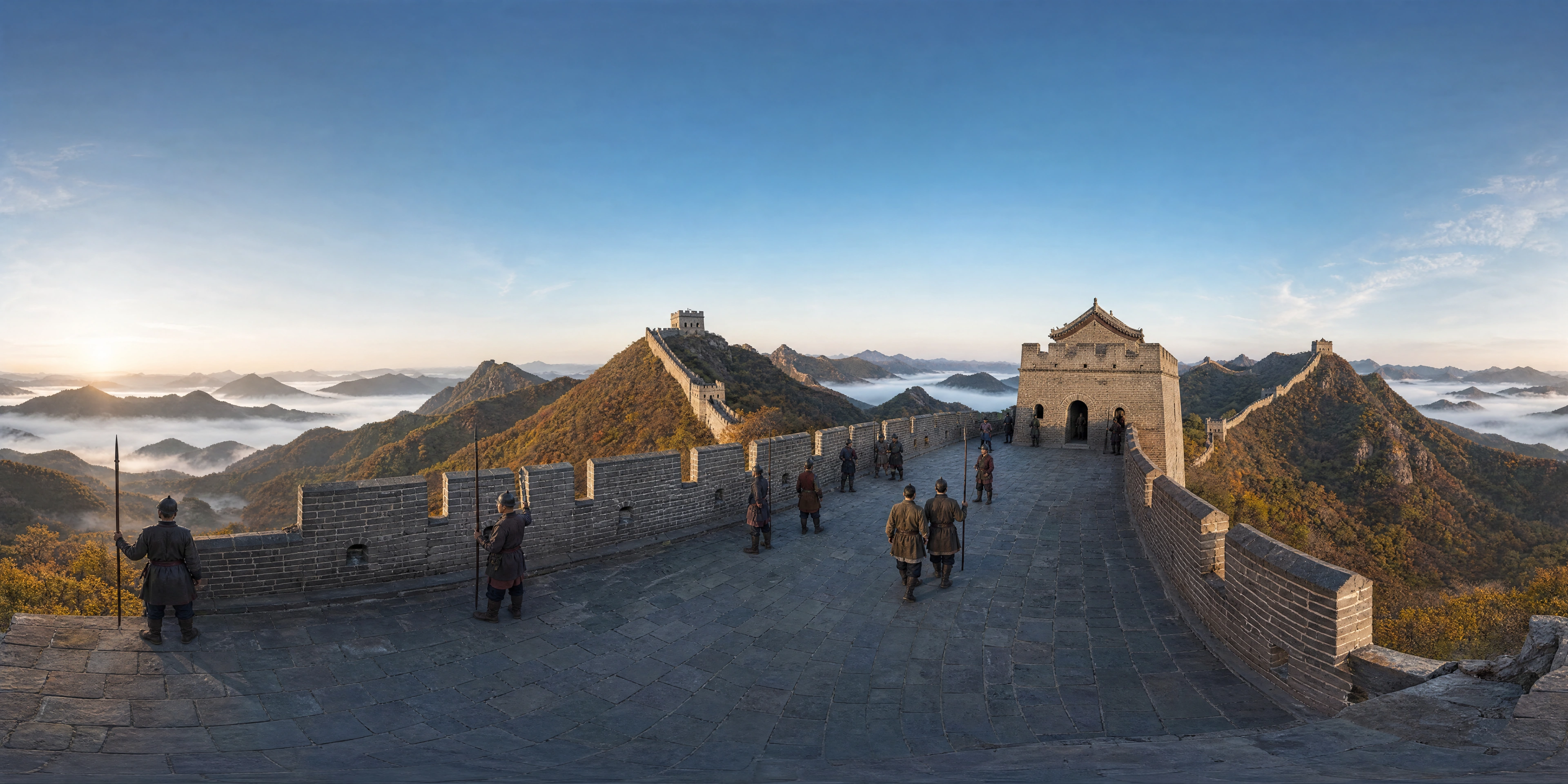
Around 1500, Ming China rebuilds the Great Wall in brick and stone across the mountain ridges north of Beijing: a battlemented rampart with watchtowers that climbs and plunges over the peaks as far as the eye can see, the most ambitious fortification ever built.
- Year
- 15th century AD
- Where
- Hebei · CN
- Era
- Renaissance
- Coordinates
- 40.677, 117.244
The moment
Not one wall, and not one age
The Great Wall is not a single wall, and not from a single time. What most people picture (broad grey-brick ramparts marching over green mountains) is overwhelmingly the work of the Ming dynasty, built and rebuilt across the fifteenth and sixteenth centuries.
The first long frontier walls were joined more than 1,700 years earlier, under Qin Shi Huang around 220 BC, and were mostly rammed earth and rubble. The brick-and-stone wall the world visits at Badaling, Mutianyu and Jinshanling is Ming. Counting every dynasty's walls, surveys put the total length above 21,000 kilometres; the Ming wall alone runs roughly 8,850 kilometres.
A wall that could talk
The wall was less a barrier than a system. Its real power was communication.
Watchtowers and beacon platforms stood within sight of one another along the whole line. A threat spotted at one tower was passed by smoke columns in daylight and fire at night, the number of signals coding the size of the enemy force; a warning could travel hundreds of kilometres faster than any rider. Garrisons lived in and behind the wall, controlling the gates through which trade and people crossed the frontier.
The myth from space
The most repeated "fact" about the Great Wall, that it is the only human structure visible from space, or from the Moon, is false.
It is long but narrow, and roughly the colour of the land around it. Astronauts have confirmed it cannot be picked out with the naked eye from low orbit, let alone the Moon. The wall's true scale is horizontal, not visual: a line of stone and earth drawn across an entire subcontinent's northern edge.
Further reading
Tagged
- china
- great-wall
- ming
- fortification
- mountains
- beijing
Published
See also

1511
Sistine Chapel, Vatican
In 1511, Michelangelo Buonarroti paints the ceiling of the Sistine Chapel; currently working on the Creation of Adam fresco while standing on his custom flat-bridge scaffolding.

1492
Guanahani (San Salvador Island), Bahamas
At dawn on 12 October 1492, Christopher Columbus and about 40 Spanish sailors land at a Lucayan-Taíno island in the Bahamas they will rename *San Salvador*: the encounter that begins five centuries of Atlantic exchange and the destruction of indigenous Caribbean populations.

1453
Theodosian Walls of Constantinople
On May 29, 1453, Mehmed II's Ottoman army breaches the Theodosian Walls of Constantinople with the giant bombards of the Hungarian engineer Orban, ending 1,123 years of Byzantine rule.