Hunebed D27, Borger
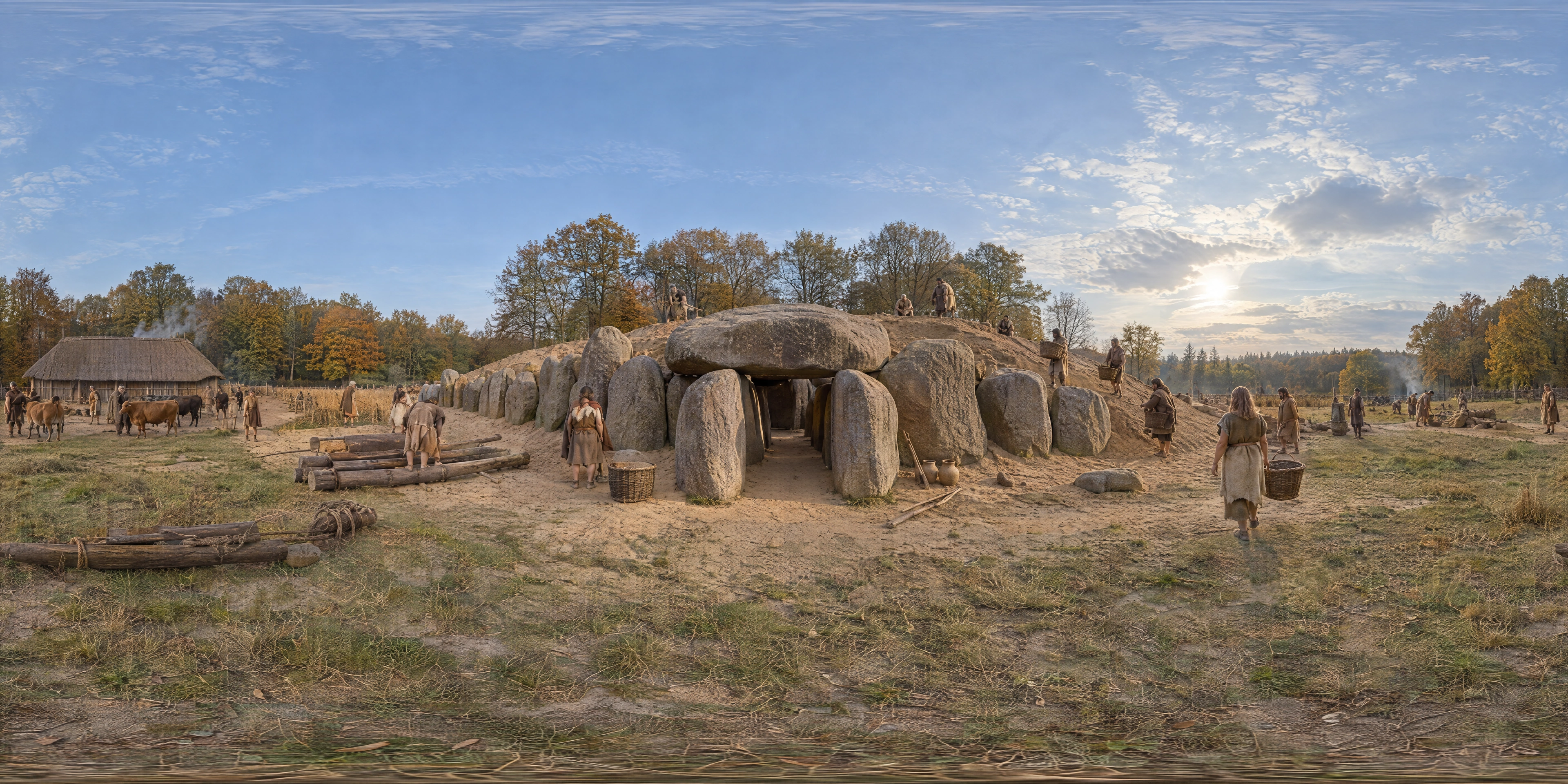
Around 3400 BC farmers of the Funnelbeaker culture on the Hondsrug ridge in Drenthe finish their largest communal tomb: a 22.6 m chamber of glacial boulders roofed with nine capstones, to be heaped over with sand until only the capstones show. Over five thousand years later D27 at Borger is still the largest hunebed in the Netherlands.
- Year
- 34th century BC
- Where
- Drenthe · NL
- Era
- Prehistoric
- Coordinates
- 52.930, 6.797
The moment
The largest tomb in the Netherlands is 5,400 years old
Around 3400 BC farmers on the Hondsrug, a low sandy ridge in Drenthe, finished the biggest communal tomb they ever built. Archaeologists call it D27, and it lies at Borger.
Its chamber is 22.6 metres long and about four metres wide. Twenty-six upright sidestones and two endstones carry nine enormous capstones, and a short entrance passage of four portal stones under one capstone opens on the south side. The floor was laid with cobbles.
When it was finished, the builders are thought to have heaped sand against the stones and over the chamber, so that only the tops of the capstones showed above a low mound.
Stones delivered by an ice sheet
Nobody quarried these boulders. They are erratics of granite and other hard rock, grey, pink and red, carried from Scandinavia by the ice sheets of the Saale glaciation and left lying on the ridge when the ice melted, long before anyone farmed here.
The builders are named after their pots. Archaeologists call them the Funnelbeaker culture, the trechterbekercultuur, after the funnel-necked beakers with incised decoration that they placed in their tombs with the dead. They were among the early farmers of the northern Netherlands, and they used tombs like this one for generations.
Later Dutch speakers had their own explanation for the stones. The word hunebed means giant's bed.
A poet dug here in 1685
On 11 June 1685 Titia Brongersma, a Frisian poet visiting the schout, the local sheriff, of Borger, had this hunebed dug into. It was the first archaeological excavation recorded in the Netherlands. She found pebbles laid in rows and, beneath them, round pots that she took to hold ash and burnt bone.
Fifty years later the hunebeds were in danger. Around 1730 shipworm ate through the wooden defences of the sea dikes, and the dikes needed stone. In 1734 the authorities of Drenthe banned the destruction of hunebeds, one of the earliest legal measures to protect archaeological monuments.
Every Dutch child starts history here
The hunebeds are the first of the fifty windows of the Canon of the Netherlands, the official outline of Dutch history taught in schools, and they are the oldest monuments in the country. Fifty-four survive: 52 in Drenthe and two in the province of Groningen.
D27 is the largest of them all and a classic school trip, with the Hunebedcentrum beside it. The forest the builders knew has given way to heath, pine plantations and farmland. The stones are the ones they set up.
Sources
Further reading
Tagged
- netherlands
- drenthe
- borger
- hunebed
- megalith
- neolithic
- funnelbeaker
- prehistory
Published
