Mohenjo-daro
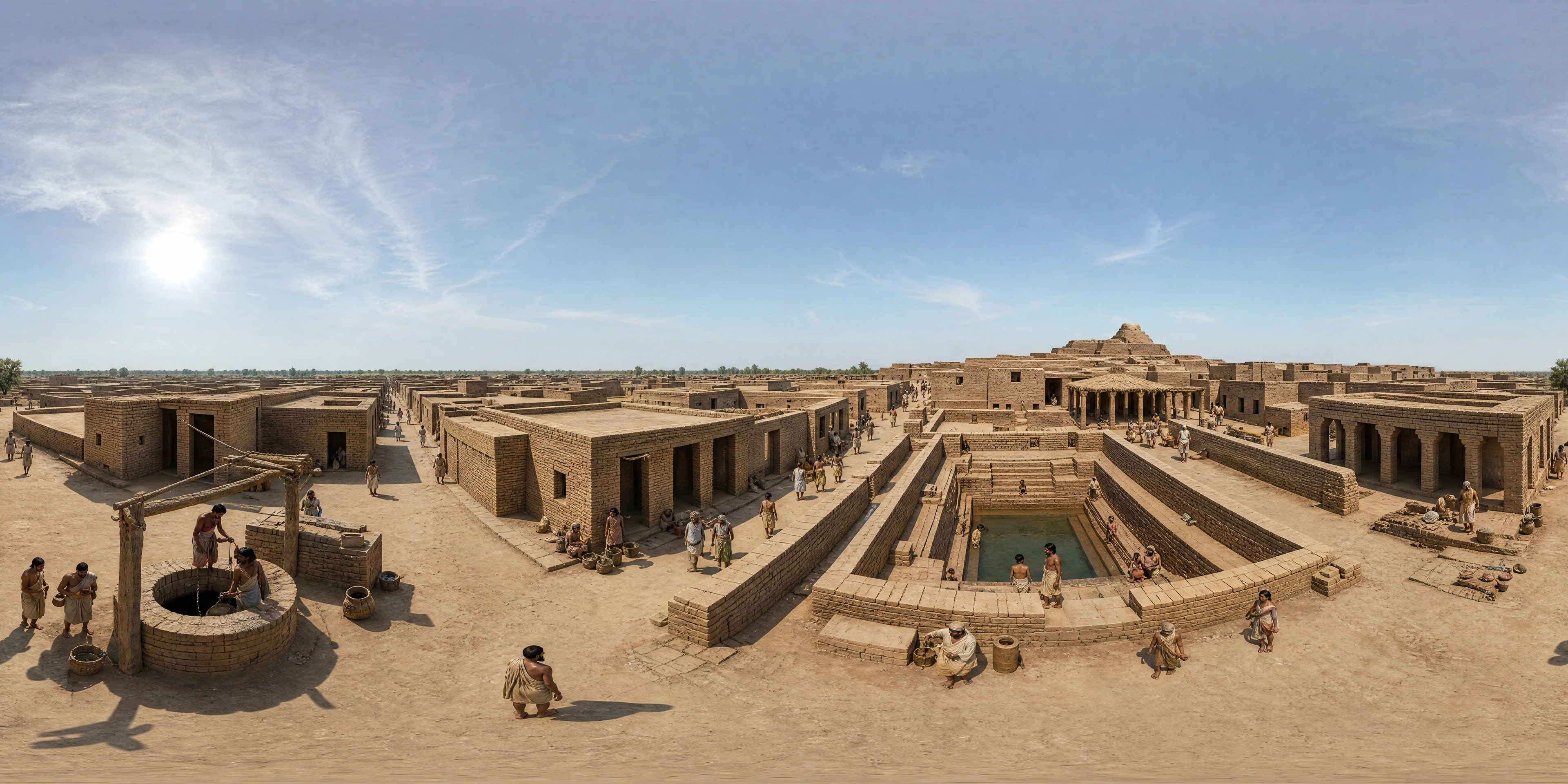
Around 2500 BC, Mohenjo-daro is one of the world's first great cities: a grid of fired-brick streets, a watertight Great Bath and covered sewers on the Indus plain, built by a civilisation whose writing has never been read and whose name for itself is unknown.
- Year
- 25th century BC
- Where
- Sindh · PK
- Era
- Prehistoric
- Coordinates
- 27.329, 68.139
The moment
A city built to a plan
Around 2500 BC, while Egypt was raising pyramids, a civilisation on the Indus built cities to a degree of planning that would not be matched for thousands of years. Mohenjo-daro was one of the largest.
Its streets run straight, on a grid, oriented to the points of the compass. Its houses are built of fired bricks made to a standard size and proportion across hundreds of kilometres of territory. Behind blank street walls, homes turned inward onto courtyards; many had their own wells (more than 700 have been counted) and their own bathrooms.
The world's first plumbing
What sets Mohenjo-daro apart is what runs beneath the streets.
Waste water from houses fed into covered brick drains laid along the lanes, with inspection holes for cleaning: a municipal sewer system older than any other known. Its most famous structure, the Great Bath, is a watertight sunken tank about 12 by 7 metres, sealed with bitumen and reached by brick steps, set on the citadel mound. No one knows its exact purpose; a ritual bathing function is the usual guess.
A civilisation we can't read
For all this sophistication, the Indus civilisation is the most mysterious of the early literate cultures.
Its writing survives only as short inscriptions on seals and tags: a few hundred signs that have resisted every attempt at decipherment. We have found no kings, no grand tombs, no temples that announce themselves, and strikingly little evidence of warfare; the society looks unusually un-hierarchical for its size. It declined around 1900 BC, probably as rivers shifted and the climate dried, and was lost until the 1920s. Even the name is modern: Mohenjo-daro means "Mound of the Dead" in Sindhi. What its builders called it, we will likely never know.
Further reading
Tagged
- indus-valley
- harappan
- mohenjo-daro
- pakistan
- lost-civilization
- bronze-age
Published
See also

2560s BC
Giza
Around 2560 BC, tens of thousands of paid workers build Khufu's pyramid at Giza, already three-quarters complete in this scene, the largest stone structure in the world for the next four millennia.

25th century BC
Stonehenge
Around 2500 BC on Salisbury Plain, Neolithic Britons heave the first sarsen monoliths into vertical position, building what will become Stonehenge.

1323 BC
Valley of the Kings
In 1323 BC, the funeral procession of the young pharaoh Tutankhamun arrives at the cliff face of the Valley of the Kings to deposit him in tomb KV62, where he will lie undisturbed until 1922.