Sacsayhuamán, above Cusco
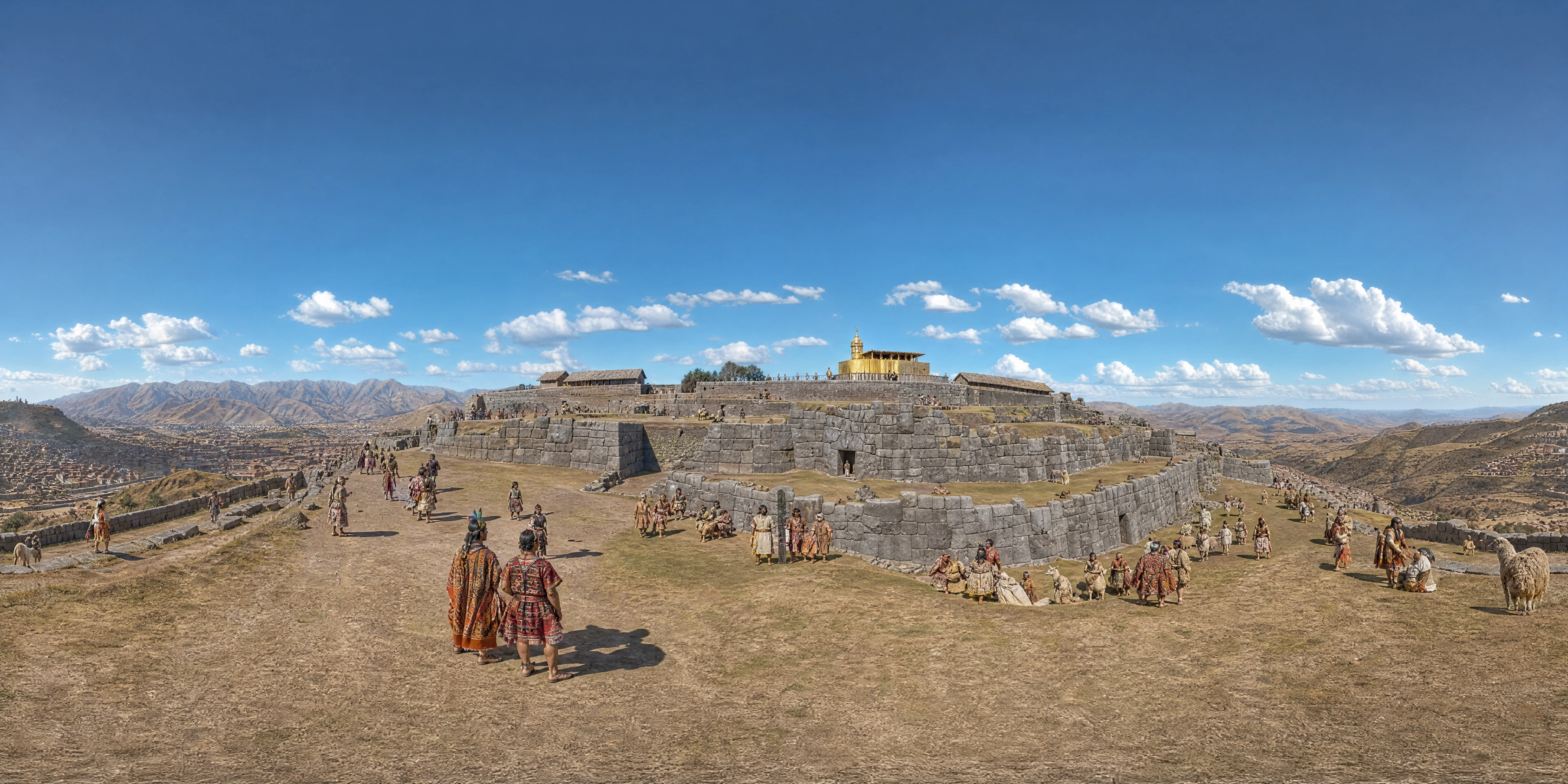
Around 1500, above the Inca capital of Cusco, the great terraces of Sacsayhuamán rise in zigzag walls of polygonal stone: boulders weighing over a hundred tonnes cut and fitted without mortar so tightly a knife-blade won't pass between them.
- Year
- 1500s
- Where
- Cusco · PE
- Era
- Renaissance
- Coordinates
- -13.509, -71.982
The moment
Stone that fits like a puzzle
Sacsayhuamán's walls are built from gigantic polygonal blocks (some weighing well over a hundred tonnes, a few over two hundred), shaped with many irregular angles so that each locks against its neighbours.
The fit is famous: no mortar, and joints so tight that a knife blade cannot be pushed between the stones. The Inca had no iron tools, no wheel and no draft animals larger than the llama; they shaped and moved these blocks with stone hammers, abrasion, ramps, levers and sheer organised labour. The irregular joints are not just showmanship: they help the walls ride out the earthquakes that regularly shake the Andes.
A capital shaped like a puma
Sacsayhuamán stood above Cusco, the "navel" of an empire that stretched the length of the Andes.
Inca tradition held that the city was laid out in the shape of a puma, with Sacsayhuamán as its head and teeth: the zigzag walls. At the city's heart was the Coricancha, the Temple of the Sun, whose walls were once sheathed in sheets of gold. Cusco was a planned imperial capital of fine stone, the centre of a road network thousands of kilometres long.
Built fast, lost fast
The Inca empire was the largest state in the pre-Columbian Americas, and astonishingly young. Sacsayhuamán was raised under the emperor Pachacuti and his successors in the fifteenth century; the empire was barely a hundred years old when the Spanish arrived in 1532.
After the conquest, the Spanish pulled down Sacsayhuamán's smaller stones to build colonial Cusco, leaving only the largest blocks, too big to move, standing where the Inca set them. That is exactly why they survive: the most impossible stones to lift are the ones still here.
Further reading
Tagged
- inca
- cusco
- sacsayhuaman
- andes
- megalithic
- peru
Published
See also

1450s
Machu Picchu
Around 1450 AD, Inca masons build the royal estate of Pachacuti at Machu Picchu, fitting andesite blocks without mortar so precisely that a knife blade cannot enter the joints.

1511
Sistine Chapel, Vatican
In 1511, Michelangelo Buonarroti paints the ceiling of the Sistine Chapel; currently working on the Creation of Adam fresco while standing on his custom flat-bridge scaffolding.

1492
Guanahani (San Salvador Island), Bahamas
At dawn on 12 October 1492, Christopher Columbus and about 40 Spanish sailors land at a Lucayan-Taíno island in the Bahamas they will rename *San Salvador*: the encounter that begins five centuries of Atlantic exchange and the destruction of indigenous Caribbean populations.