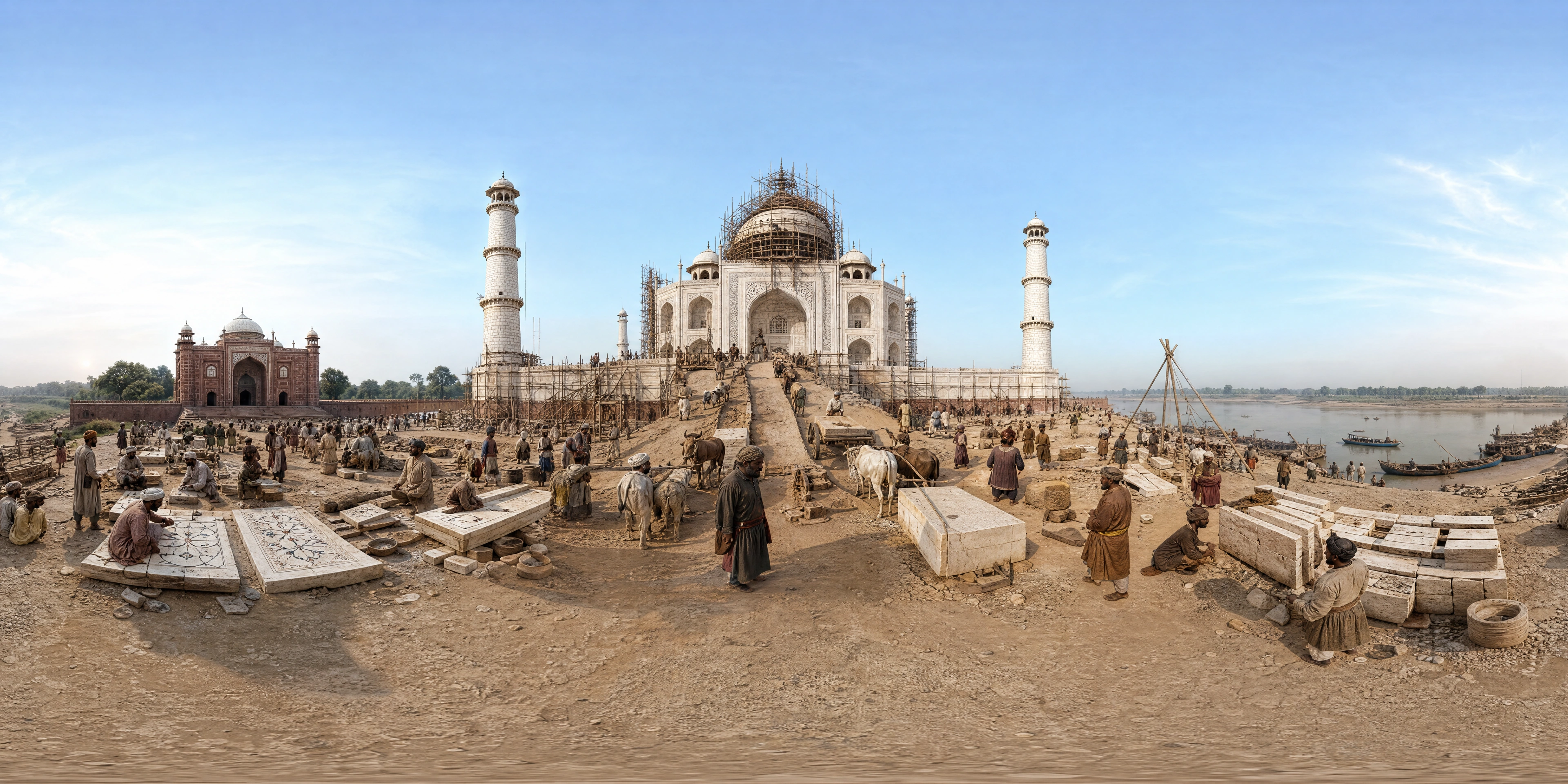
Taj Mahal under construction, Agra
Around 1640, the white marble dome of the Taj Mahal rises on its riverside platform at Agra: some twenty thousand workers and a thousand elephants raising Shah Jahan's tomb for his wife Mumtaz Mahal, partway through a project that will take more than twenty years.
- Year
- 1640s
- Where
- Uttar Pradesh · IN
- Era
- Early modern
- Coordinates
- 27.175, 78.042
The moment
A tomb for one woman
The Taj Mahal was built for Mumtaz Mahal, the favourite wife of the Mughal emperor Shah Jahan. She died in 1631 giving birth to their fourteenth child, at Burhanpur, while accompanying him on campaign.
The emperor's grief became the most expensive building project of his reign. Foundation work on the south bank of the Yamuna at Agra began in 1632. The main mausoleum was largely complete around 1643; the surrounding gateways, mosque, garden and walls took until about 1653, roughly twenty-two years in all.
The numbers
The traditional accounts, repeated since the seventeenth century, describe a workforce of about 20,000 and a transport corps of around 1,000 elephants and oxen to haul the heaviest stone.
The white marble came from Makrana in Rajasthan, more than 300 kilometres away. The inlay, the delicate floral pietra dura that covers the building up close, used many kinds of semi-precious and precious stone gathered from across Asia: carnelian and jasper, lapis lazuli from the mines of Afghanistan, jade and crystal from China, turquoise from Tibet.
An optical trick you don't notice
The four minarets that frame the tomb are not quite vertical. Each leans very slightly outward, away from the dome, by roughly two degrees.
Two reasons are usually given. One is structural: if an earthquake ever toppled them, they would fall away from the mausoleum rather than onto it. The other is aesthetic: the slight outward tilt counters the way tall parallel towers can appear to lean inward when seen from below. Either way, it shows how completely the building was thought through.
The legend, and the truth
A famous story says Shah Jahan planned a second Taj in black marble for himself, on the opposite bank, linked by a bridge. Excavations of the Mahtab Bagh garden across the Yamuna have found no trace of a black mausoleum; the dark stones once cited turned out to be discoloured white marble.
What is true is sadder. In 1658 Shah Jahan was deposed and imprisoned by his son Aurangzeb in the Agra Fort, about two and a half kilometres upriver, where he is said to have spent his last years with a view of the tomb. When he died in 1666 he was buried beside Mumtaz inside the Taj, his cenotaph set off-centre next to hers, the single asymmetry in an otherwise perfectly symmetrical building.
Further reading
Tagged
- mughal
- india
- agra
- taj-mahal
- shah-jahan
- marble
- architecture
Published
See also

1789
Bastille, Paris
On July 14, 1789, a Parisian crowd of about 1,000 storms the medieval Bastille fortress-prison, killing the governor de Launay and inaugurating the French Revolution.

1755
Praça do Comércio, Lisbon
On November 1, 1755, a magnitude 8.5+ earthquake strikes Lisbon during All Saints' Day Mass, followed by fire and a 6-meter tsunami up the Tagus, killing perhaps 50,000 in a city of 200,000.

125
Pantheon, Rome
Around 125 AD, Emperor Hadrian completes his rebuild of the Pantheon: a 43-meter unreinforced concrete dome that will remain the largest of its kind for 1300 years.