Alhambra, Granada
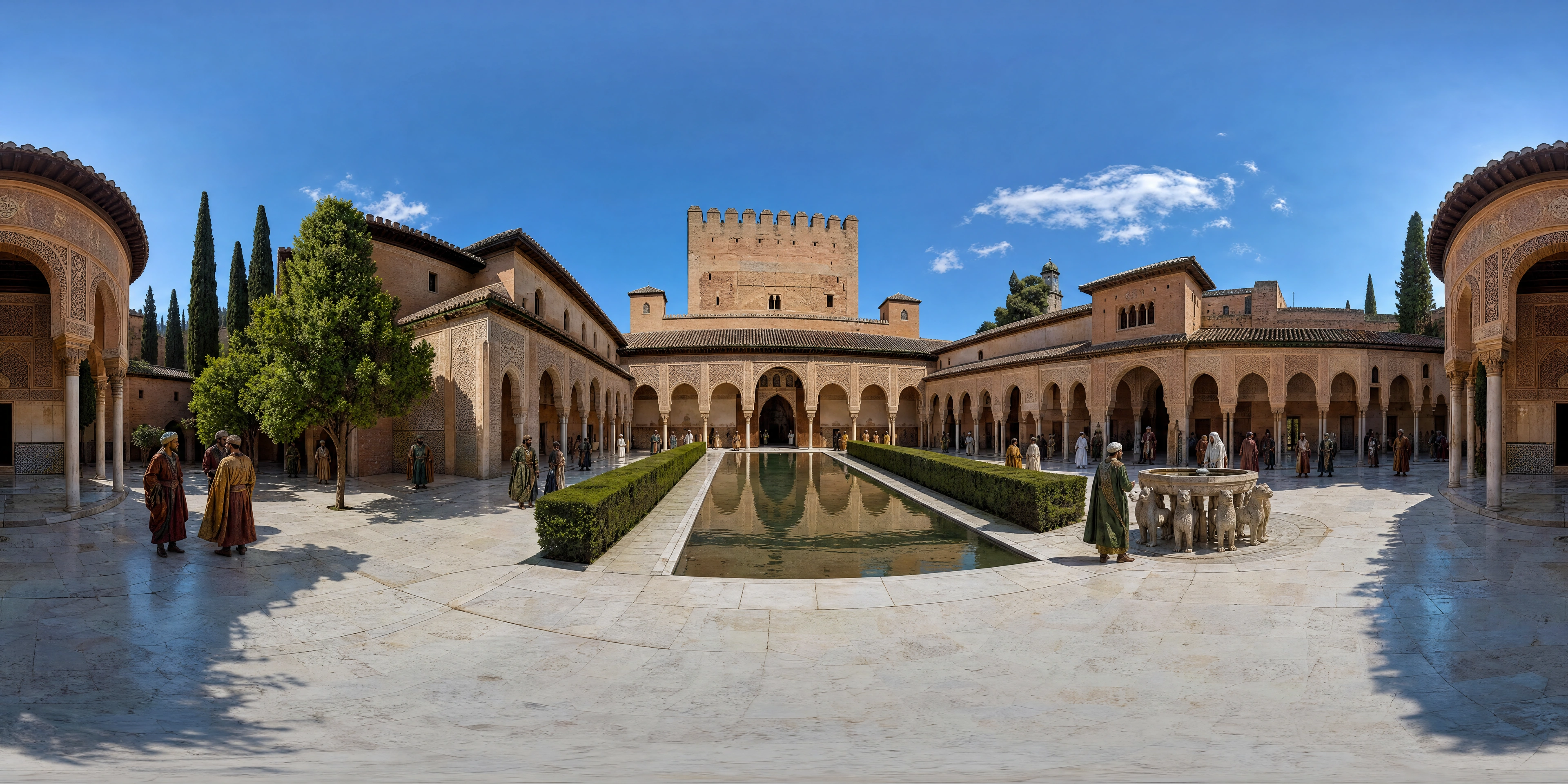
Around 1350, the Alhambra crowns its hill above Granada: the palace-citadel of the last Muslim kingdom in Spain, its courts of slender columns, carved-stucco lace and reflecting pools set against the snows of the Sierra Nevada.
- Year
- 1350s
- Where
- Andalusia · ES
- Era
- Medieval
- Coordinates
- 37.176, -3.588
The moment
The last jewel of al-Andalus
The Alhambra was the seat of the Nasrid dynasty, the last Muslim state in the Iberian Peninsula. Most of its famous palaces date from the fourteenth century, under the sultans Yusuf I and Muhammad V.
Its name comes from the Arabic al-Hamra, "the red one," for the colour of its rammed-earth walls glowing at sunset above the city.
Architecture of water and light
The Alhambra is a masterpiece of surface and shadow. Slender columns carry horseshoe arches; vaults of muqarnas hang like frozen honeycomb; every wall is covered in carved stucco, glazed tile and inscribed poetry.
And water is everywhere (still pools that double the architecture in reflection, channels that murmur through the courts, and the famous fountain of the Court of the Lions), cooling the air and turning the palace into a kind of earthly paradise garden.
1492 and after
In 1492 Granada fell to the Catholic Monarchs, Ferdinand and Isabella, ending nearly eight hundred years of Muslim rule in Spain.
The Alhambra survived, partly because its conquerors prized its beauty. After centuries of neglect it was "rediscovered" by Romantic travellers in the nineteenth century; the American writer Washington Irving lived in its rooms and made it famous in the English-speaking world; and it is now one of the most visited monuments on Earth.
Further reading
Tagged
- alhambra
- granada
- nasrid
- al-andalus
- islamic-spain
- palace
Published
See also

537
Hagia Sophia, Constantinople
On December 27, 537 AD, Emperor Justinian I dedicates the newly built Hagia Sophia in Constantinople: its 32-meter dome rising on pendentives in a structural feat that defines Byzantine architecture.

10th century AD
El Castillo, Chichén Itzá
Around 1000, El Castillo dominates the Maya city of Chichén Itzá: a four-sided step-pyramid to the feathered serpent Kukulcán with 365 stairs, built so that twice a year the equinox sun throws a serpent of shadow rippling down its edge.

1066
Senlac Hill (Battle), Sussex
On 14 October 1066, William of Normandy defeats King Harold Godwinson on Senlac Hill in Sussex: the last successful invasion of England, fought eight months after the year's other omen, the appearance of Halley's Comet.