El Castillo, Chichén Itzá
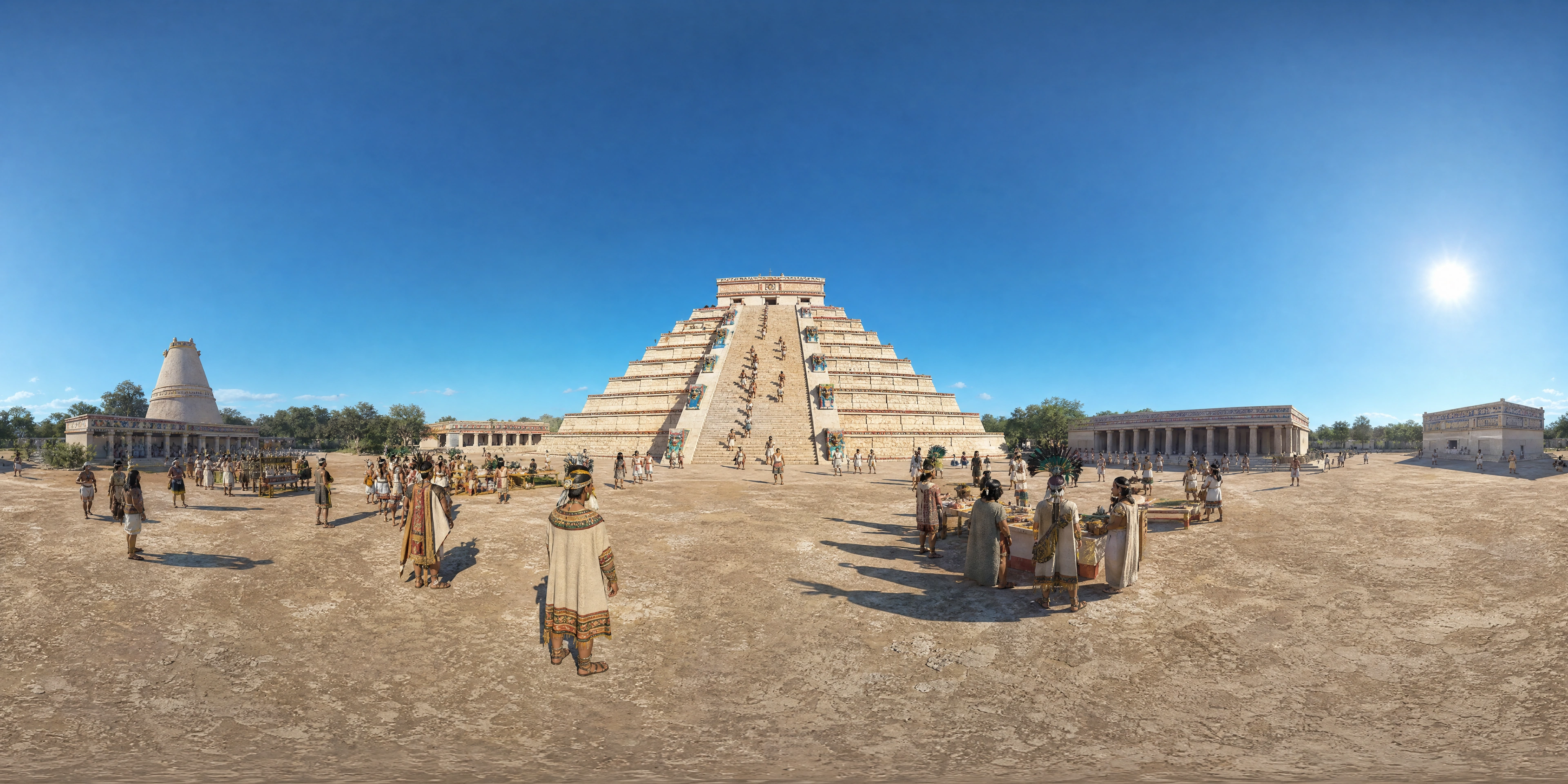
Around 1000, El Castillo dominates the Maya city of Chichén Itzá: a four-sided step-pyramid to the feathered serpent Kukulcán with 365 stairs, built so that twice a year the equinox sun throws a serpent of shadow rippling down its edge.
- Year
- 10th century AD
- Where
- Yucatán · MX
- Era
- Medieval
- Coordinates
- 20.684, -88.568
The moment
A calendar in stone
El Castillo is a clock as much as a temple. Each of its four stairways has 91 steps; four times 91 is 364, and the platform at the top makes 365, the days of the solar year. The nine terraces, split by each stairway, read as eighteen, the number of months in the Maya calendar.
It was built to Kukulcán, the feathered serpent, the Yucatec Maya form of the god the Aztecs called Quetzalcoatl.
The serpent of light
Twice a year, the building performs.
Around the spring and autumn equinoxes, the late-afternoon sun catches the stepped northwest corner and throws a row of triangular shadows along the edge of the northern balustrade. Joined to the carved serpent's head at the foot of the stair, the shadows form a snake of light and dark that appears to ripple down the pyramid as the sun drops. It is a deliberate solar alignment, and it still draws crowds to the site on the equinox today.
A city of wonders
El Castillo is only the centrepiece. The Great Ball Court beside it is the largest in the Americas, its walls carrying carvings of the deadly Mesoamerican ball game and a famous echo.
The round tower called El Caracol was an observatory, its windows aligned to the movements of Venus. And a short walk north, a vast natural sinkhole, the Sacred Cenote, received offerings of jade, gold and, the dredged remains show, people. In 2007 Chichén Itzá was named one of the New Seven Wonders of the World.
Further reading
Tagged
- maya
- chichen-itza
- kukulcan
- yucatan
- pyramid
- mesoamerica
Published
See also

537
Hagia Sophia, Constantinople
On December 27, 537 AD, Emperor Justinian I dedicates the newly built Hagia Sophia in Constantinople: its 32-meter dome rising on pendentives in a structural feat that defines Byzantine architecture.

1066
Senlac Hill (Battle), Sussex
On 14 October 1066, William of Normandy defeats King Harold Godwinson on Senlac Hill in Sussex: the last successful invasion of England, fought eight months after the year's other omen, the appearance of Halley's Comet.

1150s
Angkor Wat at dawn
Around 1150, Angkor Wat is newly finished: the largest religious monument ever built, five lotus-bud towers rising beyond a vast moat in the Khmer capital, a temple-mountain to the god Vishnu that still draws crowds to its dawn today.