Biskupin Fortified Settlement
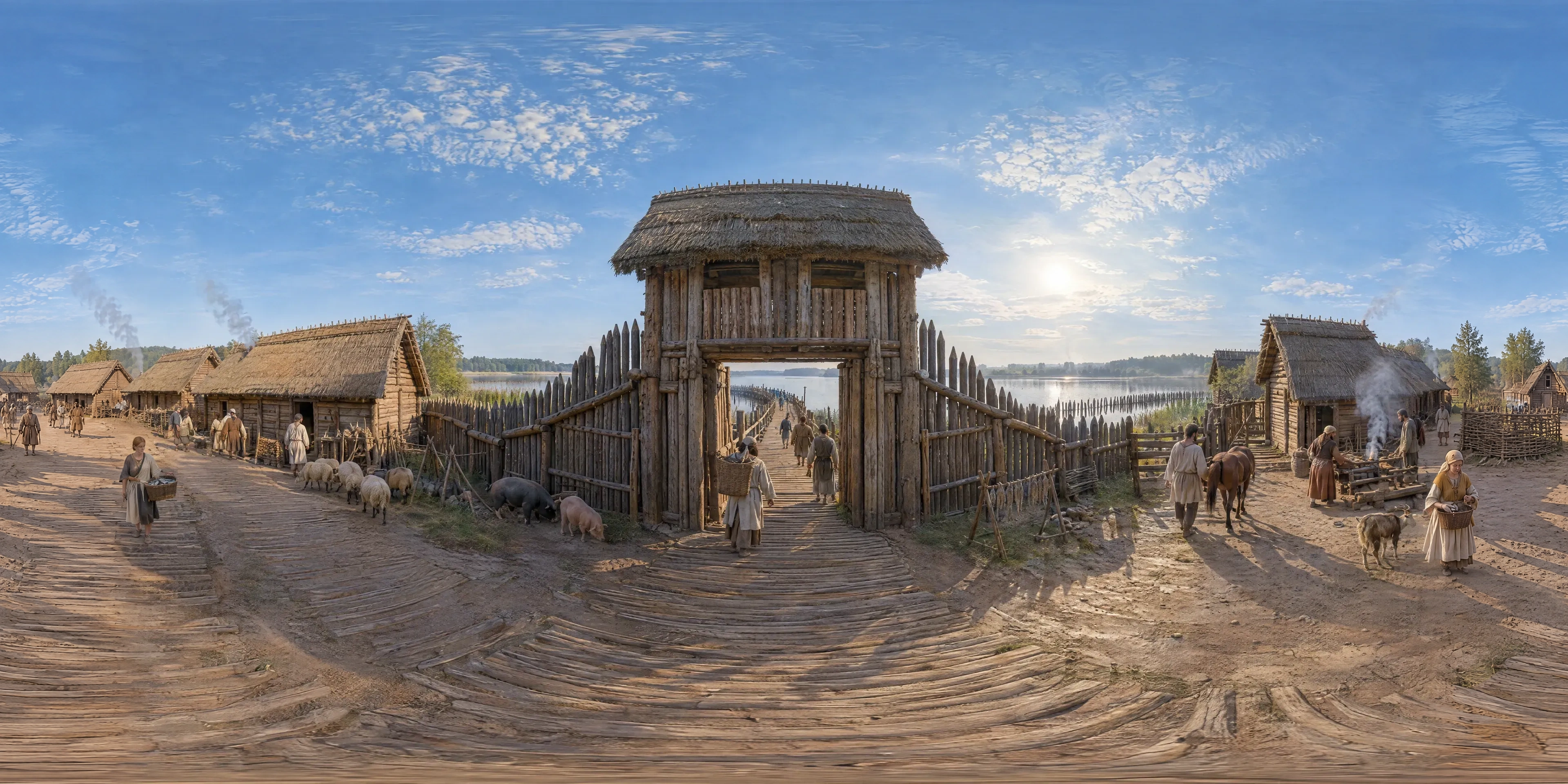
In the winter of 738/737 BC people of the Lusatian culture felled thousands of oaks to build a fortified village on an island in Lake Biskupin. Behind a timber box rampart, eleven log-paved streets of identical houses sheltered up to a thousand people, a planned settlement more than a thousand years older than the first Slavic strongholds.
- Year
- 730s BC
- Where
- Pałuki (Greater Poland) · PL
- Era
- Ancient
- Coordinates
- 52.788, 17.744
The moment
A village begun in a single winter
Tree rings give the date. The oaks of Biskupin were felled between 747 and 722 BC, most of them in a single winter, 738/737 BC. That season people of the Lusatian culture cut thousands of oaks and began a fortified village on a low island in Lake Biskupin, in the lakelands north of Gniezno.
The island measured about 200 by 160 metres and rose barely a metre above the water. The lake is lower today, and the island has become a peninsula.
Around its edge ran a rampart three to four metres high, built of oak boxes filled with earth and stones. Some 6,000 to 8,000 cubic metres of wood went into it. Outside, a breakwater of thousands of slanting oak and pine piles protected the shore.
Eleven streets and one plan
The interior was laid out in advance. A ring street followed the rampart, and eleven straight, parallel streets, two to three metres wide, crossed the island, each paved with logs laid crosswise.
Along them stood rows of houses of the same size, about a hundred in all, each roughly eight by nine metres. Their walls were horizontal planks slotted into upright posts. A narrow entrance hall led to a main room built around an oval stone hearth, probably under a roof of reed thatch.
The only way in was a gate passage about three metres wide, reached by a long oak bridge from the shore. Between 800 and 1,000 people lived inside. They kept pigs, sheep, goats and small horses, and grew millet, barley and flax on the far shore.
The village lasted about 150 years. Rising water, a worsening climate and exhausted surroundings finally drove its people away.
Found when the lake went down
In 1933 drainage works lowered the lake and exposed the old timbers. Local schoolchildren told their teacher, Walenty Szwajcer, and he spread the word.
Excavation began in 1934 under Józef Kostrzewski and Zdzisław Rajewski of Poznań University, with a first budget of 360 złoty and a crew of twenty unemployed men. The site was soon nicknamed the Polish Pompeii.
Politics followed. Polish and German scholars argued over whether the Lusatian culture was Slavic or Germanic, and from 1940 to 1942 an SS-Ahnenerbe team dug here in search of a Germanic past. The retreating Germans flooded the site, which only helped preserve the wood. Archaeologists now speak simply of the Lusatian culture, with no ethnic label.
Every Polish pupil's first prehistory
Biskupin is the prehistoric site Polish children meet in their first history lessons, and generations of school trips have walked its reconstructed streets. It has been a Monument of History since 1994 and held Poland's first archaeological festival.
Its fame rests on the plan. More than a thousand years before the first Slavic strongholds, someone here decided where every street and every house would go, and the wet ground kept the evidence.
The rampart, the streets, the house sizes and the tree-ring dates are excavated fact. The roofing and the upper part of the gate are reconstruction.
Sources
Further reading
Tagged
- poland
- biskupin
- paluki
- prehistory
- iron-age
- lusatian-culture
- lake-settlement
- archaeology
Published
See also

510s BC
Persepolis
Around 515 BC, sculptors from across the Persian Empire carve the Procession of Nations relief on the Apadana staircase at Persepolis, capital of Darius I's empire.

9th century BC
La Venta
Around 900 BC, Olmec sculptors on the humid Gulf coast of Mexico carve a colossal stone portrait head of a ruler from a single multi-ton basalt boulder.

1543
Cathedral Hill, Frombork
In late May 1543 Nicolaus Copernicus, a 70-year-old canon of the Warmian chapter, dies at Frombork; by tradition the first printed copy of his De revolutionibus, the book that sets the Earth moving around the Sun, reached him on his last day. The walled cathedral hill, beside which he lived and watched the sky for more than thirty years, looks out over the Vistula Lagoon.