Cathedral Hill, Frombork
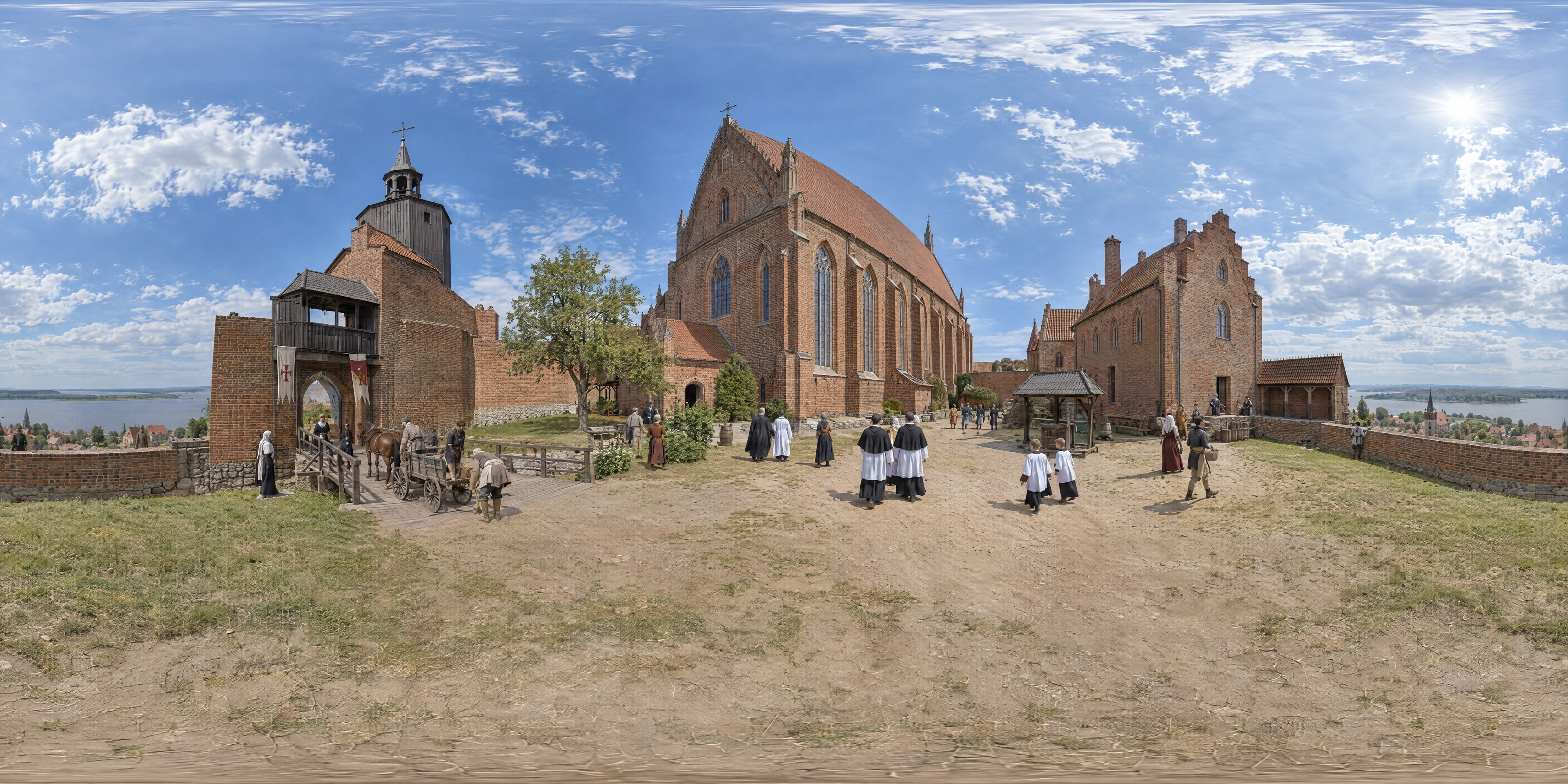
In late May 1543 Nicolaus Copernicus, a 70-year-old canon of the Warmian chapter, dies at Frombork; by tradition the first printed copy of his De revolutionibus, the book that sets the Earth moving around the Sun, reached him on his last day. The walled cathedral hill, beside which he lived and watched the sky for more than thirty years, looks out over the Vistula Lagoon.
- Year
- 1543
- Where
- Warmia · PL
- Era
- Renaissance
- Coordinates
- 54.357, 19.682
The moment
The printed book arrived at the very end
Nicolaus Copernicus died at Frombork in late May 1543, a canon of the Warmian chapter aged seventy. By tradition the first printed copy of his great book reached him on his last day.
The story comes from a letter by his friend Tiedemann Giese to Rheticus, the young Wittenberg mathematician who had joined Copernicus in 1539. Giese wrote that Copernicus had been failing for days and saw the finished book only on the day he died. The traditional date is 24 May; some historians put it as early as 21 May.
The book was De revolutionibus orbium coelestium, printed by Johannes Petreius in Nuremberg and dedicated to Pope Paul III. It set the Earth moving around the Sun. An unauthorised, unsigned preface by Andreas Osiander told readers that such hypotheses "need not be true nor even probable".
A cathedral without a tower
Copernicus settled at Frombork in 1510 or 1512 and lived beside Cathedral Hill until his death. The fortified close stood about 21 metres above the Vistula Lagoon, enclosed by a brick wall with gates and towers. One of those towers served as his lodging inside the walls; his canon's house stood outside.
The cathedral was a long Gothic hall church of red brick, built between 1329 and 1388, about 90 metres long and 16.5 metres high, with no tower at all. The slender Renaissance ridge turret came late in the century, the clock in 1638 and the baroque bell tower of Bishop Radziejowski in 1683 to 1685.
What did stand in 1543 was a new barbican of 1537 before the South Gate, reached by a wooden bridge over a dry moat, and the old octagonal artillery tower, the magna turris, a belfry since 1448.
Astronomy was never his job
Copernicus was born in Toruń on 19 February 1473 and studied in Kraków and Italy, taking a doctorate in canon law at Ferrara in 1503. His uncle Lucas Watzenrode, Bishop of Warmia, secured him the canonry.
From 1516 to 1521 he ran the chapter's estates from Olsztyn Castle and directed the defence of Olsztyn and Warmia against the Teutonic Knights. In 1526 he wrote a study of the value of money. A short outline of his theory, the Commentariolus, had circulated in manuscript since before 1514.
Why Poles say he moved the Earth
Polish children learn that Copernicus "stopped the Sun and moved the Earth", and 1543 is the textbook date for the start of the scientific revolution. He is one of the few Poles every pupil can name.
His nationality was long disputed between German and Polish historians. He was a canon of Warmia under the Polish Crown, and he wrote in Latin.
He was buried in the cathedral, and for centuries nobody knew exactly where. Remains found under its floor were matched in 2008 with hairs from a book he had owned, now at Uppsala University. On 22 May 2010 he was buried again in the cathedral, under a black granite stone engraved with a model of the solar system.
Sources
Further reading
Tagged
- poland
- frombork
- warmia
- copernicus
- renaissance
- cathedral
- science
- vistula-lagoon
Published
See also

1444
Florence Cathedral, Florence
In 1444, Brunelleschi's revolutionary double-shell brick dome over Santa Maria del Fiore in Florence approaches completion: the largest masonry dome in the world, raised without scaffolding.

1410
Grunwald Battlefield
On the hot morning of 15 July 1410 the armies of King Władysław Jagiełło and Grand Duke Vytautas wait at the edge of the woods facing the Teutonic Order across the fields of Grunwald, until two heralds ride over with two naked swords from Grand Master Ulrich von Jungingen, a taunt to come out and fight. By evening the Order's army is broken and its Grand Master dead.

15th century AD
Great Wall of China, Jinshanling
Around 1500, Ming China rebuilds the Great Wall in brick and stone across the mountain ridges north of Beijing: a battlemented rampart with watchtowers that climbs and plunges over the peaks as far as the eye can see, the most ambitious fortification ever built.