Caernarfon Castle
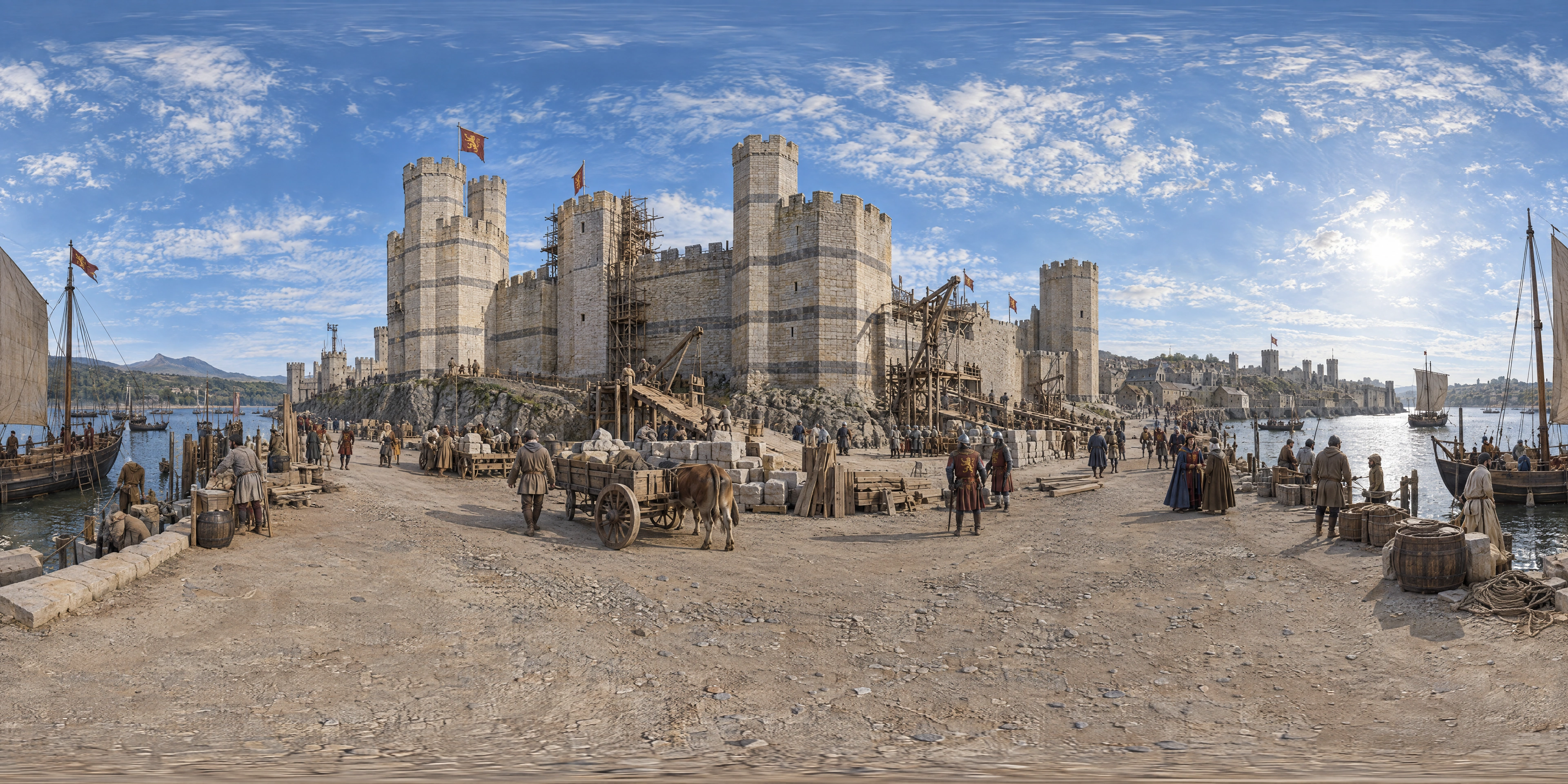
In spring 1284, a year after Edward I completed his conquest of Gwynedd, his masons are raising a castle and a walled town at Caernarfon on the Menai Strait. Tradition holds that here, on 25 April, Queen Eleanor gives birth to the future Edward II, later the first heir of an English king to be made Prince of Wales.
- Year
- 1284
- Where
- Gwynedd, Wales · GB
- Era
- Medieval
- Coordinates
- 53.139, -4.278
The moment
A building site with a royal nursery
In the spring of 1284 Caernarfon was a building site less than a year old. Edward I's conquest of Gwynedd had ended in May 1283 with the fall of Dolbadarn, the last castle of Dafydd ap Gruffudd, and the first record of work dates from 24 June 1283, when a ditch was dug between the castle and the planned town to its north.
Timber came by ship from as far away as Liverpool. While the stone foundations went in, timber-framed apartments were built for the king and Queen Eleanor of Castile, who arrived in July 1283 and stayed more than a month.
Tradition holds that on 25 April 1284 Eleanor gave birth here to a son, the future Edward II. How much of the castle then stood is uncertain. The architectural historian Arnold Taylor thought the Eagle Tower, at the western corner, might have been complete by Easter.
Walls that quote Constantinople
Edward's architect, Master James of St George, built on a peninsula between the River Seiont and the Menai Strait, taking in the mound of a Norman motte raised there in the late eleventh century. The Roman fort of Segontium stood nearby, and the link was deliberate: a chronicle reports that the body of the emperor Magnus Maximus was found during the works and reburied on Edward's orders.
The walls made the same claim. Their many-sided towers and bands of darker stone recall the walls of Constantinople, a statement of imperial ambition carried to the edge of Snowdonia.
In March 1284 the Statute of Rhuddlan made Caernarfon a borough and the administrative centre of Gwynedd. That year the castle had a garrison of forty men, and by 1285 the town walls were mostly complete.
Never finished, and taken within ten years
In 1294 the rising led by Madog ap Llywelyn captured the town and damaged its walls; the English retook it the next year. Work went on until 1330, when the accounts end, by which time £20,000 to £25,000 had been spent on castle and town walls.
It was never completed: the backs of the King's Gate and Queen's Gate were left unfinished, and foundations inside mark buildings never raised.
Why the Welsh still argue over the title
Edward II was created Prince of Wales in 1301, the first heir of an English king to hold the title. The story that his father promised the Welsh a prince born in Wales who spoke no English, then presented the baby, can be traced only to the sixteenth century and is probably apocryphal.
The castle turned the title into ceremony: the investiture of the future Edward VIII was held here in 1911 at the insistence of David Lloyd George, and that of Charles, now Charles III, in 1969, contested by Welsh nationalists.
For many in Wales, Caernarfon remains a monument of conquest as much as a masterpiece, and the title of Prince of Wales a symbol of subjugation. Since 1986 it has been part of the UNESCO World Heritage Site of the Castles and Town Walls of King Edward in Gwynedd.
Sources
Further reading
Tagged
- united-kingdom
- wales
- gwynedd
- edward-i
- conquest-of-wales
- castle
- medieval
- construction
Published
See also

12th century AD
Kealakekua / Big Island, Hawaii
Around 1200 AD, a Polynesian double-hulled voyaging canoe from the Marquesas Islands makes landfall on the unpopulated Big Island of Hawaii after navigating 4,000 km of open Pacific.

1357
Charles Bridge, Prague
In 1357 Emperor Charles IV lays the foundation stone of a new stone bridge on the Old Town bank near St Clement's, fifteen years after ice and floodwater wrecked the Judith Bridge. Tradition sets the moment at 5:31 on 9 July, a palindrome of odd numbers; the bridge will take 45 years to finish.

14th century AD
Rapa Nui (Easter Island)
Around 1400 AD, Rapa Nui islanders "walk" a 9-meter basalt moai statue upright across the volcanic landscape from the quarry at Rano Raraku toward a coastal ahu platform.