Charles Bridge, Prague
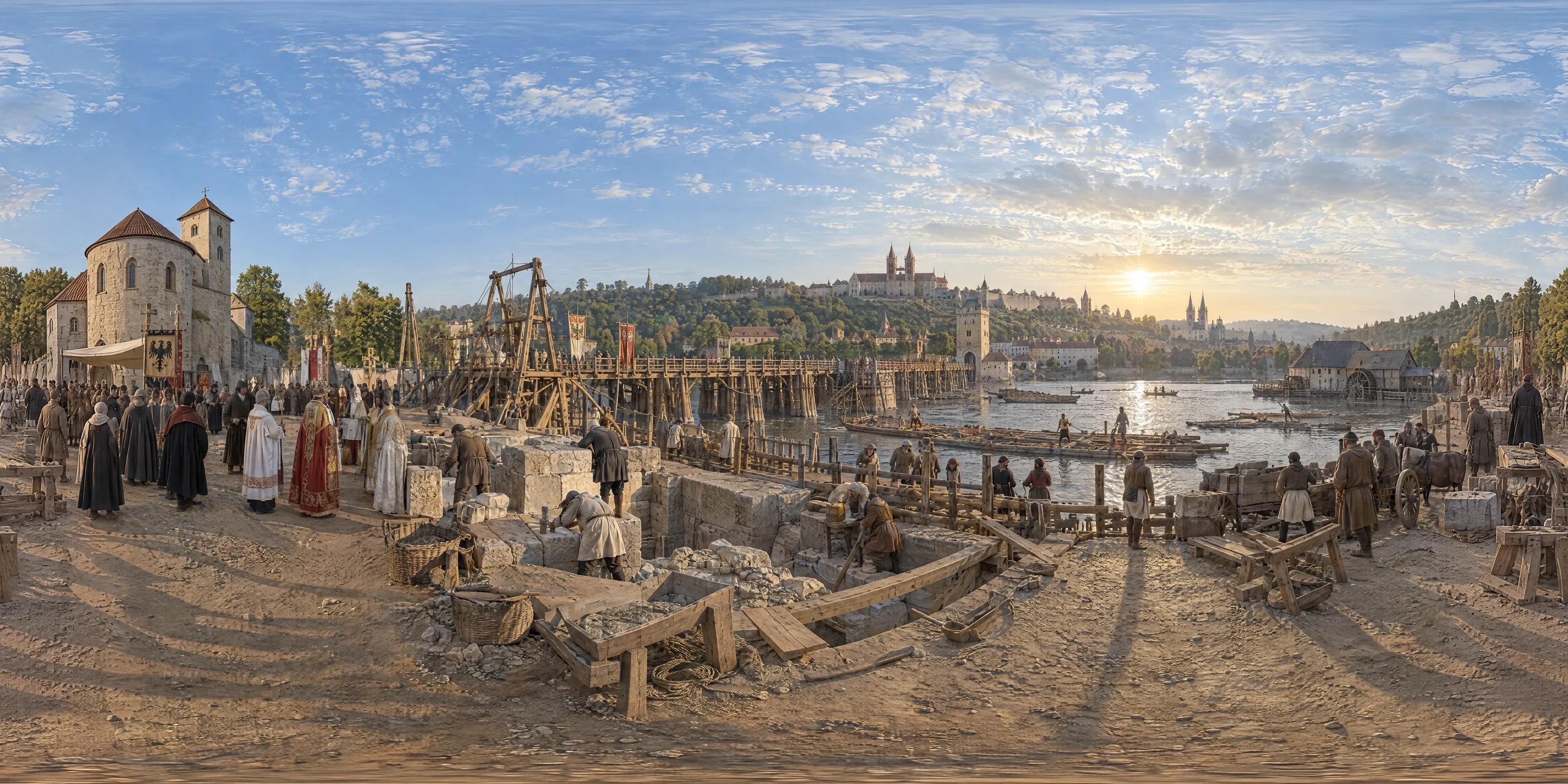
In 1357 Emperor Charles IV lays the foundation stone of a new stone bridge on the Old Town bank near St Clement's, fifteen years after ice and floodwater wrecked the Judith Bridge. Tradition sets the moment at 5:31 on 9 July, a palindrome of odd numbers; the bridge will take 45 years to finish.
- Year
- 1357
- Where
- Bohemia · CZ
- Era
- Medieval
- Coordinates
- 50.086, 14.414
The moment
The famous hour is a 1979 hypothesis
Prague celebrates a precise moment: the foundation stone of Charles Bridge, the story goes, was laid at 5:31 in the morning on 9 July 1357. Written as numbers, 1357 9 7 5:31 reads the same in both directions, climbing through the odd digits to nine and back down again.
The sources are less precise. The chronicler Beneš Krabice of Weitmile records only the year and the place, beside the Dominican monastery of St Clement on the Old Town bank. The day and the minute were proposed by the astronomer Zdeněk Horský in 1979; the idea caught on and is now the popular date, but it remains a hypothesis.
Fifteen years without a stone bridge
Prague had had a stone bridge since the twelfth century. The Judith Bridge, built between 1158 and 1172, was wrecked by ice and floodwater in 1342, and for fifteen years the city made do with a temporary wooden crossing on its line.
In 1357 the far bank still showed the older city. The squat Romanesque Judith tower guarded the Lesser Town end, between the walled Bishop's Court and the commandery of the Knights of St John.
On the castle ridge the Romanesque basilica of St Vitus still stood with its two towers. East of it, the Gothic choir chapels of the new cathedral were rising in scaffolding under Peter Parler, master of the cathedral lodge since 1356. Petřín hill had no wall yet: Charles's Hunger Wall followed in 1360 to 1362.
Forty-five years, sixteen arches
Parler is credited with the bridge as well. It took forty-five years to finish, until 1402: sixteen arches of Bohemian sandstone, 515.8 metres long and 9.5 metres wide.
For more than four centuries it was simply the Stone Bridge, or the Prague Bridge. It has been called Charles Bridge only since 1870.
The statues are much later. Most of the thirty went up around 1700, and all are now replicas; the originals began moving to a museum in 1965. The bridge has been mended again and again: a flood damaged three pillars in 1432, Swedish troops battered it in 1648, and the flood of 1890 destroyed three arches.
Why it is Charles's bridge
Charles IV was voted the Greatest Czech in a national television poll, and in surveys of the periods Czechs are proudest of, his reign comes first. The bridge is the most visible thing he left.
It tied the Old Town to the Lesser Town and the castle, and it became the emblem of both the city and the reign. It has stood for more than six centuries, through the kind of floods that wrecked its predecessor.
Tradition says Charles chose the hour himself, trusting the numbers to strengthen the bridge. Nobody can prove it. What the chronicle does record is plainer and more convincing: in 1357, on the Old Town bank by St Clement's, the emperor started building, and the city was still at work forty-five years later.
Sources
Further reading
Tagged
- czechia
- prague
- bohemia
- charles-iv
- medieval
- bridge
- vltava
- prague-castle
Published
See also

1410
Old Town Square, Prague
On 9 October 1410 the Old Town councillors reward the clockmaker Mikuláš of Kadaň for the astronomical dial he has built on the town hall tower, the heart of today's Prague orloj. Below it the market square trades as usual in the year Wycliffe's books are burned in Prague and Jan Hus is excommunicated.

1881
National Theatre, Prague
On the afternoon of 12 August 1881, two months after its opening, the National Theatre, built over thirteen years from the pennies of a whole nation, catches fire and loses its copper dome, auditorium and stage. Within 47 days the Czechs collect a million gulden to rebuild it, and it reopens in 1883.

1939
Lower Wenceslas Square, Prague
On the morning of 15 March 1939, in a heavy fall of wet snow, German columns roll down Wenceslas Square as Hitler's troops occupy what remains of Czechoslovakia. Thousands of Praguers watch from the pavements, weeping, booing and singing the national anthem; that evening Hitler reaches Prague Castle, and the next day he proclaims the Protectorate of Bohemia and Moravia.