Monks Mound, Cahokia
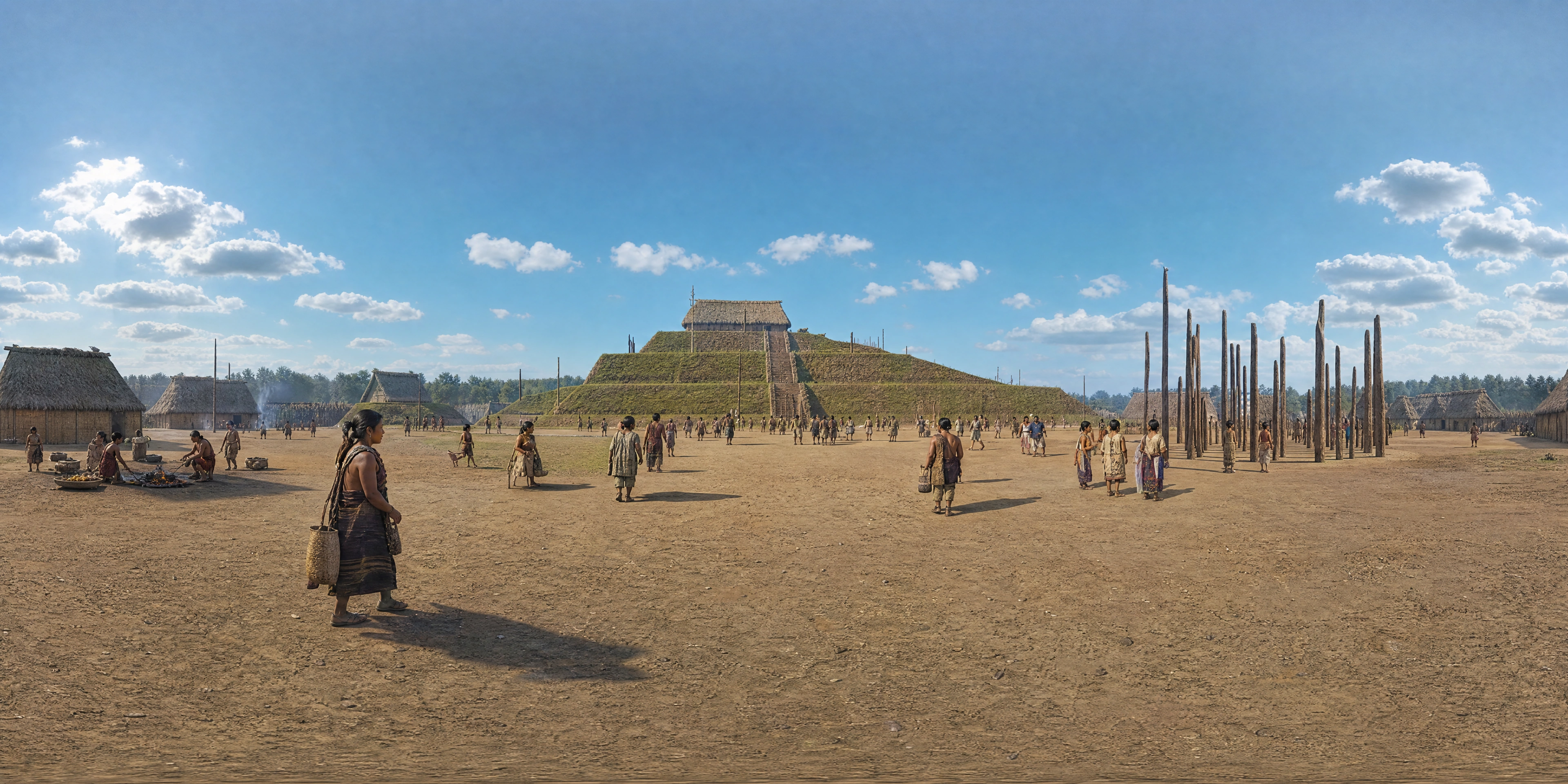
Around 1100, Cahokia is the largest city north of Mexico: some fifteen thousand people, around a hundred and twenty earthen mounds, and a flat-topped pyramid of packed earth thirty metres high whose base covers as much ground as the Great Pyramid of Giza.
- Year
- 11th century AD
- Where
- Illinois · US
- Era
- Medieval
- Coordinates
- 38.661, -90.061
The moment
The city most people have never heard of
Around the year 1100, the largest city in what is now the United States stood on the Mississippi floodplain a few kilometres from modern St. Louis. It was bigger than London at the same date.
Cahokia covered roughly 15 square kilometres and held an estimated 10,000 to 20,000 people, with more in satellite communities: numbers no settlement north of Mexico would reach again until Philadelphia in the late 1700s. It was the centre of the Mississippian culture: maize farmers, mound builders, traders and sky-watchers whose reach extended across much of the American Midwest and South.
A mountain made by hand
Its central monument, Monks Mound, is the largest earthwork in the Americas north of the great pyramids of Mesoamerica.
It rises about 30 metres in four terraces, and its base covers around 14 acres, roughly the same footprint as the Great Pyramid of Giza. It was built entirely by hand, from an estimated several million basket-loads of earth carried and packed over decades. On its flat summit stood a large building, probably the residence of the paramount chief or a temple. The city once had more than 120 mounds of many shapes and sizes; about 80 survive.
The name is an accident. It comes from a group of French Trappist monks who lived nearby in the early 1800s, long after the city was gone. We do not know what its builders called it, or themselves.
Chunkey, and the woodhenge
Two things would strike a visitor at once.
One is the game. Chunkey was played in the open plaza: a player rolled a polished stone disc, and competitors threw spears to land where the disc would stop. It drew gatherings and heavy gambling, and it mattered. Chunkey stones were prized, and the game was bound up with status and ritual across the whole Mississippian world.
The other is the "woodhenge": one or more great circles of tall red-cedar posts on the plain west of Monks Mound, set so that, from a central post, the sun rose over specific points at the solstices and equinoxes. It was a calendar built of timber.
Why it vanished
By about 1350, Cahokia was effectively empty.
There is no single agreed cause. Scholars point to a combination of environmental strain (deforestation for fuel and the great cedar posts, flooding of the floodplain, perhaps crop failure) together with political fragmentation and possibly disease or conflict. The decline unfolded over more than a century. By the time Europeans reached the interior, the city had been abandoned for generations and its enormous mounds were grassed-over hills.
It is now a UNESCO World Heritage Site, with an interstate highway running through what was once its edge.
Further reading
Tagged
- mississippian
- north-america
- cahokia
- mound-builders
- pre-columbian
- monks-mound
Published
See also

537
Hagia Sophia, Constantinople
On December 27, 537 AD, Emperor Justinian I dedicates the newly built Hagia Sophia in Constantinople: its 32-meter dome rising on pendentives in a structural feat that defines Byzantine architecture.

10th century AD
El Castillo, Chichén Itzá
Around 1000, El Castillo dominates the Maya city of Chichén Itzá: a four-sided step-pyramid to the feathered serpent Kukulcán with 365 stairs, built so that twice a year the equinox sun throws a serpent of shadow rippling down its edge.

1066
Senlac Hill (Battle), Sussex
On 14 October 1066, William of Normandy defeats King Harold Godwinson on Senlac Hill in Sussex: the last successful invasion of England, fought eight months after the year's other omen, the appearance of Halley's Comet.