Cité de Carcassonne
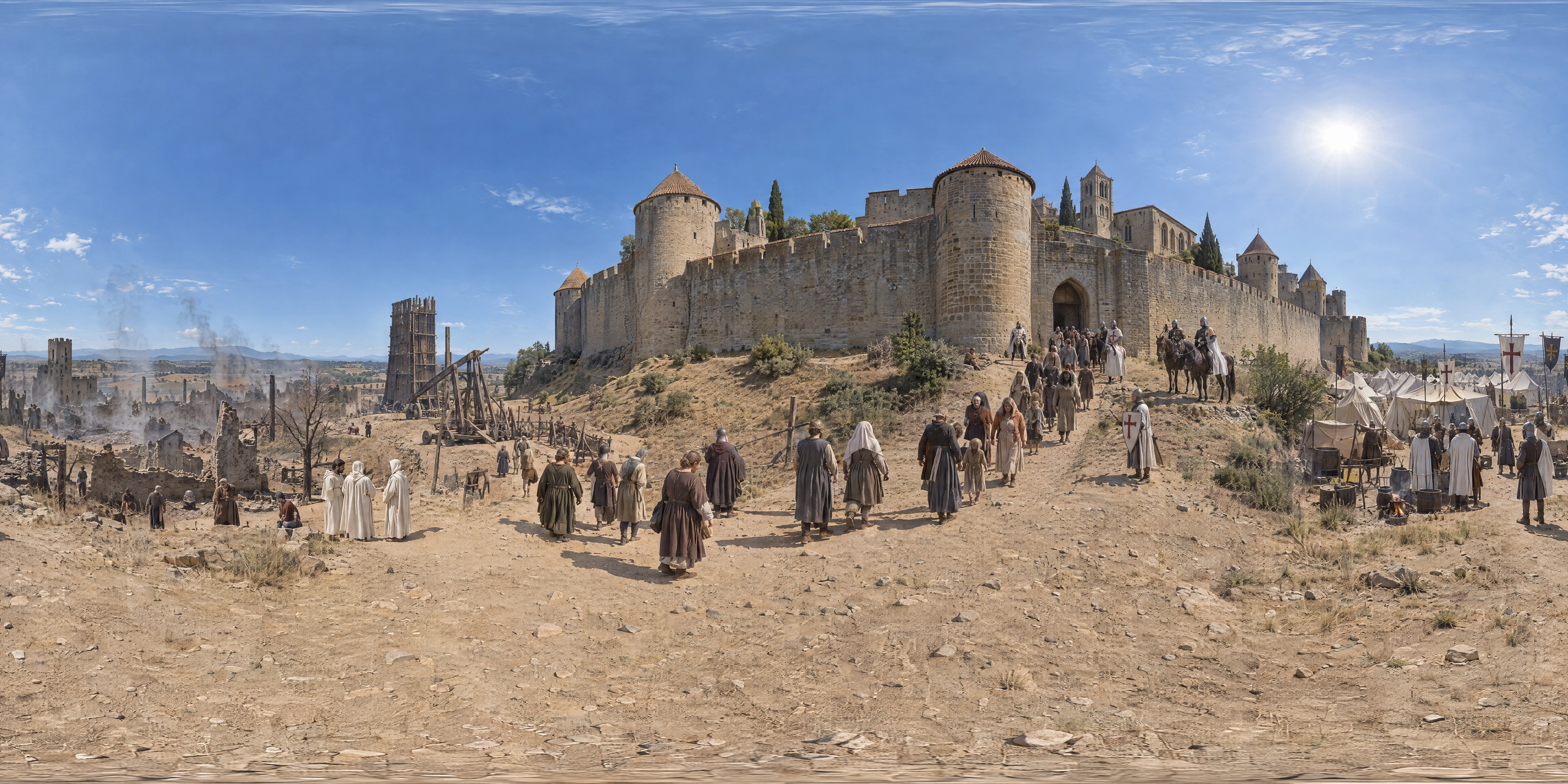
On 15 August 1209, after two weeks of siege in a heatwave with its wells run dry, Carcassonne surrenders to the army of the Albigensian Crusade: Viscount Raymond-Roger Trencavel gives himself up as hostage and every inhabitant must walk out with nothing but the clothes they wear. The fall of the Trencavel city opens the conquest of Languedoc by the lords of the north.
- Year
- 1209
- Where
- Languedoc · FR
- Era
- Medieval
- Coordinates
- 43.207, 2.368
The moment
The city ran out of water in August
On 1 August 1209 the army of the Albigensian Crusade, some 20,000 people and huge for its time, arrived before Carcassonne. It was led by the abbot of Cîteaux, Arnaud Amaury, with northern lords such as the Duke of Burgundy and Simon de Montfort. Three weeks earlier it had sacked Béziers and killed most of its inhabitants.
The city belonged to Raymond-Roger Trencavel, viscount of Carcassonne and Béziers, who had crowded it with knights, soldiers and refugees. Its weakness was water. On 3 August the crusaders took the suburb nearest the Aude and cut the town off from the river. In the summer heat the wells began to run dry.
A king offered him eleven companions
Peter II of Aragon, overlord of Carcassonne as count of Barcelona, came to mediate. The best terms he could obtain would have let Raymond-Roger leave with eleven companions of his choice. The viscount refused, and on 6 August the king rode home.
Both fortified suburbs fell. The northern one was taken after three days of fighting and burned; the southern one, the Castellar, gave way after a mine brought down part of its wall. With the wells dry and every source of water in crusader hands, Raymond-Roger went to the crusader camp to negotiate and was held there. The surrender was fixed for 15 August, Assumption Day, with the viscount as sole hostage. Every inhabitant had to walk out with nothing but the clothes they wore.
The viscount died in his own city
Arnaud Amaury did not let his hostage go. Raymond-Roger was imprisoned and died on 10 November 1209. After much bargaining among the crusade's lords, his viscounties went to Simon de Montfort, who then had to conquer the rest of the country with armies that went home once their forty days of service were done.
The Carcassonne they took looked nothing like today's. It had a single ring of walls, largely late Roman, raised from the third century; towers such as La Marquière and Samson survive from it. Inside stood the Château Comtal and the Romanesque church of Saint-Nazaire, whose building stone Pope Urban II had blessed in 1096. The outer wall came only after 1240, when Raymond-Roger's son failed to retake the city and Louis IX ordered a second ring.
Why the south still calls it Cathar country
For the French, the fall of Carcassonne marks the brutal absorption of the Occitan south into the kingdom of the north. In Occitanie the crusade is remembered as a war of conquest and religious persecution, and the memory is still cultivated under the name Pays cathare, Cathar country.
The city itself nearly vanished. In the nineteenth century the local scholar Jean-Pierre Cros-Mayrevieille fought to save it from demolition, and Eugène Viollet-le-Duc restored it from 1853 to 1879, with results still argued over: critics object that his pointed slate roofs belong to the north, not to the tiled south. The double ring now runs for nearly 3 km with 52 towers, and it has been a UNESCO World Heritage Site since 1997.
Sources
Further reading
Tagged
- france
- occitanie
- carcassonne
- cathars
- albigensian-crusade
- medieval
- trencavel
- siege
Published
See also

12th century AD
Kealakekua / Big Island, Hawaii
Around 1200 AD, a Polynesian double-hulled voyaging canoe from the Marquesas Islands makes landfall on the unpopulated Big Island of Hawaii after navigating 4,000 km of open Pacific.

1357
Charles Bridge, Prague
In 1357 Emperor Charles IV lays the foundation stone of a new stone bridge on the Old Town bank near St Clement's, fifteen years after ice and floodwater wrecked the Judith Bridge. Tradition sets the moment at 5:31 on 9 July, a palindrome of odd numbers; the bridge will take 45 years to finish.

14th century AD
Rapa Nui (Easter Island)
Around 1400 AD, Rapa Nui islanders "walk" a 9-meter basalt moai statue upright across the volcanic landscape from the quarry at Rano Raraku toward a coastal ahu platform.