Legionary Fortress of Carnuntum
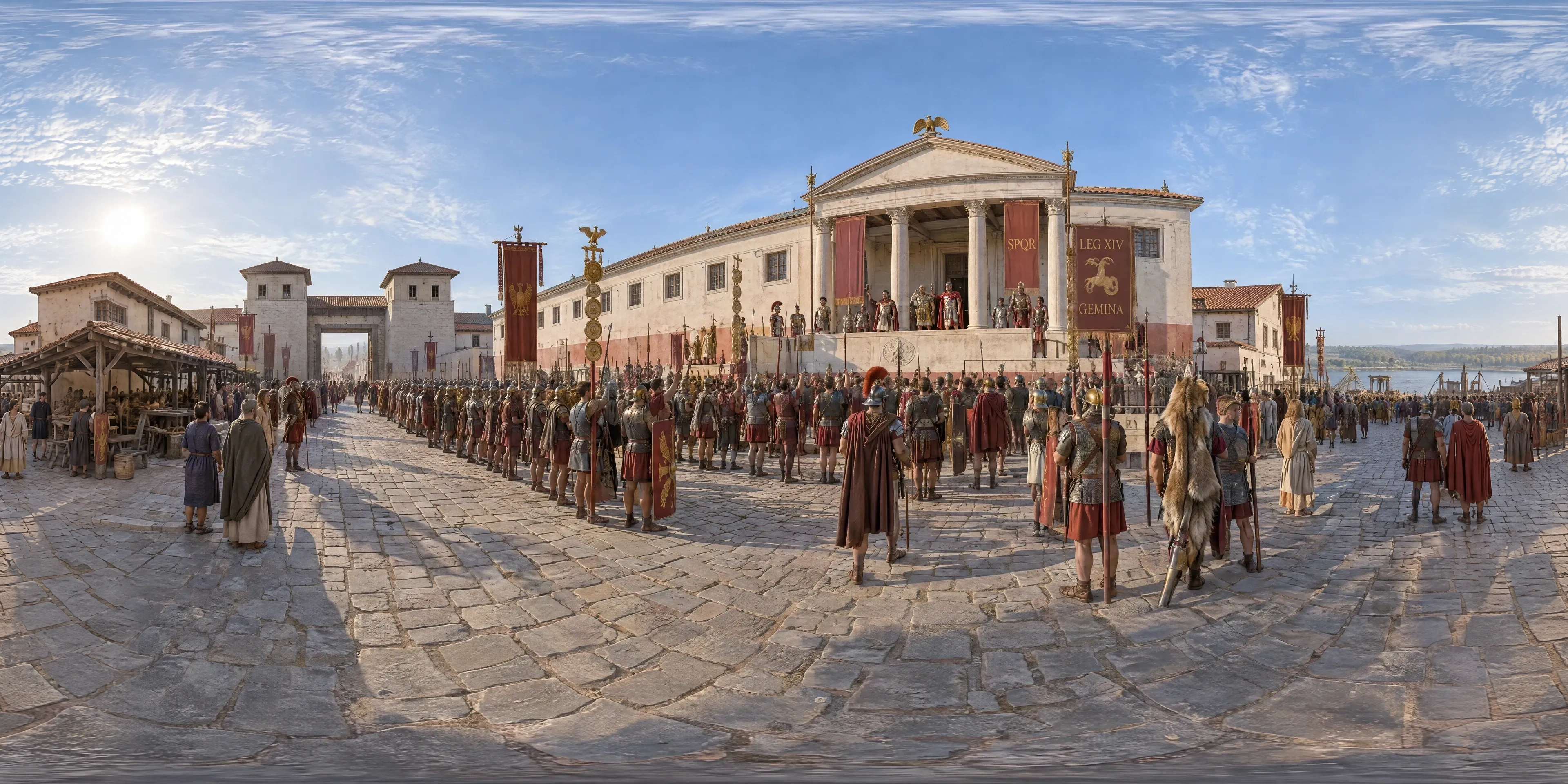
On 9 April 193, twelve days after the murder of Emperor Pertinax in Rome, the Pannonian legions proclaim their governor Lucius Septimius Severus emperor at Carnuntum, capital of Upper Pannonia on the Danube frontier. He wins the civil war that follows, founds the Severan dynasty and raises Carnuntum to the rank of a colony.
- Year
- 193
- Where
- Lower Austria (Roman Pannonia Superior) · AT
- Era
- Classical antiquity
- Coordinates
- 48.116, 16.858
The moment
An emperor made on the Danube
On 9 April 193 the legions of Pannonia proclaimed their governor emperor at Carnuntum, the capital of Upper Pannonia on the Danube frontier. He was Lucius Septimius Severus, a man of 46.
Rome was in chaos. On 28 March the Praetorian Guard had murdered the emperor Pertinax, and then sold the throne to the highest bidder, Didius Julianus. Severus was proclaimed twelve days after Pertinax's death.
He moved fast. He reached Rome before his rivals, and on 1 June Julianus was executed, barely two months after Pertinax.
A fortress on the bluff
The Fourteenth Legion, Gemina Martia Victrix, had its fortress on a plateau right above the Danube. It had been stationed at Carnuntum since the reign of Hadrian, and its stone camp held up to 6,000 men.
Streets ran from towered gates to the headquarters building, the principia, whose windows were glazed. Long rows of barracks, workshops and storehouses stood under tiled roofs. Below the bluff the Danube spread into a braided river of side arms and gravel islands, with the flat Marchfeld on the far bank.
Where exactly Severus was acclaimed is not recorded. A tribunal before the headquarters is a natural guess, not a documented scene.
Beyond the fortress grew a camp town and a civil city. At its height Carnuntum had about 50,000 inhabitants.
Five emperors in one year
The year 193 is remembered as the Year of the Five Emperors. Severus defeated the last of his rivals, Pescennius Niger at Issus in 194 and Clodius Albinus at Lugdunum in 197, and founded the Severan dynasty. Carnuntum's civil town became a colonia, its title, Septimia Aurelia Antoniniana, carrying the dynasty's names.
The city had seen an emperor at work before. In the 170s Marcus Aurelius spent years here during the war against the Marcomanni and wrote part of his Meditations. In 308 the retired emperor Diocletian chaired a conference of rulers at Carnuntum to settle the quarrels of the Tetrarchy.
Why Austrians know the name
Carnuntum is the best-known Roman site in Austria. Since 2021 it has been part of the UNESCO World Heritage Site of the Danube Limes, the frontier of the empire along the river.
Its landmark, the Heidentor, is a later monument, a triumphal arch built under Constantius II between 354 and 361. In 2011 aerial photographs and ground-penetrating radar revealed a gladiator school.
For Austrians it is the Roman chapter of their history in one place: the city where a philosopher-emperor wrote and a provincial governor became emperor.
Sources
Further reading
Tagged
- austria
- carnuntum
- roman-empire
- pannonia
- danube-limes
- septimius-severus
- legion
- unesco
Published
See also

310s
Porta Nigra, Trier
Around 310, while Constantine the Great holds court in Trier and raises a vast palace hall, the city's monumental north gate has already stood for 140 years, never quite finished. Augusta Treverorum is now one of the capitals of the Roman West and seat of the praetorian prefect of the Gauls.

79
Pompeii
On a late October afternoon in 79 AD, Mount Vesuvius unleashes a Plinian eruption that buries Pompeii under meters of pumice and ash within hours.

400s
Aksum
Around 400 AD, masons of King Ezana of Aksum raise a 24-meter granite stele carved to resemble a multi-story house: a monumental tradition unique to the Aksumite kingdom of Ethiopia.