Porta Nigra, Trier
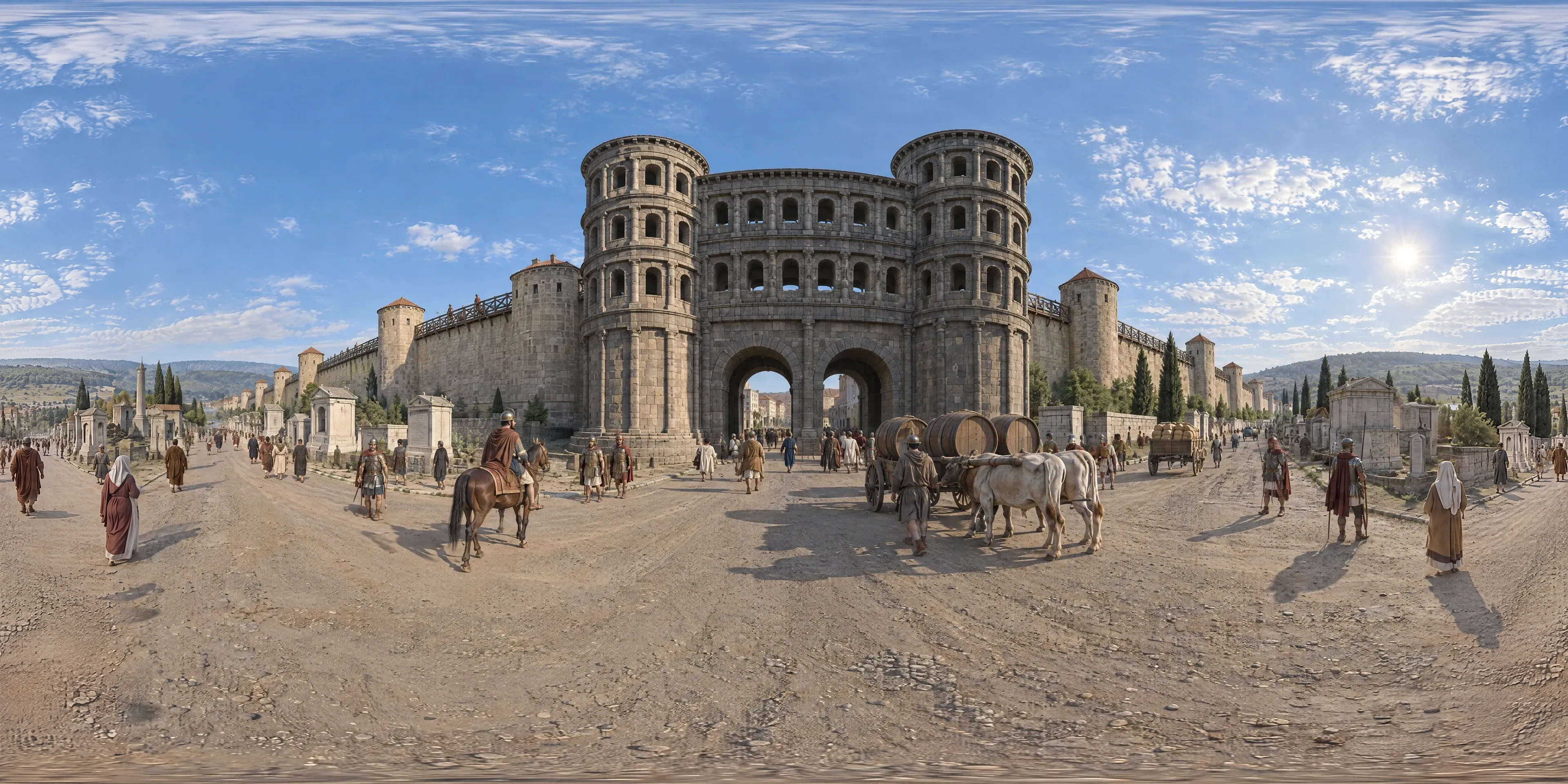
Around 310, while Constantine the Great holds court in Trier and raises a vast palace hall, the city's monumental north gate has already stood for 140 years, never quite finished. Augusta Treverorum is now one of the capitals of the Roman West and seat of the praetorian prefect of the Gauls.
- Year
- 310s
- Where
- Moselle, Rhineland-Palatinate (Roman Gallia Belgica) · DE
- Era
- Classical antiquity
- Coordinates
- 49.760, 6.644
The moment
A gate that was never finished
Around 310 the north gate of Augusta Treverorum was already an old building. Tree-ring dating puts the start of work in 170, in the reign of Marcus Aurelius, and the gate was never quite completed.
It is colossal: about 36 metres long, 21.5 metres wide and 29 metres high, built from some 7,200 sandstone blocks held together with iron clamps set in lead. Two towers, four storeys high and rounded toward the field, flank a double arched passage, and tiers of arched windows framed by half-columns cover the front.
On the field side the finish stops. Many blocks were never dressed smooth and the half-columns were left rough, so travellers arriving from the north faced the unfinished side. From the towers the city wall ran off in both directions, its wall-walk about six metres up.
An emperor on the Moselle
In 310 Trier was one of the capitals of the Roman West. Constantine the Great held court here, and the city was the seat of the praetorian prefect of the Gauls.
The emperor built on an imperial scale. His palace hall, the Aula Palatina, rose in these years: 67 metres long and 33 metres high, it is the largest hall to survive from classical antiquity, and it is still in use, today as a Protestant church.
Outside the gate the road ran north between the tombs and funerary monuments of the city's northern cemetery, then on into the flat Moselle valley.
A hermit saved it
The gate outlived Rome because of one man. After 1028 a Greek monk named Simeon lived as a hermit in its ruins. After his death in 1035 it was turned into a church, in fact two churches, one above the other: the upper for the clergy of a new foundation named after him, the lower for the townspeople.
Others were less kind. Metal robbers broke the iron and lead clamps out of the walls for reuse, and the holes they left still pock the stone.
The name is medieval too. Porta Nigra, the Black Gate, refers to the darkened stone; what the Romans called it is lost. Napoleon's administration dissolved the church, and after his visit to Trier in 1804 the gate was returned to its Roman form. A medieval apse still clings to its east side, and the east tower stands lower than it did in Roman times.
Why Trier calls itself Germany's oldest city
Trier claims to be the oldest city in Germany, and the Porta Nigra is its emblem. It is the best-preserved Roman city gate north of the Alps and has been a UNESCO World Heritage Site since 1986. It has appeared on German stamps and, in 2017, on a two-euro coin.
For Germans it is the textbook image of Roman Germany. It also recalls a chapter many visitors do not expect: the years when an emperor ruled the western half of the empire from a city on the Moselle.
Sources
Further reading
Tagged
- germany
- trier
- roman-empire
- late-antiquity
- constantine
- porta-nigra
- city-gate
- unesco
Published
See also

193
Legionary Fortress of Carnuntum
On 9 April 193, twelve days after the murder of Emperor Pertinax in Rome, the Pannonian legions proclaim their governor Lucius Septimius Severus emperor at Carnuntum, capital of Upper Pannonia on the Danube frontier. He wins the civil war that follows, founds the Severan dynasty and raises Carnuntum to the rank of a colony.

79
Pompeii
On a late October afternoon in 79 AD, Mount Vesuvius unleashes a Plinian eruption that buries Pompeii under meters of pumice and ash within hours.

400s
Aksum
Around 400 AD, masons of King Ezana of Aksum raise a 24-meter granite stele carved to resemble a multi-story house: a monumental tradition unique to the Aksumite kingdom of Ethiopia.