Angkor Wat at dawn
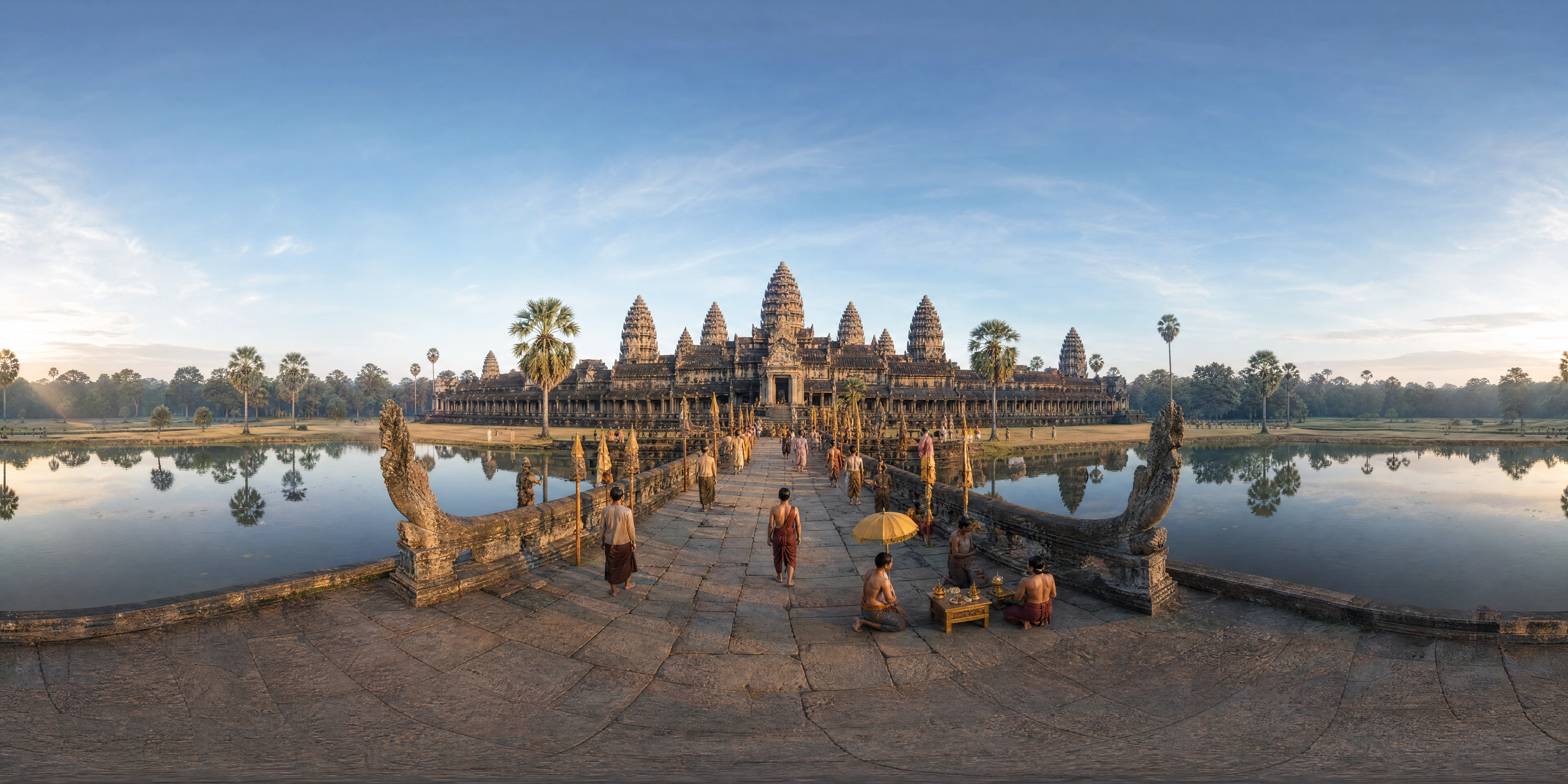
Around 1150, Angkor Wat is newly finished: the largest religious monument ever built, five lotus-bud towers rising beyond a vast moat in the Khmer capital, a temple-mountain to the god Vishnu that still draws crowds to its dawn today.
- Year
- 1150s
- Where
- Angkor (Siem Reap) · KH
- Era
- Medieval
- Coordinates
- 13.412, 103.867
The moment
The largest temple in the world
Angkor Wat was built in the early twelfth century, between roughly 1122 and 1150, as the state temple of the Khmer king Suryavarman II. It remains the largest religious monument ever constructed: about 160 hectares within its moat.
Its form is a model of the Hindu cosmos: a stepped temple-mountain standing for Mount Meru, home of the gods, ringed by a moat standing for the cosmic ocean. The five towers are its peaks. The whole is oriented to the west, unusual for Khmer temples and one reason it is often linked to Vishnu and to funerary symbolism.
From Vishnu to Buddha
The temple was dedicated to Vishnu, but the Khmer Empire's faith shifted, and by the late twelfth and thirteenth centuries Angkor Wat was a Buddhist sanctuary.
That continuity is why it survived so well. While the surrounding city of Angkor was abandoned to the forest after the fifteenth century, Angkor Wat was never wholly deserted; Buddhist monks kept it in use, and it remained a living pilgrimage site through the centuries when European visitors "rediscovered" it and assumed, wrongly, that such a thing could not have been built by the ancestors of the people living around it.
The carvings and the moat
The outer galleries carry more than half a kilometre of continuous bas-relief: the Churning of the Sea of Milk, scenes from the Hindu epics, and Suryavarman II's own army on the march.
The moat is not only symbolic. It is part of a vast hydraulic landscape of reservoirs and canals that fed Angkor, one of the largest pre-industrial cities in the world. Today the temple is the emblem on Cambodia's flag and one of the most visited monuments in Asia, and the crowds that gather before sunrise to watch the towers blacken against a reddening sky are doing something pilgrims have done here for nine centuries.
Further reading
Tagged
- cambodia
- khmer
- angkor-wat
- suryavarman
- temple
- vishnu
Published
See also

1200s
Bayon temple, Angkor Thom
Around 1200 AD, a royal procession of the Khmer king Jayavarman VII winds through the Bayon temple at the heart of Angkor Thom, surrounded by the smiling stone faces that crown its 54 towers.

537
Hagia Sophia, Constantinople
On December 27, 537 AD, Emperor Justinian I dedicates the newly built Hagia Sophia in Constantinople: its 32-meter dome rising on pendentives in a structural feat that defines Byzantine architecture.

10th century AD
El Castillo, Chichén Itzá
Around 1000, El Castillo dominates the Maya city of Chichén Itzá: a four-sided step-pyramid to the feathered serpent Kukulcán with 365 stairs, built so that twice a year the equinox sun throws a serpent of shadow rippling down its edge.