Omaha Beach, Normandy
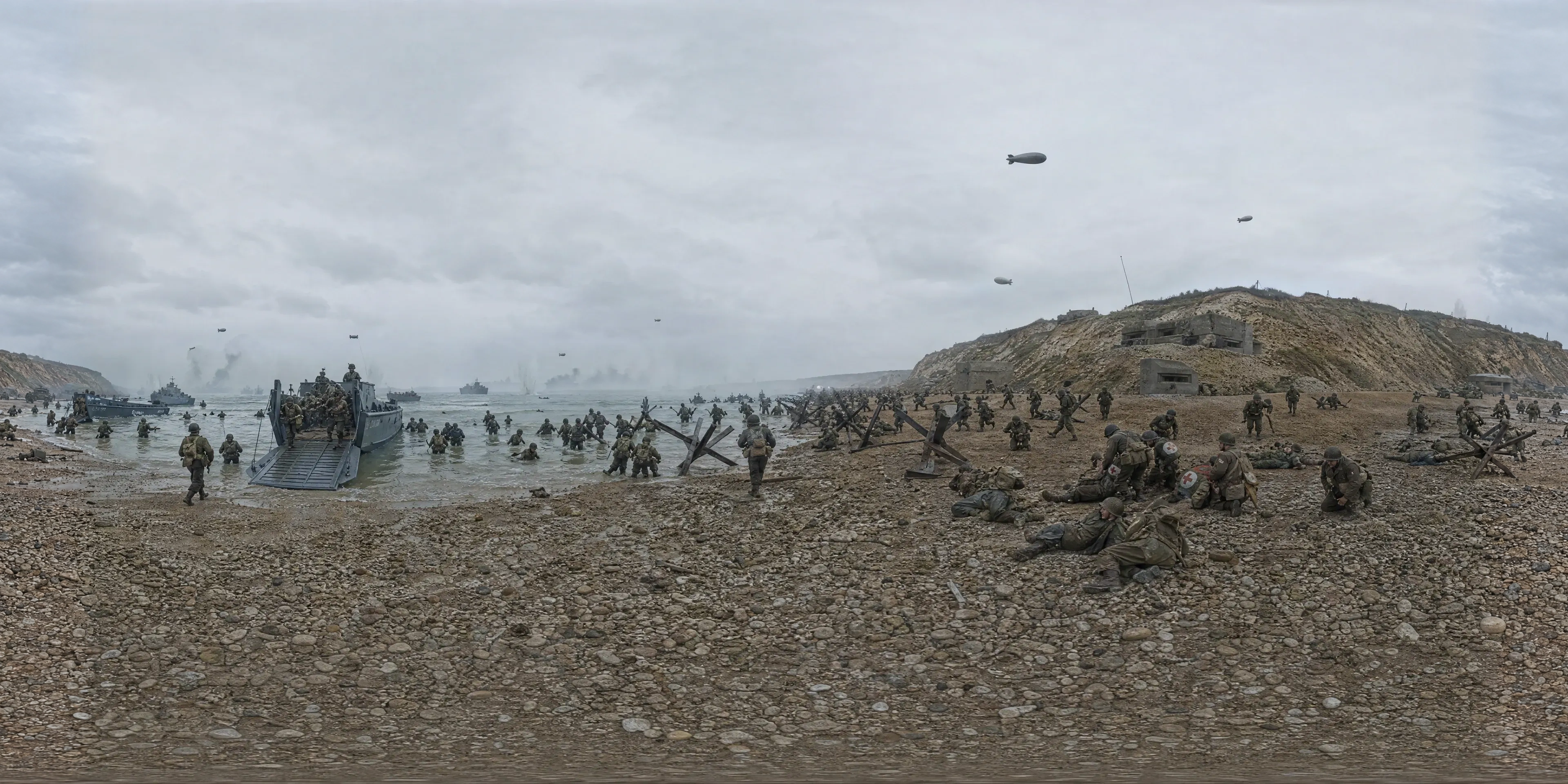
At 6:30 a.m. on June 6, 1944, the first waves of American soldiers from the 1st and 29th Infantry Divisions wade ashore at Omaha Beach under heavy German machine-gun fire in the bloodiest landing of D-Day.
- Year
- 1944
- Where
- Calvados, Normandy · FR
- Era
- modern_early
- Coordinates
- 49.370, -0.875
The moment
The largest seaborne invasion in history
Operation Overlord, the Allied invasion of Nazi-occupied France on 6 June 1944, landed 156 000 troops on five Normandy beaches on the first day.
The supporting naval armada included 6 939 ships of all sizes (the largest amphibious operation ever assembled), 11 590 aircraft, and 195 700 naval and merchant marine personnel.
The American landing zones were code-named Utah and Omaha. The British landed at Gold and Sword. The Canadians at Juno.
Omaha Beach was the worst.
The first wave of US 1st Division and 29th Division infantry (1 450 men in 36 landing craft) was almost entirely destroyed within ten minutes of landing. The 2 400 American casualties at Omaha that day were more than all the other four beaches combined.
A beach that should not have been chosen
Omaha was the wrong beach for an amphibious assault.
The 6.5-kilometre crescent of sand was overlooked by 30-to-50- metre cliffs on which the Germans had built 12 strongpoints (Widerstandsnester or WN) with bunkers, gun positions, machine-gun nests, and trench systems.
The German defenders were the 352nd Infantry Division, one of the better-trained German units in the West, which had arrived at the beach only weeks before D-Day in a relocation Allied intelligence had failed to detect.
Allied pre-invasion bombardment overshot the beach defences by an average of a kilometre. Bomber crews delayed their bomb release by a few seconds to avoid hitting their own infantry, and the bombs landed in the fields beyond the cliffs without harming the defenders.
The 47-minute swim
The first wave of US infantry landed at 06:30 in choppy seas off Omaha.
The DD Sherman tanks, Duplex Drive Shermans modified to swim ashore with canvas screens, were launched 5 000 metres from shore. Of the 32 DD tanks of the 741st Tank Battalion, 27 sank in the choppy seas before reaching the beach.
The infantry, who had been counting on tank support, arrived at the bunker-fortified beach without armour. Many drowned in the surf weighed down by 30 kilograms of equipment. The survivors had to advance over 300 metres of open beach under direct machine-gun fire.
By 09:00 the beach was choked with dead and wounded. The seventh wave of landings was being suspended because there was no space on the shore.
What turned the day
Omaha Beach was secured by mid-afternoon largely through the initiative of individual junior officers and NCOs who improvised small assaults up the cliff draws: the narrow valleys cut through the bluffs by streams.
The most famous was the action of Brigadier General Norman Cota of the 29th Division, who walked along the beach at the height of the slaughter encouraging men to advance and personally led the assault up the Vierville draw.
By evening the Americans had secured a beachhead 2 kilometres deep.
The cost was staggering: 2 400 casualties for 1 600 metres of advance. Of the five D-Day beaches, Omaha was the only one where the outcome was in serious doubt until the final hours of daylight.
Further reading
Tagged
- ww2
- dday
- normandy
- omaha
- 1944
- allied
Published
See also

1939
Lower Wenceslas Square, Prague
On the morning of 15 March 1939, in a heavy fall of wet snow, German columns roll down Wenceslas Square as Hitler's troops occupy what remains of Czechoslovakia. Thousands of Praguers watch from the pavements, weeping, booing and singing the national anthem; that evening Hitler reaches Prague Castle, and the next day he proclaims the Protectorate of Bohemia and Moravia.

1945
Mt. Suribachi, Iwo Jima
At midday on February 23, 1945, six United States Marines raise a larger replacement American flag on a length of iron pipe atop Mt. Suribachi on Iwo Jima, captured in Joe Rosenthal's photograph.

1941
Battleship Row, Pearl Harbor
At 8:06 a.m. on December 7, 1941, the USS Arizona's forward magazine detonates during the Japanese attack on Pearl Harbor, sending a 300-meter black plume vertically into the Hawaiian sky.