Lower Wenceslas Square, Prague
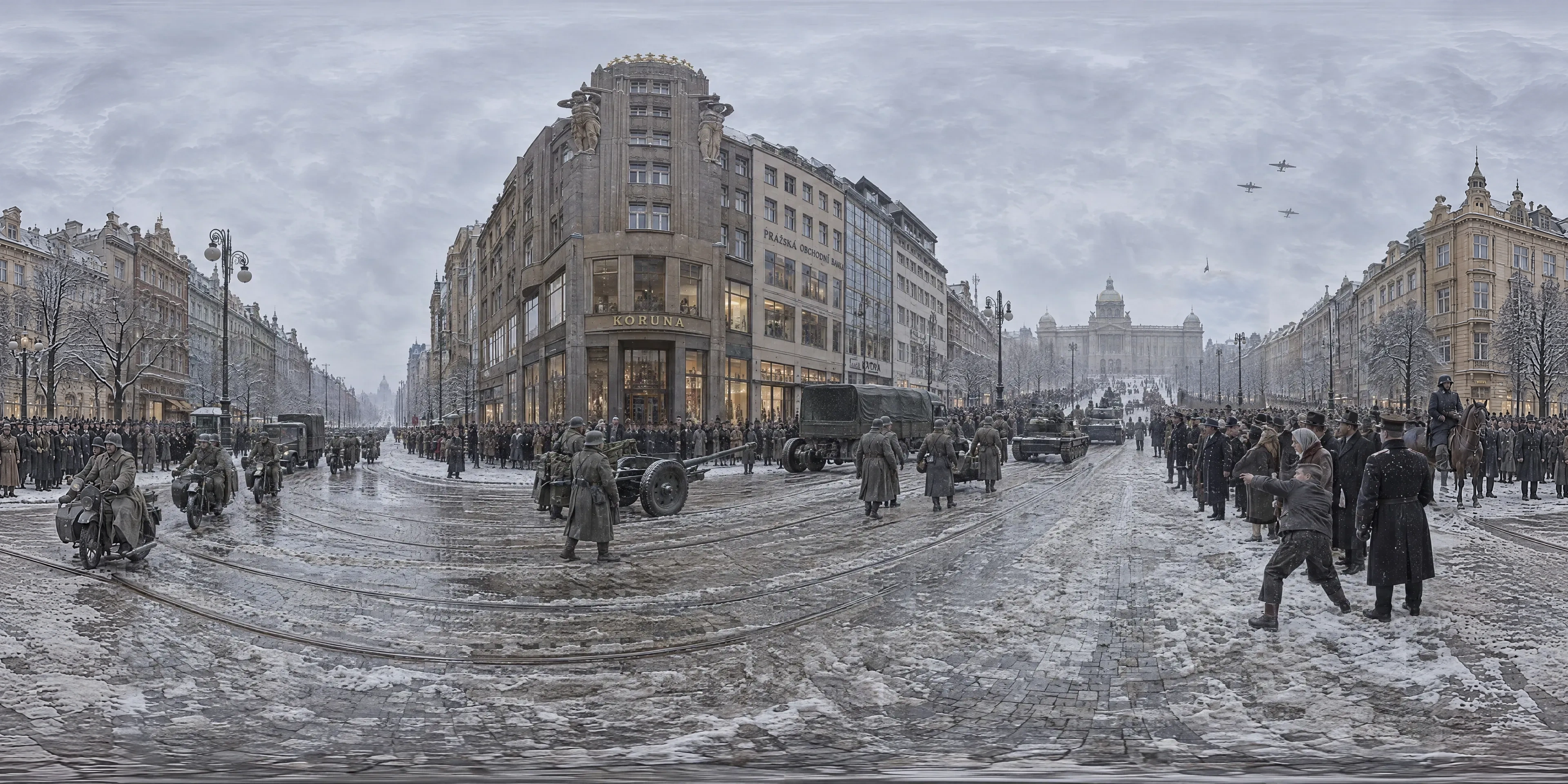
On the morning of 15 March 1939, in a heavy fall of wet snow, German columns roll down Wenceslas Square as Hitler's troops occupy what remains of Czechoslovakia. Thousands of Praguers watch from the pavements, weeping, booing and singing the national anthem; that evening Hitler reaches Prague Castle, and the next day he proclaims the Protectorate of Bohemia and Moravia.
- Year
- 1939
- Where
- Bohemia · CZ
- Era
- modern_early
- Coordinates
- 50.084, 14.424
The moment
The occupation came in a snowstorm
On the morning of Wednesday 15 March 1939, German troops entered Prague in heavy, wet snow. They met practically no resistance.
At the foot of Wenceslas Square, beside the Koruna Palace, a crowd of some five thousand people watched a German column come down the square: motorcyclists with sidecars, cyclists, towed anti-tank guns, light tanks and lorries, soldiers in field-grey greatcoats with snow on their helmets. Some in the crowd wept, some booed, and groups sang the national anthem.
The column turned into 28. října street, a street named after the day Czechoslovakia was founded.
Signed away in Berlin overnight
The end had come in stages. At Munich, on 29 September 1938, Czechoslovakia had been made to cede its border regions, the Sudetenland, to Germany.
On 14 March 1939 the Slovak parliament declared an independent Slovak state. That night President Emil Hácha, summoned to Berlin, was given a choice between letting German troops in peacefully or seeing resistance broken by force; by one account Göring threatened to bomb Prague, and Hácha signed.
On the same day Hungarian troops occupied Carpatho-Ukraine, the easternmost part of the republic. What remained of Czechoslovakia was gone.
Trams still drove on the left
The Koruna Palace of 1914, with the crown on its corner tower held up by atlantes, still marks the lower end of the square. From there Wenceslas Square rises about 750 metres to the domed National Museum, with Myslbek's St Wenceslas, complete with all four saints, small before it.
Down the middle ran the tram strip of 1927. Trams and cars still kept to the left: Prague switched to right-hand traffic only on 26 March, eleven days later.
On the right stood the functionalist Lindt building, the glass-fronted Baťa store and the Hotel Juliš; on the left, the Art Nouveau Hotel Evropa.
The start of the darkest years
That evening Hitler reached Prague Castle, and on 16 March he proclaimed the Protectorate of Bohemia and Moravia from it. Czechs call the six years that followed the darkest period of their history.
The occupation soon showed what it meant. On 17 November 1939, after student protests, the Nazis stormed the Czech universities, arrested about 1,200 students, killed nine, and closed the universities; the date is still a Czech state holiday. Nazi rule ended only with Germany's surrender on 8 May 1945.
The newsreel images from 15 March, weeping crowds on Wenceslas Square in the snow and German vehicles passing between them, are known to every Czech. They show a humiliation, not a parade.
Sources
Further reading
Tagged
- czechia
- prague
- wenceslas-square
- ww2
- nazi-occupation
- protectorate
- snow
- 20th-century
Published
See also

1918
Wenceslas Square, Prague
Late in the morning of 28 October 1918, as news spreads that Austria-Hungary has accepted President Wilson's terms, crowds pour onto Wenceslas Square and the priest Isidor Zahradník proclaims an independent Czechoslovak state at the St Wenceslas monument. That evening the National Committee passes the new republic's first law.

1968
National Museum, Wenceslas Square, Prague
On the morning of 21 August 1968, hours after Warsaw Pact armies invaded to crush the Prague Spring, Soviet tanks coming from Vinohradská rake the facade of the National Museum with machine-gun fire. Praguers fill the upper square, surround the tanks to argue with their crews and cover the statue of St Wenceslas with flags and slogans.

1944
Omaha Beach, Normandy
At 6:30 a.m. on June 6, 1944, the first waves of American soldiers from the 1st and 29th Infantry Divisions wade ashore at Omaha Beach under heavy German machine-gun fire in the bloodiest landing of D-Day.