Castle Hill of Esztergom
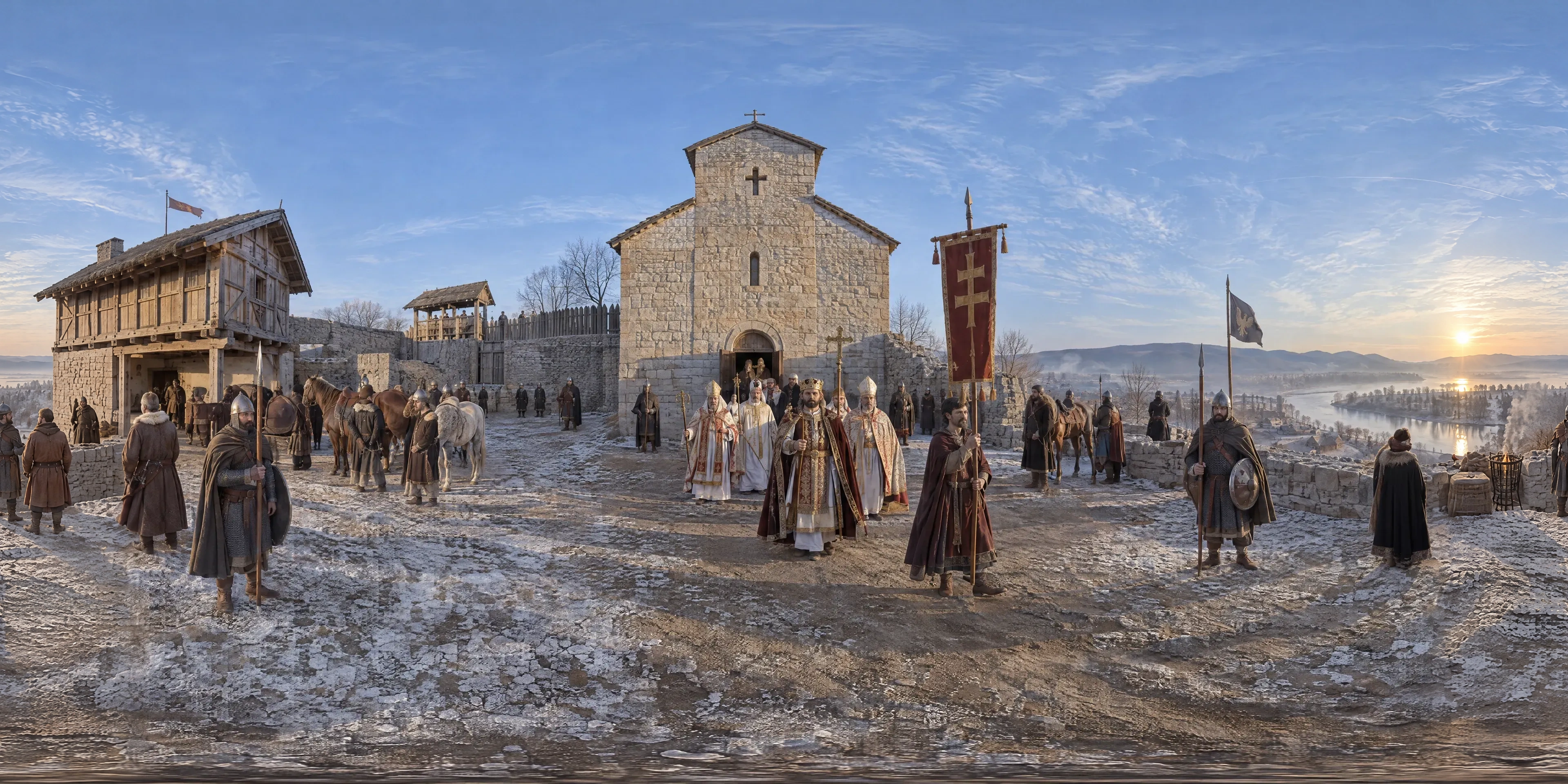
At Christmas 1000, or on New Year's Day 1001, Stephen, son of Grand Prince Géza, is anointed and crowned the first king of Hungary, tradition says in the church on Esztergom's Castle Hill. The crown, won in Rome with the backing of Pope Sylvester II and Emperor Otto III, turns the Hungarian principality into a Christian kingdom of the Latin West.
- Year
- 1000
- Where
- Northern Transdanubia · HU
- Era
- Medieval
- Coordinates
- 47.799, 18.736
The moment
Two possible dates, two possible places
Hungary's first king was crowned at Christmas in the year 1000, or on New Year's Day 1001. The sources allow both, and historians have never settled it.
The place is just as open. Tradition puts the ceremony on the Castle Hill of Esztergom, in the hill's first church, dedicated to St Stephen the Protomartyr. The other candidate is Székesfehérvár. Who performed the anointing is uncertain.
About the king himself there is no doubt. Stephen was born at Esztergom around 975 and first named Vajk. His father, Grand Prince Géza, had made the old Roman fort on the hill his residence, on a rock rising more than 50 metres above the right bank of the Danube.
A crown from Rome, with an emperor's backing
The crown was the point. By the traditional account it came from Rome with the blessing of Pope Sylvester II. The German chronicler Thietmar of Merseburg, a contemporary, says Stephen received it "with the favour and urging" of Emperor Otto III.
The German connection ran through the court too. Stephen had married Gisela of Bavaria in or after 995, and knights of her German following came with her.
What the young king wore can only be pieced together. The coronation mantle, made in 1031 as a chasuble, shows an open jewelled crown, and a lance with a banner served as his royal emblem. With the anointing and the crown, the principality of the Hungarians became a Christian kingdom of the Latin West.
The crown in Parliament is a later one
The Holy Crown that Hungarians call St Stephen's cannot be the crown of 1000. Its lower band carries enamels of the Byzantine emperor Michael VII Doukas, made in Constantinople in the 1070s, decades after Stephen's death in 1038. Its upper part is also eleventh century, and the crown took its present form around the late twelfth.
It has had an eventful modern life. The cross on top was knocked crooked in the seventeenth century and left that way. American forces recovered the crown in Austria in 1945 and kept it at Fort Knox until 6 January 1978, when it was returned to Hungary. Since 1 January 2000 it has been kept in the Parliament building in Budapest.
Why 20 August is Hungary's main holiday
Stephen was canonised on 20 August 1083, and his feast became the day of the foundation of the state, Hungary's main national holiday. It honours the first king, and with him the founding of the Christian kingdom.
The hill looks nothing like it did in 1000. The small church and Géza's residence are long gone. A basilica with a green dome now crowns the rock, beside the palace tower and chapel of Béla III, and a bridge crosses the Danube to Štúrovo, on the Slovak bank.
The debate over the day and the place has never dented the date that matters to Hungarians. On 20 August the country celebrates not a ceremony it can pin down, but the kingdom that came out of it.
Sources
Further reading
Tagged
- hungary
- esztergom
- saint-stephen
- coronation
- arpad-dynasty
- christianity
- medieval
- danube
Published
See also

12th century AD
Kealakekua / Big Island, Hawaii
Around 1200 AD, a Polynesian double-hulled voyaging canoe from the Marquesas Islands makes landfall on the unpopulated Big Island of Hawaii after navigating 4,000 km of open Pacific.

1357
Charles Bridge, Prague
In 1357 Emperor Charles IV lays the foundation stone of a new stone bridge on the Old Town bank near St Clement's, fifteen years after ice and floodwater wrecked the Judith Bridge. Tradition sets the moment at 5:31 on 9 July, a palindrome of odd numbers; the bridge will take 45 years to finish.

14th century AD
Rapa Nui (Easter Island)
Around 1400 AD, Rapa Nui islanders "walk" a 9-meter basalt moai statue upright across the volcanic landscape from the quarry at Rano Raraku toward a coastal ahu platform.