Forbidden City, Beijing
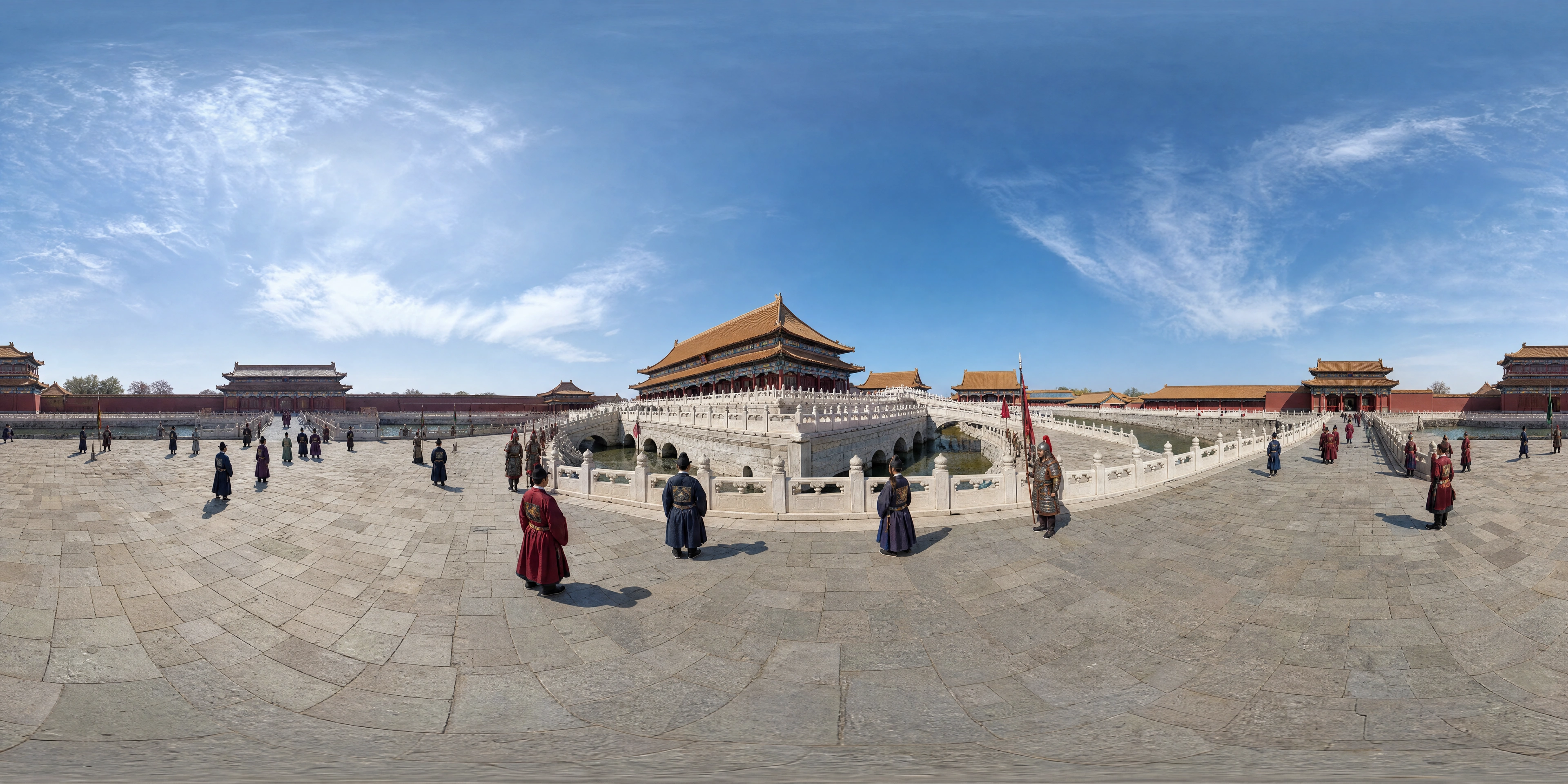
In 1420, the Yongle Emperor's new palace is finished at the heart of Beijing: the Forbidden City, nearly a thousand timber halls behind a moat and vermilion walls, the largest palace complex on Earth and the seat of Chinese emperors for the next five centuries.
- Year
- 1420
- Where
- Beijing · CN
- Era
- Renaissance
- Coordinates
- 39.916, 116.397
The moment
The centre of the world
In 1420 the Yongle Emperor moved the Ming capital north to Beijing and occupied a palace built to be the ceremonial centre of the empire and, in the cosmology of the age, of the world.
The Forbidden City took fourteen years and, by tradition, more than a million workers. It holds around 980 surviving buildings across 72 hectares, ringed by a 10-metre wall and a 52-metre-wide moat. From 1420 until the fall of the Qing in 1924, twenty-four emperors of two dynasties ruled from inside it.
Built of wood, in symmetry
For all its scale, the palace is a complex of timber halls: post-and-beam structures raised on marble terraces, not stone vaults.
Everything obeys the central north–south axis and strict bilateral symmetry, arranged by cosmological and feng-shui principles. The roofs carry colour-coded meaning: the golden-yellow glazed tile that dominates was reserved for the emperor. The largest hall, the Hall of Supreme Harmony, was the tallest building in Beijing, and the throne inside it sat on the axis at the symbolic heart of the realm.
Forbidden
The name is literal. This was the "Purple Forbidden City," and ordinary people were barred from entering on pain of death.
Inside lived the emperor, his family, his concubines, and the officials and thousands of eunuchs who served them: a sealed world of ritual largely hidden from the population it ruled. Today the walls are open: as the Palace Museum it is among the most-visited museums on Earth, drawing well over ten million people a year onto the same paving the emperors once crossed.
Further reading
Tagged
- china
- ming
- forbidden-city
- beijing
- yongle
- imperial-palace
Published
See also

15th century AD
Great Wall of China, Jinshanling
Around 1500, Ming China rebuilds the Great Wall in brick and stone across the mountain ridges north of Beijing: a battlemented rampart with watchtowers that climbs and plunges over the peaks as far as the eye can see, the most ambitious fortification ever built.

1511
Sistine Chapel, Vatican
In 1511, Michelangelo Buonarroti paints the ceiling of the Sistine Chapel; currently working on the Creation of Adam fresco while standing on his custom flat-bridge scaffolding.

1492
Guanahani (San Salvador Island), Bahamas
At dawn on 12 October 1492, Christopher Columbus and about 40 Spanish sailors land at a Lucayan-Taíno island in the Bahamas they will rename *San Salvador*: the encounter that begins five centuries of Atlantic exchange and the destruction of indigenous Caribbean populations.