Gutenberg's workshop, Mainz
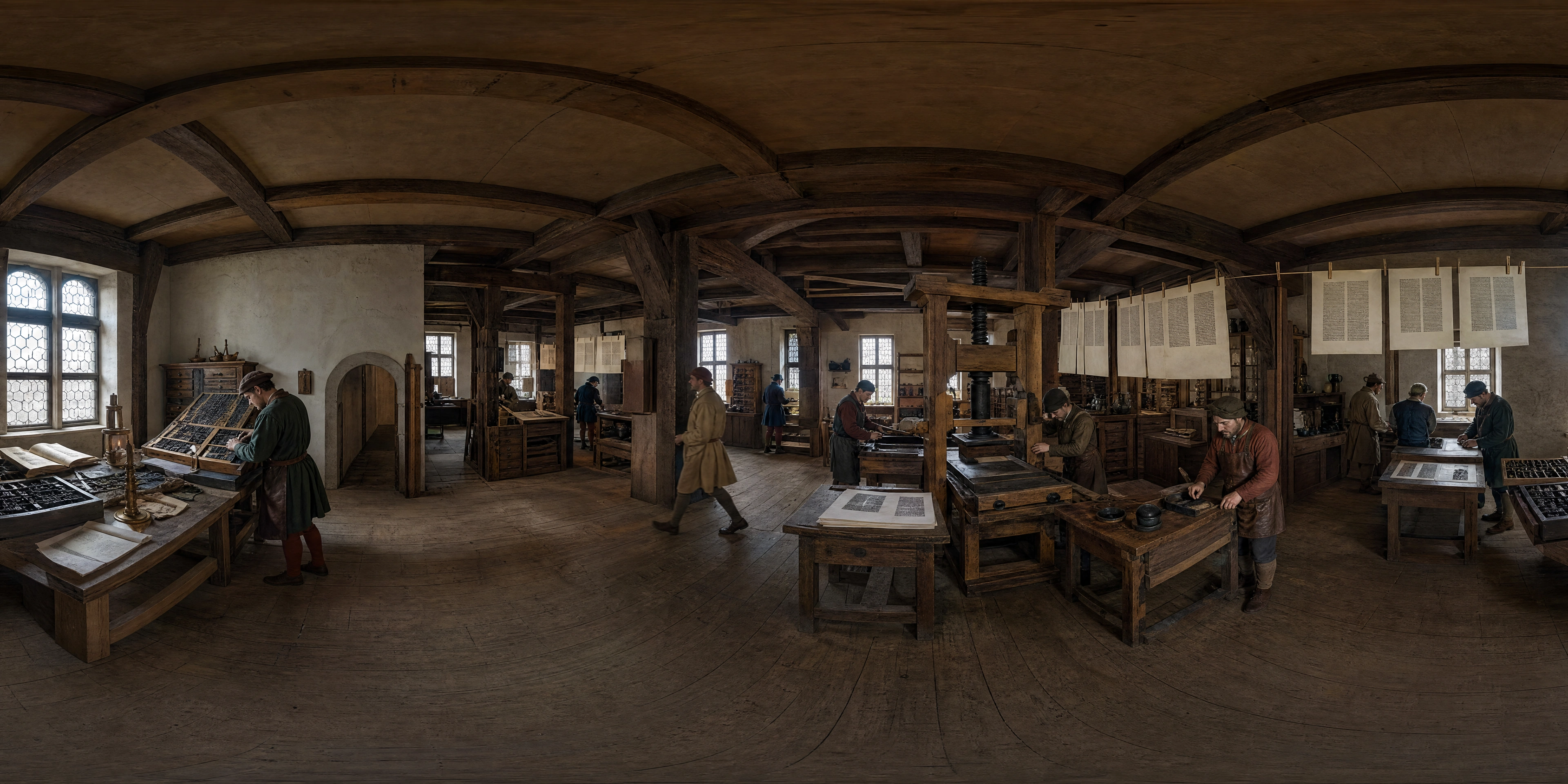
Around 1450 in Mainz, Johannes Gutenberg pulls the first sheets from a printing press of movable metal type: the workshop where the printed book is born, and with it the fastest spread of ideas in human history.
- Year
- 1450s
- Where
- Rhineland · DE
- Era
- Renaissance
- Coordinates
- 49.999, 8.274
The moment
The press that changed everything
Around 1450 in Mainz, Johannes Gutenberg brought together several inventions into one system: a hand mould that could cast identical metal letters quickly and cheaply, a durable oil-based ink, and a screw press adapted from those used for wine and paper.
His masterpiece was the 42-line Bible of about 1455, the first major book printed in Europe with movable type, and still, to many eyes, one of the most beautiful ever made.
How it worked
A compositor picked individual cast letters from a case and set them, upside down and backwards, into lines and then full pages held in a frame. The page of type was inked with leather "ink-balls," a damp sheet of paper laid over it, and the screw turned to press the two together.
The crucial idea was reuse: once printed, the type could be broken up and reset for the next page. A single press could now produce in a day what a scribe had needed months to copy by hand.
The Gutenberg Revolution
Within fifty years, printing presses had spread across Europe and produced millions of books, where before there had been only painstakingly hand-copied manuscripts.
That flood of cheap text fed the Renaissance, made the Reformation possible, and powered the scientific revolution: arguably the most consequential information technology before the internet. Few rooms have changed the world as much as this one. Gutenberg himself, sued by his financier Johann Fust, lost control of his press and died with little to show for it.
Further reading
Tagged
- gutenberg
- printing-press
- mainz
- movable-type
- bible
- germany
Published
See also

1511
Sistine Chapel, Vatican
In 1511, Michelangelo Buonarroti paints the ceiling of the Sistine Chapel; currently working on the Creation of Adam fresco while standing on his custom flat-bridge scaffolding.

1492
Guanahani (San Salvador Island), Bahamas
At dawn on 12 October 1492, Christopher Columbus and about 40 Spanish sailors land at a Lucayan-Taíno island in the Bahamas they will rename *San Salvador*: the encounter that begins five centuries of Atlantic exchange and the destruction of indigenous Caribbean populations.

15th century AD
Great Wall of China, Jinshanling
Around 1500, Ming China rebuilds the Great Wall in brick and stone across the mountain ridges north of Beijing: a battlemented rampart with watchtowers that climbs and plunges over the peaks as far as the eye can see, the most ambitious fortification ever built.