Pyramids of Meroë
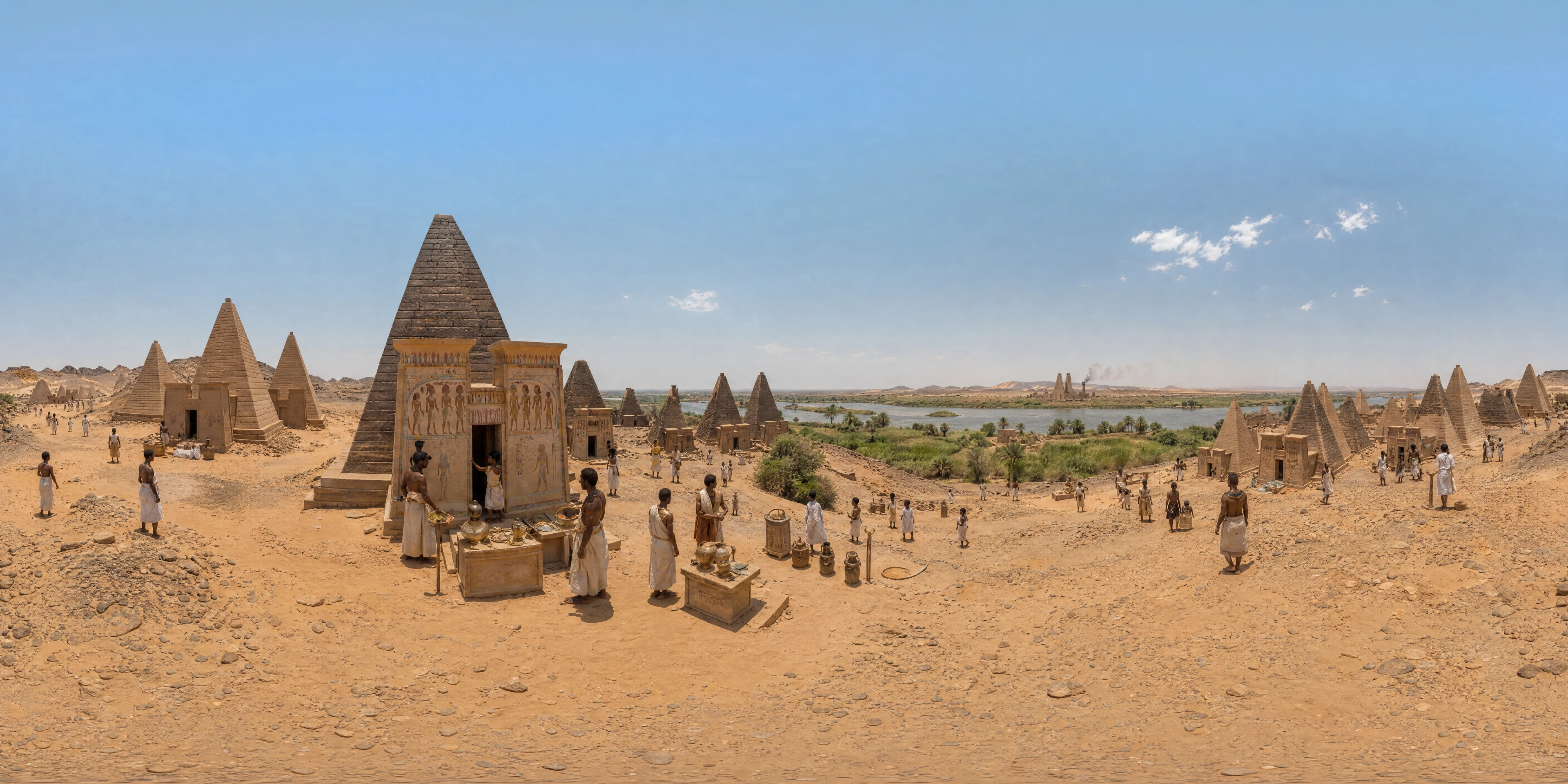
Around 250 BC, the kings and queens of Kush are buried beneath dozens of steep, narrow pyramids on the Nile in what is now Sudan: a desert necropolis of an African civilisation that once ruled Egypt itself, with more pyramids than Egypt has.
- Year
- 3rd century BC
- Where
- River Nile State · SD
- Era
- Classical antiquity
- Coordinates
- 16.938, 33.749
The moment
More pyramids than Egypt
Sudan has more pyramids than Egypt. Over 200 (by some counts more than 250) Nubian pyramids survive, built for the kings, queens and nobles of the kingdom of Kush across centuries.
The largest cluster is at Meroë, the kingdom's later capital, where royal pyramids crowd the desert ridges above the Nile.
Steeper, smaller, distinct
These are not copies of Egypt's pyramids. They rise at a sharp angle of around 70 degrees, far steeper than the Egyptian ~50, from small bases rarely more than a few metres wide, and they seldom exceed 30 metres in height.
Each has a small chapel attached to its east face, where offerings were made to the dead, its walls carved with reliefs. It is a distinctly Nubian architecture, related to Egypt's but unmistakably its own.
The Black Pharaohs and the kingdom of iron
Kush was a great African power. In the eighth and seventh centuries BC its kings conquered and ruled Egypt as the 25th Dynasty, the "Black Pharaohs."
Its later capital, Meroë, was a major iron-working centre and a hub of trade linking sub-Saharan Africa, Egypt and the Mediterranean, and it wrote in its own Meroitic script, still only partly deciphered. The kingdom fell around AD 350. The flat, broken tops on many of the pyramids are recent damage: in the 1830s the Italian treasure-hunter Giuseppe Ferlini blew the summits off dozens of them looking for gold.
Further reading
Tagged
- kush
- nubia
- meroe
- pyramids
- sudan
- black-pharaohs
- lost-civilization
Published
See also

438 BC
Parthenon, Acropolis of Athens
In the summer of 438 BC, Athens dedicates the finished Parthenon at the Great Panathenaia: its Pentelic marble still bright with painted red, blue and gold, and inside stands Phidias's twelve-metre Athena of gold and ivory, at the peak of the city's brief golden age.

80
Colosseum, Rome
In 80 AD, Emperor Titus opens the Flavian Amphitheatre (the Colosseum) with 100 days of games, including the rare flooding of the arena for a mock naval battle.

79
Pompeii
On a late October afternoon in 79 AD, Mount Vesuvius unleashes a Plinian eruption that buries Pompeii under meters of pumice and ash within hours.