Parthenon, Acropolis of Athens
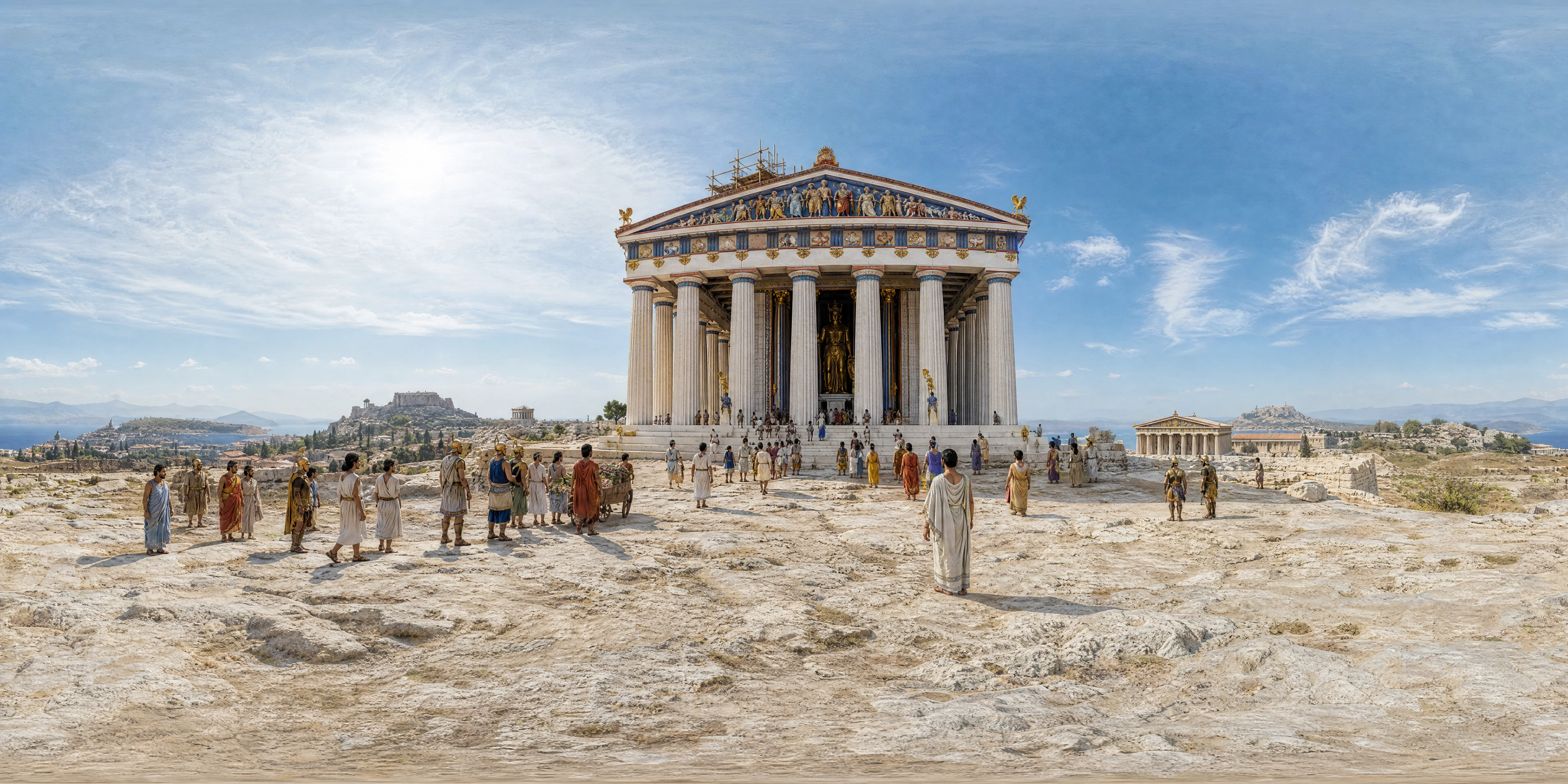
In the summer of 438 BC, Athens dedicates the finished Parthenon at the Great Panathenaia: its Pentelic marble still bright with painted red, blue and gold, and inside stands Phidias's twelve-metre Athena of gold and ivory, at the peak of the city's brief golden age.
- Year
- 438 BC
- Where
- Attica · GR
- Era
- Classical antiquity
- Coordinates
- 37.971, 23.727
The moment
Built fast, at the height of the city
The Parthenon went up quickly. Work began in 447 BC; the temple was structurally complete and dedicated at the Great Panathenaic festival of 438 BC, about nine years, though the sculptures in the pediments were not finished until 432 BC.
It was built at the peak of Athenian power, and paid for in large part from the treasury of the Delian League, the anti-Persian alliance Athens led and increasingly ran as an empire. Pericles had the League's treasury moved from Delos to Athens in 454 BC, and drew on its tribute for the building programme over loud objections that he was decking the city out, in Plutarch's later phrase, "like a vain woman" with money meant for the common defence.
The golden age was brief. The Peloponnesian War against Sparta broke out in 431 BC, the year after the sculptures were done, and a plague soon swept the crowded city; it killed Pericles himself in 429 BC.
It was not white
The biggest surprise for a modern visitor would be the colour.
Greek temples were painted. The Parthenon's carved decoration, its ninety-two metopes, the 160-metre running frieze, the figures filling both pediments, was finished in vivid pigment: red and blue grounds, gilding, painted hair, drapery and weapons, with applied bronze for reins, spears and wreaths. The honey-and-white bare marble we picture today is the result of twenty-four centuries of weathering and lost paint.
The Athena inside
The temple was built to house one object: the Athena Parthenos, the cult statue by Phidias, the leading sculptor of the age.
It stood almost twelve metres high: a wooden core sheathed in carved ivory for the flesh and over a tonne of gold for the clothing and armour, the gold reportedly made removable so it could be weighed and used as a reserve in an emergency. Athena stood helmeted, shield and spear at her side, a serpent coiled within the shield, and a roughly two-metre winged figure of Nike (Victory) standing in her open right hand.
The statue is lost. It survived into the Roman period and then vanishes from the record; everything we know comes from ancient descriptions and small Roman copies.
The temple shows its own festival
Running around the top of the inner building was a continuous sculpted frieze, unusual for a Doric temple, which most scholars read as the Panathenaic procession itself: horsemen, elders, musicians, water-carriers, and the presentation of a new woven robe, the peplos, for the goddess.
In other words, the building depicts the very ceremony climbing the rock toward it. The Athenians carved their own festival onto their own temple.
Further reading
Tagged
- athens
- greece
- classical
- acropolis
- pericles
- phidias
- parthenon
Published
See also

80
Colosseum, Rome
In 80 AD, Emperor Titus opens the Flavian Amphitheatre (the Colosseum) with 100 days of games, including the rare flooding of the arena for a mock naval battle.

79
Pompeii
On a late October afternoon in 79 AD, Mount Vesuvius unleashes a Plinian eruption that buries Pompeii under meters of pumice and ash within hours.

120s
Roman Forum, Rome
Around 120 AD, the Roman Forum is the crowded heart of an empire of fifty million: temples, basilicas and triumphal arches packed along the Sacred Way beneath the Capitol, with Trajan's new column and forum rising alongside.