Cliff Palace, Mesa Verde
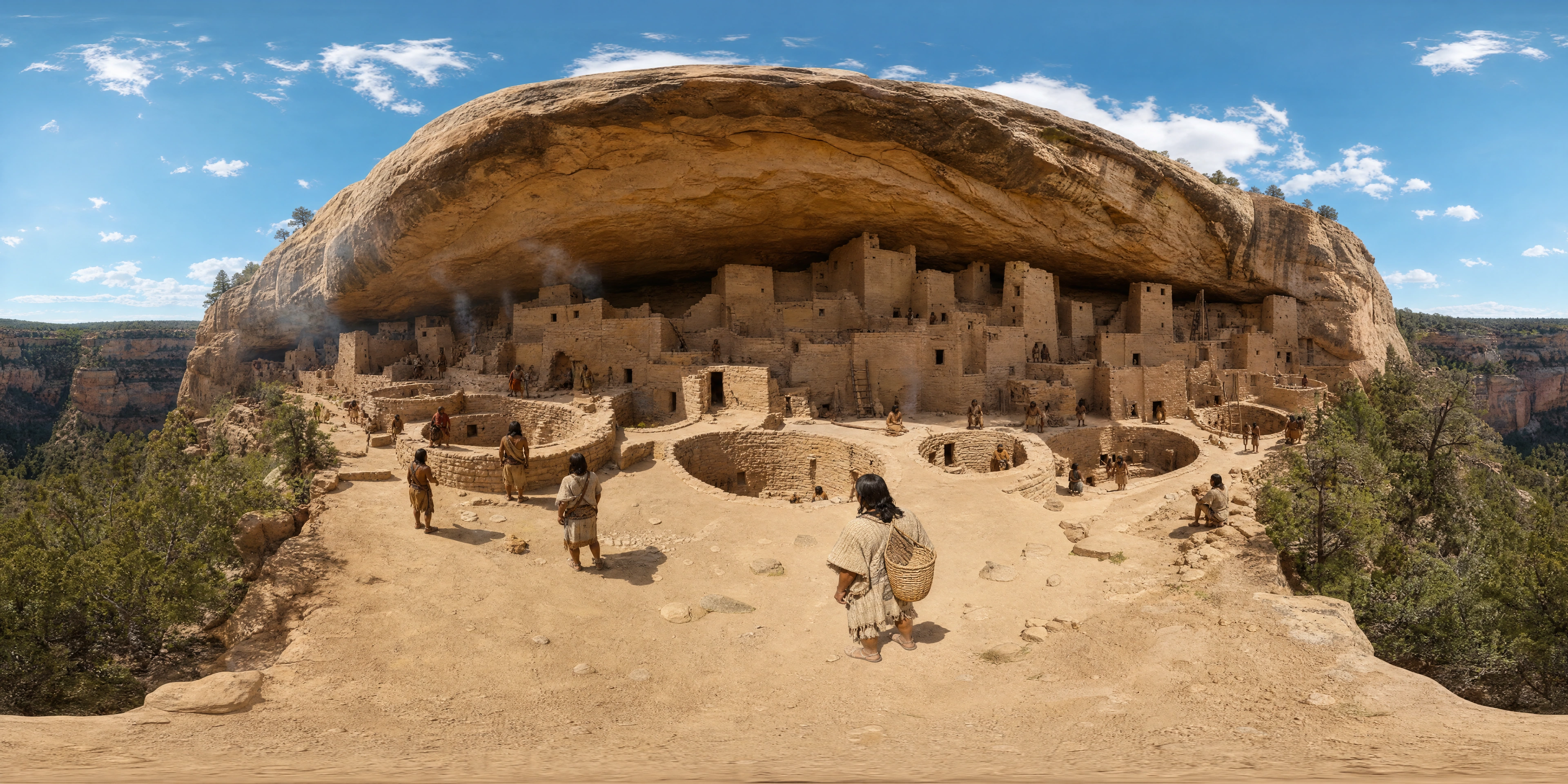
Around 1250, the Ancestral Puebloans build Cliff Palace into a sandstone alcove high in a Colorado canyon wall: over a hundred and fifty rooms and two dozen round ceremonial kivas tucked beneath an overhang, the largest cliff dwelling in North America.
- Year
- 1250s
- Where
- Colorado · US
- Era
- Medieval
- Coordinates
- 37.167, -108.473
The moment
A town under a cliff
Cliff Palace is built into a natural rock alcove partway up a canyon wall, sheltered from snow and sun by the overhang above. It holds roughly 150 rooms and about two dozen kivas (round, sunken ceremonial chambers) and once housed around a hundred people.
It is the largest cliff dwelling in North America. The walls are coursed sandstone blocks set in mud mortar and finished with plaster, some of it still painted; the builders farmed maize, beans and squash on the mesa top above and climbed hand-and-toe holds cut into the rock to come and go.
Why kivas
The round sunken rooms are the signature of the culture. A kiva typically had a fire pit, a ventilation shaft, a low deflector wall, and a small hole in the floor, the sipapu, symbolising the place of emergence in origin stories.
This is not a dead tradition. The Ancestral Puebloans are the direct ancestors of today's Pueblo peoples (the Hopi, Zuni, Acoma and the Rio Grande pueblos) who still build and use kivas. Cliff Palace is part of a living heritage, not a closed chapter.
Why they left
Cliff Palace was occupied for only about a century, roughly 1200 to 1300, and then abandoned within a couple of generations.
A long, severe drought in the late 1200s is the leading explanation, probably compounded by depleted soil and timber, and social and political stress. But the people did not vanish; they migrated south and east, to the Rio Grande valley and the Hopi mesas, where their descendants have lived ever since. What looks like a mystery of disappearance was, in large part, a planned migration.
Further reading
Tagged
- ancestral-puebloan
- mesa-verde
- cliff-palace
- colorado
- kiva
- north-america
Published
See also

537
Hagia Sophia, Constantinople
On December 27, 537 AD, Emperor Justinian I dedicates the newly built Hagia Sophia in Constantinople: its 32-meter dome rising on pendentives in a structural feat that defines Byzantine architecture.

10th century AD
El Castillo, Chichén Itzá
Around 1000, El Castillo dominates the Maya city of Chichén Itzá: a four-sided step-pyramid to the feathered serpent Kukulcán with 365 stairs, built so that twice a year the equinox sun throws a serpent of shadow rippling down its edge.

1066
Senlac Hill (Battle), Sussex
On 14 October 1066, William of Normandy defeats King Harold Godwinson on Senlac Hill in Sussex: the last successful invasion of England, fought eight months after the year's other omen, the appearance of Halley's Comet.