Mont-Saint-Michel
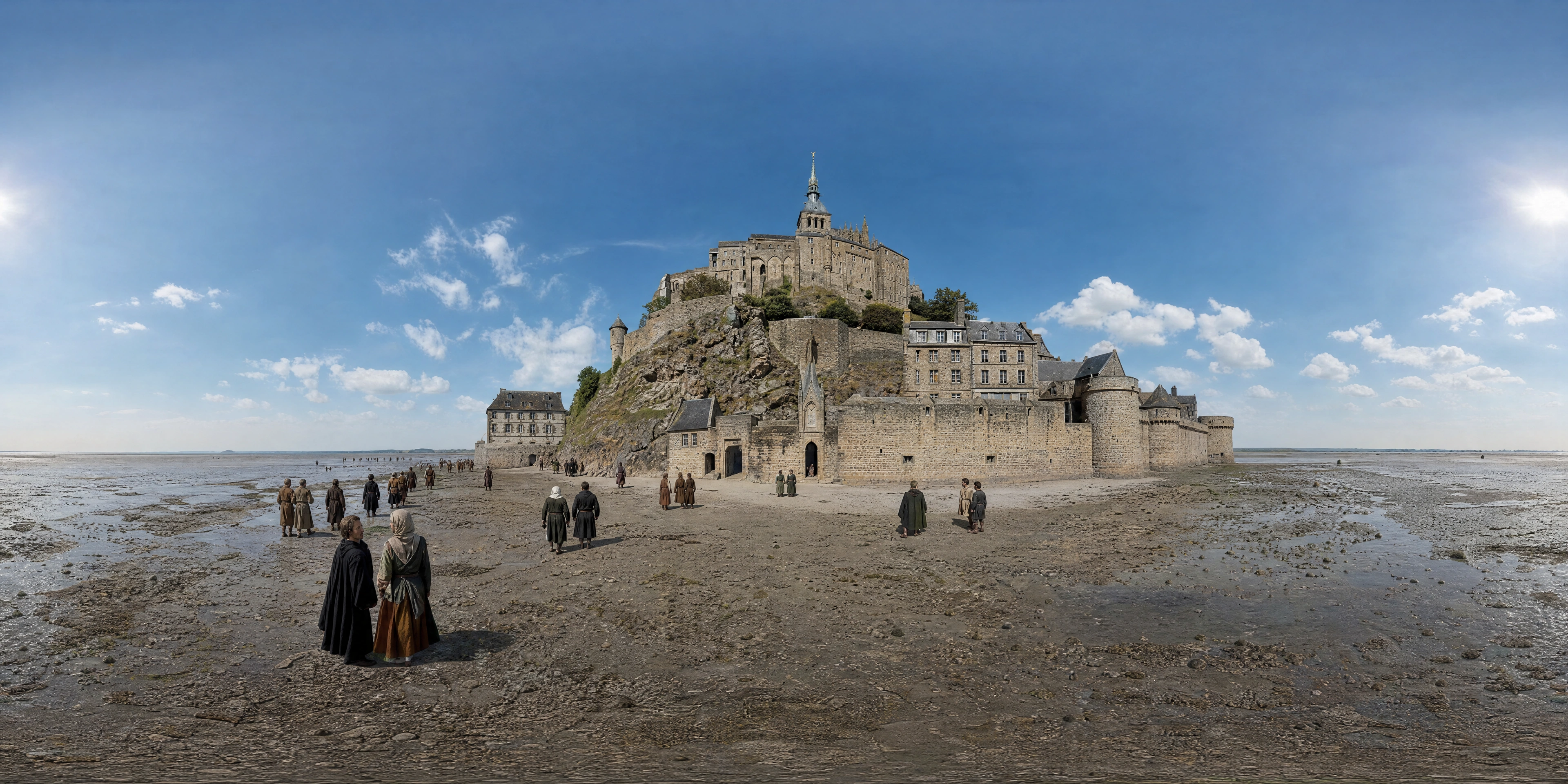
Around 1300, the abbey of Mont-Saint-Michel rises tier upon tier from a rocky tidal island off Normandy: a Gothic church on the summit ringed by some of the strongest tides in Europe, which turn the mount into an island twice a day.
- Year
- 13th century AD
- Where
- Normandy · FR
- Era
- Medieval
- Coordinates
- 48.636, -1.512
The moment
An island, twice a day
Mont-Saint-Michel sits in a bay with some of the strongest tides in continental Europe: a range of up to fifteen metres between low and high water.
At low tide the mount stands amid miles of wet sand; then the sea floods back in, by legend "at the speed of a galloping horse", and cuts it off as an island. For medieval pilgrims the crossing was an act of faith and a real danger; the sands and the fast tide drowned the unwary.
A church on a needle of rock
The abbey grew over centuries on an almost impossible site. Its thirteenth-century Gothic complex, called La Merveille, "the Marvel", stacked monastery halls, a refectory and a cloister vertiginously up the side of the rock beneath the church.
Dedicated to the archangel Michael, it became one of the great pilgrimage destinations of Christendom, drawing the faithful from across Europe to the church on its spire of granite.
Fortress, prison, monument
Its situation made it nearly impregnable. During the Hundred Years' War it held out against the English, who never took it.
After the French Revolution it was turned into a prison; only later was it restored as a monument. Today it is a UNESCO World Heritage Site and one of the most visited places in France, with millions crossing each year to the mount that the tides still surround.
Further reading
Tagged
- france
- normandy
- mont-saint-michel
- abbey
- gothic
- pilgrimage
Published
See also

1066
Senlac Hill (Battle), Sussex
On 14 October 1066, William of Normandy defeats King Harold Godwinson on Senlac Hill in Sussex: the last successful invasion of England, fought eight months after the year's other omen, the appearance of Halley's Comet.

537
Hagia Sophia, Constantinople
On December 27, 537 AD, Emperor Justinian I dedicates the newly built Hagia Sophia in Constantinople: its 32-meter dome rising on pendentives in a structural feat that defines Byzantine architecture.

10th century AD
El Castillo, Chichén Itzá
Around 1000, El Castillo dominates the Maya city of Chichén Itzá: a four-sided step-pyramid to the feathered serpent Kukulcán with 365 stairs, built so that twice a year the equinox sun throws a serpent of shadow rippling down its edge.