Sanctuary of Zeus, Olympia
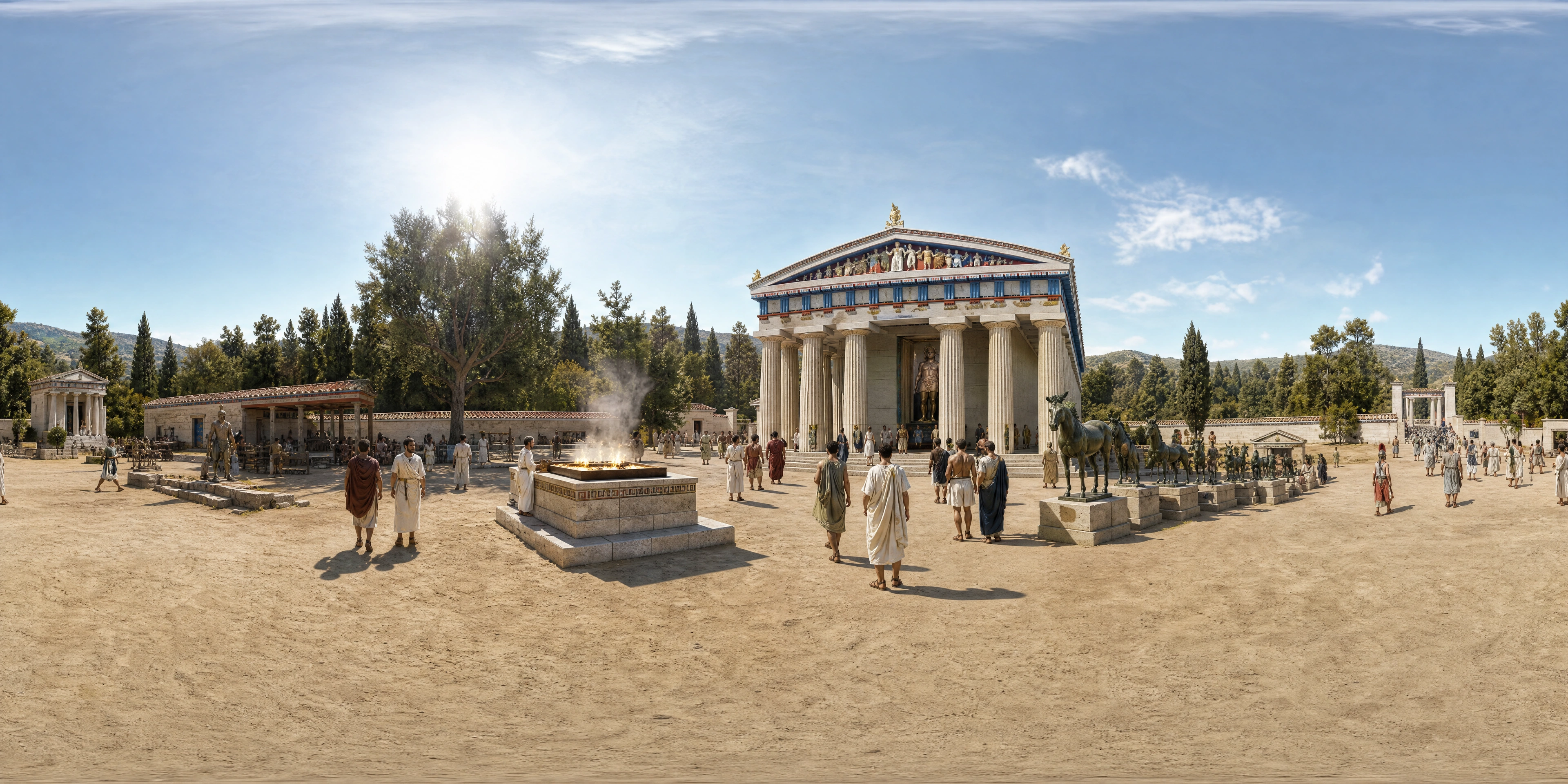
Around 430 BC, the sanctuary of Olympia holds a new wonder: Phidias's gold-and-ivory Zeus, a seated god twelve metres high filling his temple, while every four years the games in his honour bring the whole Greek world to the stadium beyond the sacred grove.
- Year
- 430s BC
- Where
- Elis · GR
- Era
- Classical antiquity
- Coordinates
- 37.638, 21.630
The moment
The third wonder
Inside the Temple of Zeus sat the masterpiece of Phidias, the same sculptor who made the Athena of the Parthenon. His Zeus was a seated figure about 12.4 metres high, of ivory flesh and gold robes over a wooden core, holding a winged Victory in one hand and a sceptre in the other.
It was so large for its temple that the geographer Strabo joked the god would take the roof off if he stood up. Commissioned by the Eleans around 435 BC, it became one of the Seven Wonders of the Ancient World.
The original Games
Olympia was first of all a sanctuary, and the Olympic Games were a religious festival held there in Zeus's honour every four years from 776 BC.
For the duration a sacred truce was declared across the Greek world. Athletes competed naked in running, wrestling, boxing, the brutal pankration, and chariot racing; victors won only a wreath of wild olive, but glory and honour at home. The festival ran, remarkably, for more than a thousand years.
How both were lost
In AD 393 the Christian emperor Theodosius banned the Games as a pagan rite, and the sanctuary declined.
The great statue was reportedly carried off to Constantinople and later destroyed by fire; the temple was toppled by earthquakes and buried. In 1954–58 archaeologists found Phidias's actual workshop beside the temple, complete with his tools and a small cup scratched with the words "I belong to Pheidias." And the idea of Olympia never quite died: the modern Olympic Games revived it in 1896.
Further reading
Tagged
- greece
- olympia
- zeus
- phidias
- olympic-games
- seven-wonders
Published
See also

438 BC
Parthenon, Acropolis of Athens
In the summer of 438 BC, Athens dedicates the finished Parthenon at the Great Panathenaia: its Pentelic marble still bright with painted red, blue and gold, and inside stands Phidias's twelve-metre Athena of gold and ivory, at the peak of the city's brief golden age.

80
Colosseum, Rome
In 80 AD, Emperor Titus opens the Flavian Amphitheatre (the Colosseum) with 100 days of games, including the rare flooding of the arena for a mock naval battle.

79
Pompeii
On a late October afternoon in 79 AD, Mount Vesuvius unleashes a Plinian eruption that buries Pompeii under meters of pumice and ash within hours.