Palmyra
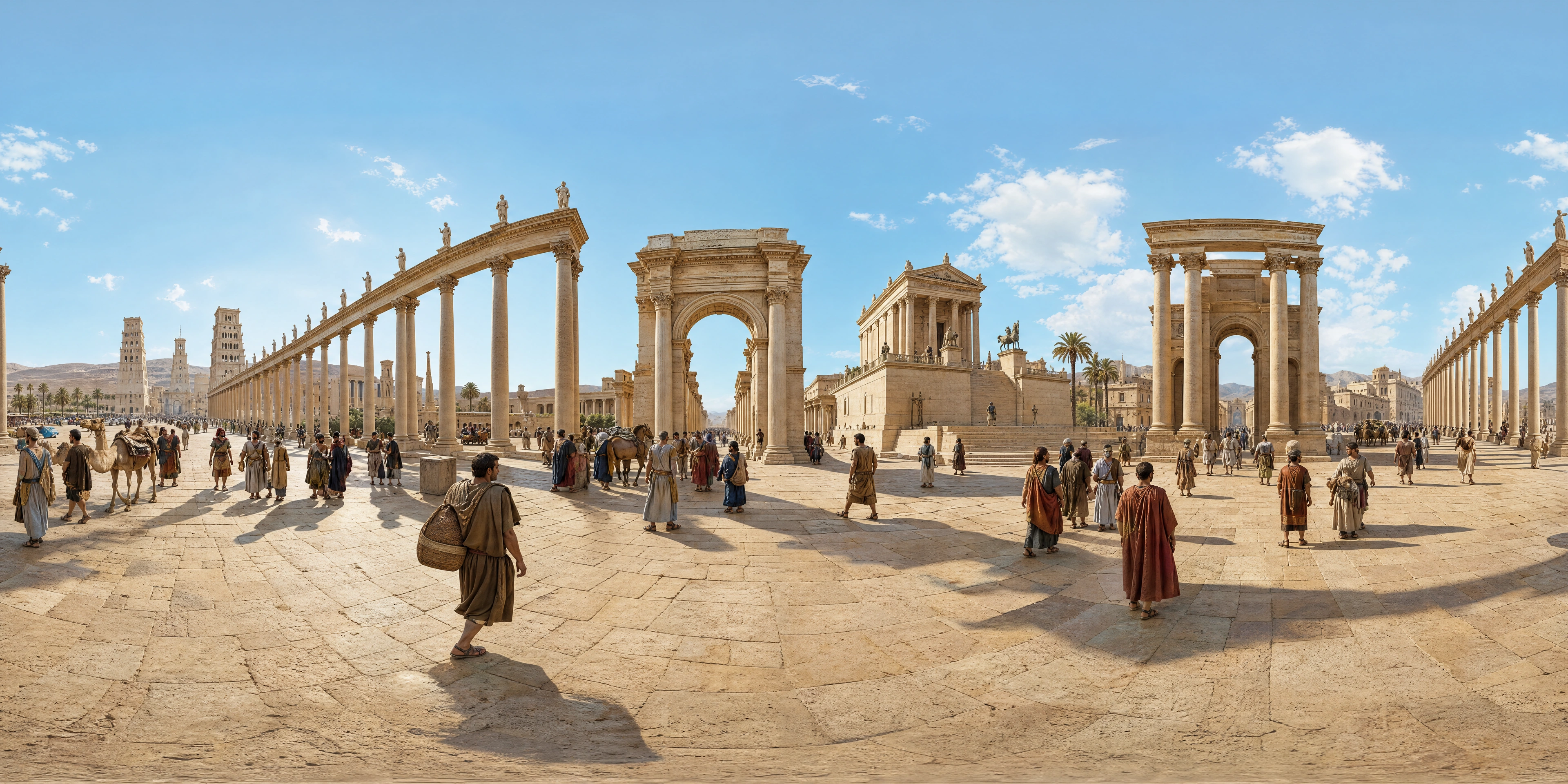
Around 200 AD, Palmyra is a fabulously rich caravan city in the Syrian desert: a kilometre-long avenue of columns linking the great Temple of Bel to the city gates, an oasis where the trade of Rome, Persia and the East all met.
- Year
- 2nd century AD
- Where
- Homs · SY
- Era
- Classical antiquity
- Coordinates
- 34.552, 38.267
The moment
Where the trade routes met
Palmyra sat on the route between the Roman Mediterranean and the Persian Gulf, a halfway oasis on the western reach of the Silk Road. It grew immensely rich taxing the caravans that passed through: silk from China, spices and pepper from India, incense from Arabia.
Its culture was a true crossroads: Greco-Roman architecture, Persian and Arab dress, local gods, and its own dialect of Aramaic, written alongside Greek on its monuments.
A city of columns
The Great Colonnade ran for more than a kilometre, lined with hundreds of columns. The Temple of Bel, dedicated in AD 32, was one of the most important religious buildings of the Roman East; the monumental arch and the tetrapylon punctuated the avenue; and at the desert's edge rose the eerie multi-storey tower-tombs in which the great families buried their dead.
Zenobia, and 2015
In the third century, Queen Zenobia of Palmyra rebelled against Rome and briefly ruled an empire from Egypt to Anatolia, before the emperor Aurelian crushed the city in AD 273.
Its ruins survived as some of the finest in the world, until 2015, when the militant group ISIS dynamited the Temple of Bel and the monumental arch and murdered Khaled al-Asaad, the archaeologist who had cared for the site for decades. The destruction made headlines around the world and turned Palmyra into a symbol of cultural loss.
Further reading
Tagged
- palmyra
- syria
- caravan-city
- temple-of-bel
- silk-road
- classical
Published
See also

438 BC
Parthenon, Acropolis of Athens
In the summer of 438 BC, Athens dedicates the finished Parthenon at the Great Panathenaia: its Pentelic marble still bright with painted red, blue and gold, and inside stands Phidias's twelve-metre Athena of gold and ivory, at the peak of the city's brief golden age.

80
Colosseum, Rome
In 80 AD, Emperor Titus opens the Flavian Amphitheatre (the Colosseum) with 100 days of games, including the rare flooding of the arena for a mock naval battle.

79
Pompeii
On a late October afternoon in 79 AD, Mount Vesuvius unleashes a Plinian eruption that buries Pompeii under meters of pumice and ash within hours.