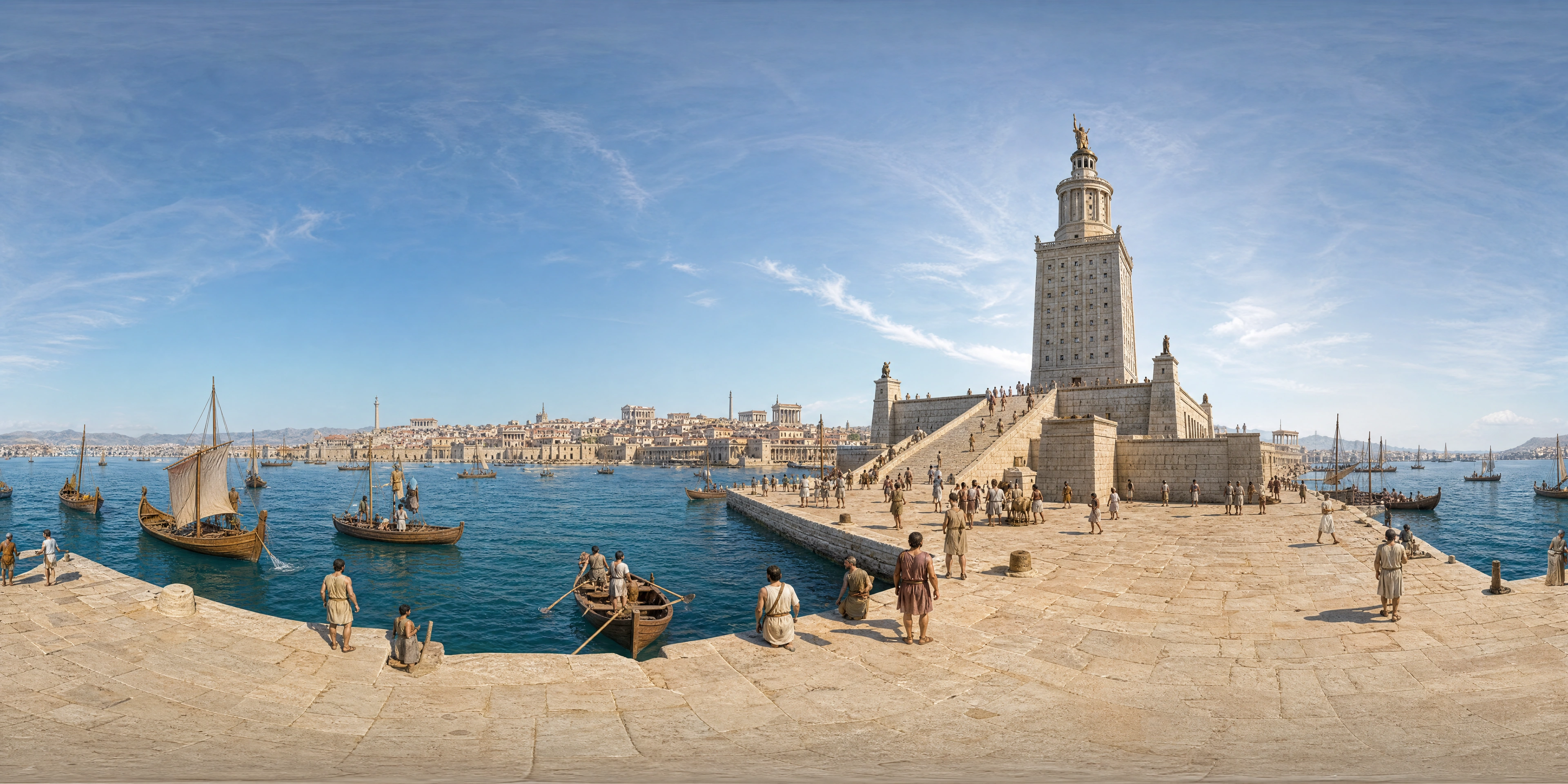
Pharos lighthouse, Great Harbour of Alexandria
Around 280 BC, ships entering Alexandria's Great Harbour pass beneath the Pharos: a three-tiered stone tower well over a hundred metres tall, its mirrored flame visible far out at sea, the tallest building of its world and one of the Seven Wonders of antiquity.
- Year
- 3rd century BC
- Where
- Alexandria · EG
- Era
- Classical antiquity
- Coordinates
- 31.214, 29.886
The moment
The tallest thing in the world, after a pyramid
For most of the seventeen centuries it stood, the Pharos of Alexandria was the tallest building humans had ever made apart from the Great Pyramid of Giza.
Estimates of its height range from roughly 100 to 130 metres. It was begun under Ptolemy I, the Macedonian general who took Egypt after the death of Alexander, and completed under his son Ptolemy II around 280 BC. The architect was Sostratus of Cnidus.
It gave its name to the very idea of a lighthouse: the word survives in the French phare, the Italian and Spanish faro.
How it worked
The tower rose in three diminishing stages, a square lower section, an octagonal middle, a round top, a silhouette known to us only from coins, mosaics, ancient descriptions and the medieval Arab writers who saw it still standing.
A fire burned at the summit through the night. By day, ancient sources describe a polished metal mirror that reflected the sunlight far out to sea. How well any of this actually worked is impossible to verify, but the claim that the light was visible tens of kilometres offshore recurs across the sources.
The architect's signature
There is a famous story, told by the Roman writer Lucian. Ptolemy wanted his own name carved on the lighthouse; Sostratus, the architect, wanted his.
So Sostratus is said to have cut his own dedication into the stone ("Sostratus of Cnidus, son of Dexiphanes, to the Saviour Gods, on behalf of those who sail the seas") and then covered it in plaster bearing the king's name. The plaster eventually fell away, the story goes, revealing the architect's name beneath.
It is probably a legend. It has been repeated for two thousand years anyway.
How it fell, and what was found
The Pharos outlasted almost everything around it. Earthquakes damaged it over the centuries; serious shocks struck in AD 956, and the great quakes of 1303 and 1323 finally brought it down.
In 1477 the Sultan Qaitbay built a fort on the site, reusing some of the fallen stone; the last of the Pharos went into it by about 1480. Then, in 1994, a French team led by the archaeologist Jean-Yves Empereur mapped thousands of blocks, columns and statue fragments on the floor of the Great Harbour: the scattered remains of the wonder, lying where the earthquakes had dropped them.
Further reading
Tagged
- alexandria
- egypt
- hellenistic
- ptolemaic
- seven-wonders
- lighthouse
- pharos
Published
See also

438 BC
Parthenon, Acropolis of Athens
In the summer of 438 BC, Athens dedicates the finished Parthenon at the Great Panathenaia: its Pentelic marble still bright with painted red, blue and gold, and inside stands Phidias's twelve-metre Athena of gold and ivory, at the peak of the city's brief golden age.

80
Colosseum, Rome
In 80 AD, Emperor Titus opens the Flavian Amphitheatre (the Colosseum) with 100 days of games, including the rare flooding of the arena for a mock naval battle.

79
Pompeii
On a late October afternoon in 79 AD, Mount Vesuvius unleashes a Plinian eruption that buries Pompeii under meters of pumice and ash within hours.