Djinguereber Mosque, Timbuktu
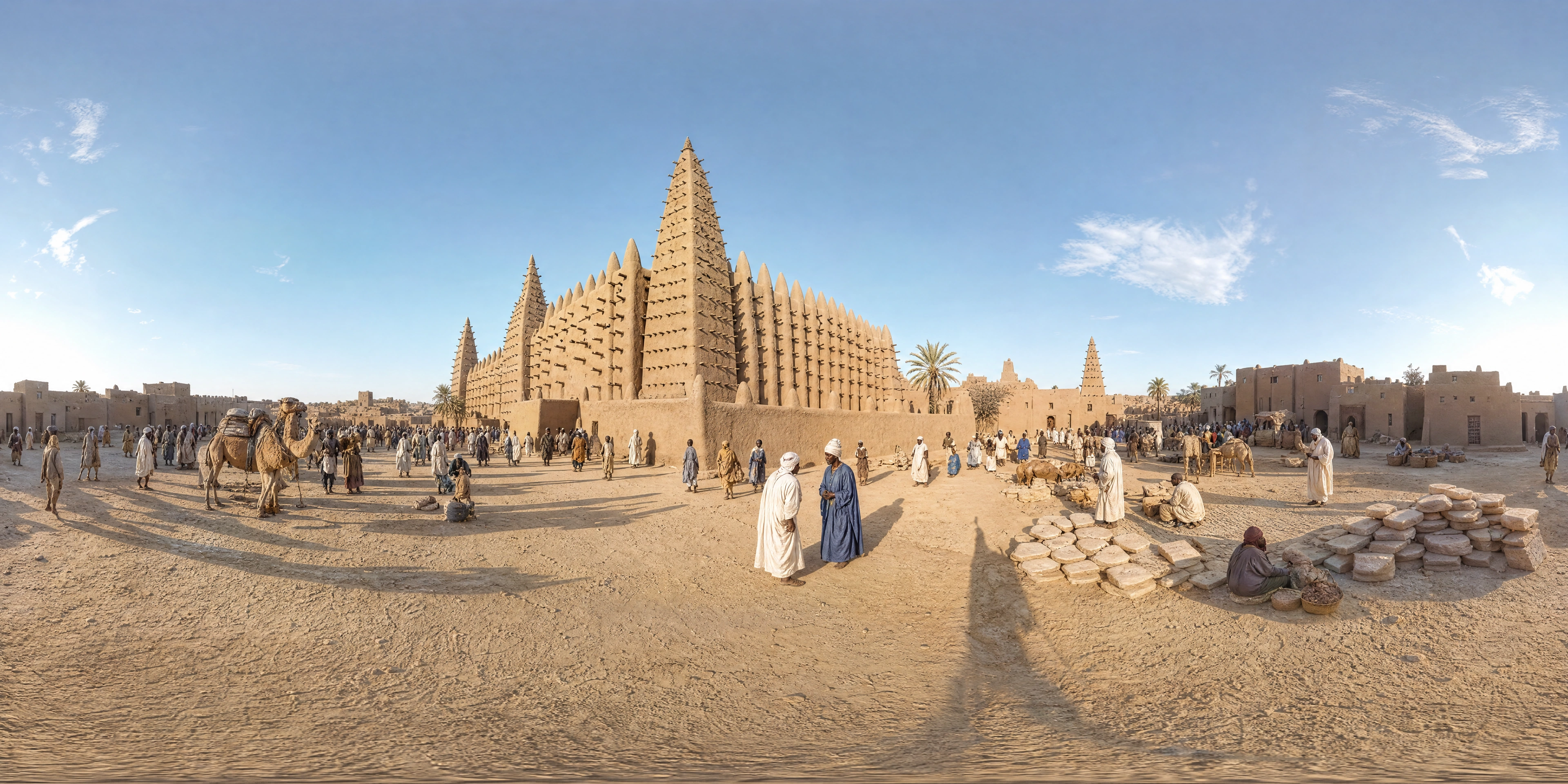
Around 1327, on the southern edge of the Sahara, the great mud-brick Djinguereber Mosque rises in Timbuktu, commissioned by Mansa Musa of Mali, whose gold and salt caravans and famous pilgrimage to Mecca made his empire a byword for wealth and learning.
- Year
- 1320s
- Where
- Tombouctou Region · ML
- Era
- Medieval
- Coordinates
- 16.773, -3.007
The moment
The richest man, and his city
In 1324 the ruler of the Mali Empire, Mansa Musa, set out across the Sahara on pilgrimage to Mecca with a famously vast entourage and a famously vast quantity of gold.
His spending in Cairo on the way, gifts and purchases on such a scale, is said to have depressed the value of gold in Egypt for years afterward. The story made Mali, and its desert trading city of Timbuktu, legendary across the medieval world, and put them on European maps: a century later a Catalan atlas drew Mansa Musa enthroned, holding a golden nugget.
On his return, around 1327, Mansa Musa set about building. The greatest result was the Djinguereber Mosque.
A cathedral of mud
The mosque is one of the masterpieces of Sudano-Sahelian architecture, and it is built, almost entirely, of earth.
Its walls are mud brick rendered in smooth earth plaster, its roof carried on rows of heavy pillars, its minaret a tapering pyramid. The most striking feature is the toron: bundles of palm-wood beams left permanently projecting from the walls. They are not decoration. Mud buildings must be re-plastered every year after the rains, and the toron are the built-in scaffold the whole community climbs to do it; the mosque is, in a sense, repaired by hand forever.
Tradition says it was designed by al-Sahili, a poet and architect Mansa Musa is supposed to have brought back from Arabia. Today historians are sceptical: the style is rooted in much older Saharan and West African building, and the foreign-genius story probably gives too little credit to local masons.
Gold one way, salt the other
Timbuktu existed because of two things that meet there: gold and salt.
Gold came up from the forest kingdoms to the south. Salt (essential, and scarce in the Sahel) came down from mines deep in the Sahara, at places like Taghaza, cut into great slabs and carried by camel caravan across the desert. In the markets of the Sahel the two were sometimes traded close to weight for weight. The caravans that crossed the sand also carried copper, cloth, and books, and the tolls on this trade are what made Mali, and its mansa, so rich.
A city of books
Timbuktu's deeper fame was not gold but learning.
Around its mosques (Djinguereber, Sankore, Sidi Yahya) grew one of the great centres of scholarship in the medieval Islamic world, sometimes called the University of Timbuktu. Students came to study the Qur'an, law, grammar, astronomy and medicine. The city accumulated tens of thousands of manuscripts, copied and traded and handed down in private family libraries.
Many survive. In 2012, when armed groups occupied the city and threatened to destroy them, residents and librarians smuggled hundreds of thousands of manuscripts out of Timbuktu to safety: a rescue, seven centuries on, of the thing the city was really built around.
Further reading
Tagged
- mali
- timbuktu
- mansa-musa
- trans-saharan
- islamic-scholarship
- sudano-sahelian
- west-africa
Published
See also

537
Hagia Sophia, Constantinople
On December 27, 537 AD, Emperor Justinian I dedicates the newly built Hagia Sophia in Constantinople: its 32-meter dome rising on pendentives in a structural feat that defines Byzantine architecture.

10th century AD
El Castillo, Chichén Itzá
Around 1000, El Castillo dominates the Maya city of Chichén Itzá: a four-sided step-pyramid to the feathered serpent Kukulcán with 365 stairs, built so that twice a year the equinox sun throws a serpent of shadow rippling down its edge.

1066
Senlac Hill (Battle), Sussex
On 14 October 1066, William of Normandy defeats King Harold Godwinson on Senlac Hill in Sussex: the last successful invasion of England, fought eight months after the year's other omen, the appearance of Halley's Comet.