Tiwanaku, Lake Titicaca
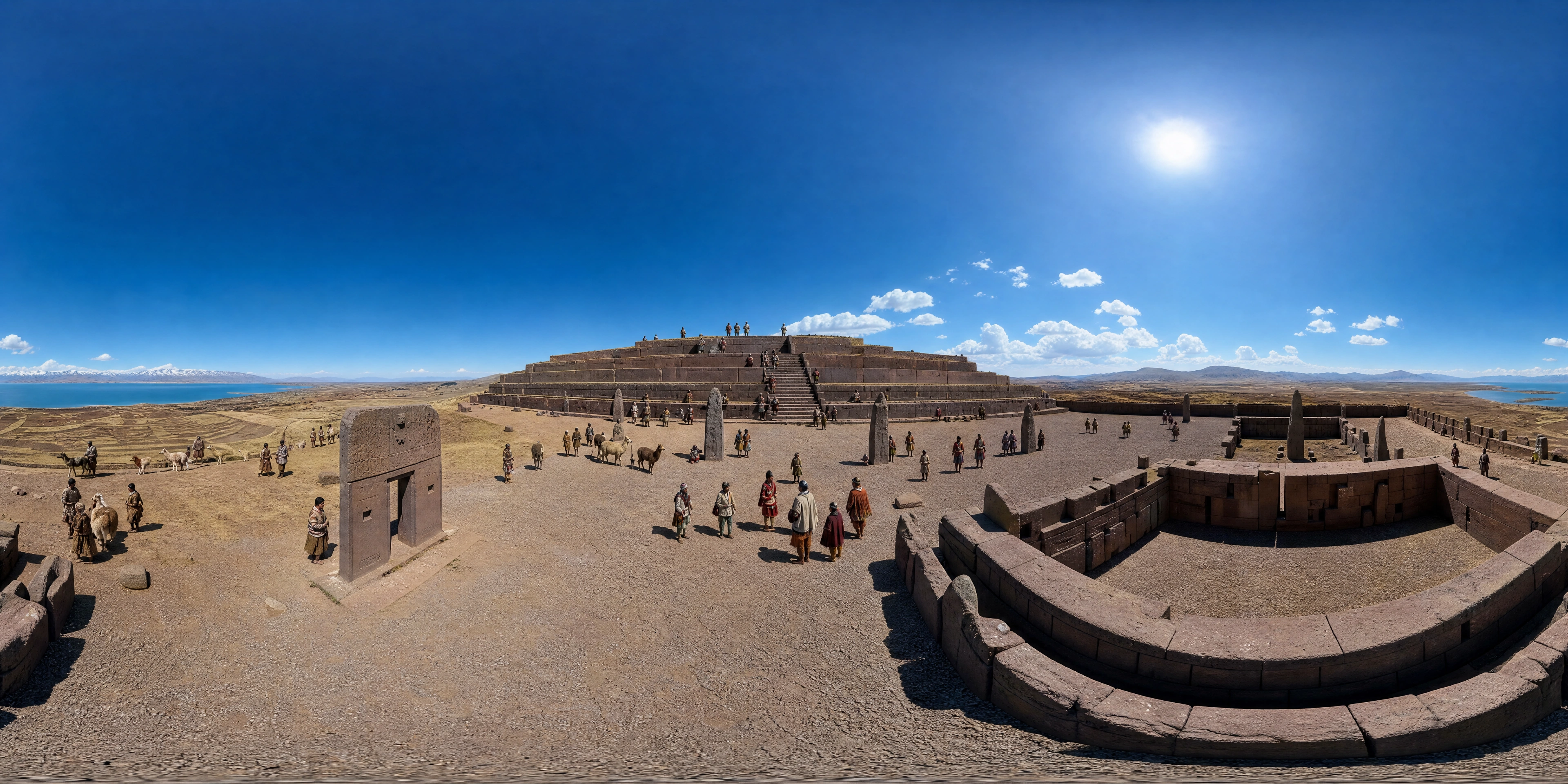
Around 800, on the high plain south of Lake Titicaca, Tiwanaku is the ceremonial heart of an Andean civilisation: precision-cut stone temples and a monolithic gateway carved from a single block, almost four kilometres above the sea, six centuries before the Inca and now utterly vanished.
- Year
- 8th century AD
- Where
- La Paz Department · BO
- Era
- Medieval
- Coordinates
- -16.555, -68.673
The moment
A city in the sky, before the Inca
Long before the Inca, a civilisation built monuments of cut stone on the bare Andean altiplano, almost four kilometres above sea level.
Tiwanaku, on the plain south of Lake Titicaca in what is now Bolivia, flourished from roughly AD 500 to 1000, reaching its height around 800 with a population estimated between 10,000 and 20,000 in the city, and more across its hinterland. It was the religious and political centre of a state whose influence reached across the southern Andes through colonies, llama caravans and a shared iconography, six hundred years before the Inca empire that would later claim Tiwanaku as the place where the creator god made humanity.
Farming the roof of the world
Almost four kilometres up, frost can strike on any night of the year. That Tiwanaku fed tens of thousands here at all is the deeper marvel.
Its farmers used suka kollus: raised planting beds separated by water channels. The channels stored the day's heat and released it at night, fending off frost, while the still water bred algae and fish that fertilised the beds. The system grew potatoes and quinoa on land that looks barren, and supported large herds of llama and alpaca for meat, wool and transport.
Stone cut like a key
Tiwanaku's masonry is its signature. Blocks were dressed flat and square and fitted together so closely that, at the Pumapunku complex, andesite and red sandstone were cut into repeating, almost interchangeable H-shaped modules, some locked with cast copper cramps poured into matching slots.
The precision is real, and it has a real explanation: skilled stoneworkers, hard hammerstones, abrasives, and long practice. It is worth saying plainly, because the very perfection of the cuts has made Pumapunku a magnet for "ancient aliens" speculation. There is no mystery requiring outsiders, only a sophisticated Andean civilisation that has been underestimated for centuries.
The single most famous monument is the Gate of the Sun, carved from one block of andesite, its lintel showing a central figure holding two staffs (often identified with the creator/sun deity later called Viracocha), flanked by forty-eight smaller winged attendants in a frieze that may also encode a calendar.
Why it vanished
Around AD 1000 the state began to fail. The clearest culprit is climate: ice cores and lake-sediment studies point to a long drought across the altiplano. As rainfall fell and the lake's edge retreated, the raised-field system that fed the city could no longer sustain it.
The population dispersed; the ceremonial centre was abandoned. By the time the Inca arrived centuries later, Tiwanaku was already an ancient ruin, which they wove into their own origin myth. Later still, treasure-hunters, a colonial church and a railway line all took stone from the site. What survives is enough to show a civilisation that thrived where almost nothing should, and then was gone.
Further reading
Tagged
- andes
- bolivia
- tiwanaku
- lake-titicaca
- lost-civilization
- pre-columbian
- altiplano
Published
See also

537
Hagia Sophia, Constantinople
On December 27, 537 AD, Emperor Justinian I dedicates the newly built Hagia Sophia in Constantinople: its 32-meter dome rising on pendentives in a structural feat that defines Byzantine architecture.

10th century AD
El Castillo, Chichén Itzá
Around 1000, El Castillo dominates the Maya city of Chichén Itzá: a four-sided step-pyramid to the feathered serpent Kukulcán with 365 stairs, built so that twice a year the equinox sun throws a serpent of shadow rippling down its edge.

1066
Senlac Hill (Battle), Sussex
On 14 October 1066, William of Normandy defeats King Harold Godwinson on Senlac Hill in Sussex: the last successful invasion of England, fought eight months after the year's other omen, the appearance of Halley's Comet.