Castle Rock of Trenčín (Laugaricio)
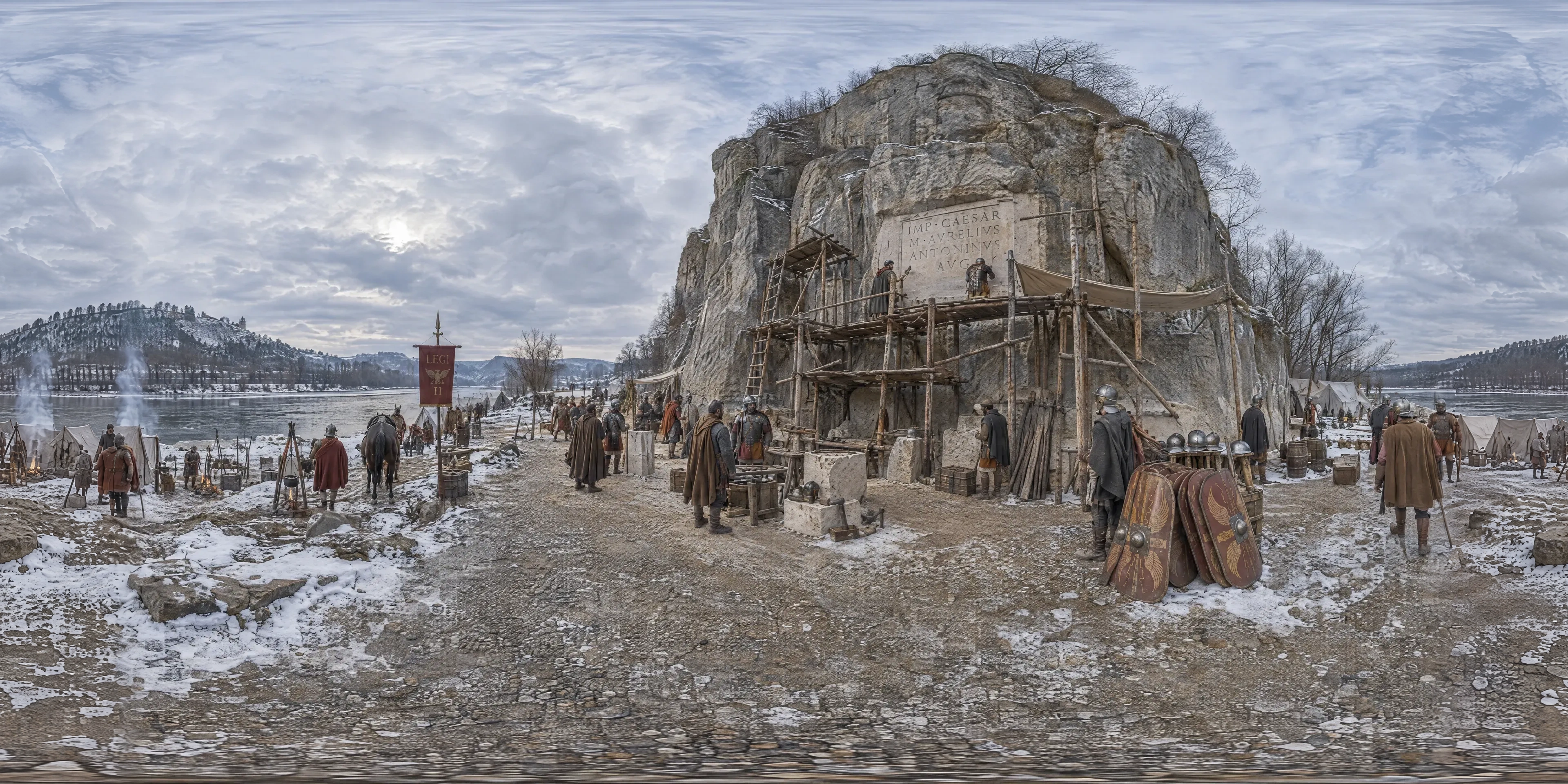
Winter of 179: soldiers of the Second Legion Adiutrix, wintering deep in the land of the Quadi at the end of the Marcomannic Wars, cut a dedication to the emperors' victory into the cliff above the Váh, naming their camp Laugaricio and their strength, 855 men. It is the most important Roman inscription in Central Europe north of the Danube still in its original place.
- Year
- 179
- Where
- Váh valley, Roman-era barbaricum north of the Danube · SK
- Era
- Classical antiquity
- Coordinates
- 48.896, 18.044
The moment
Six lines cut into the castle rock
In the winter of 179, soldiers of the Second Legion Adiutrix cut six lines of Latin into a sheer limestone cliff above the river Váh, where Trenčín now stands. The letters shrink line by line, and the message is short.
"To the victory of the emperors, the army stationed at Laugaricio, 855 soldiers of the Second Legion. Maximianus, legate of the Second Legion Adiutrix, had it made."
The emperors were Marcus Aurelius and his son Commodus, and the victory was over the Quadi, at the end of the Marcomannic Wars. It is the northernmost Roman inscription in Central Europe north of the Danube still in its original place.
Wintering in enemy country
The Danube was the frontier of the empire, and Trenčín lies far beyond it, in what was then the land of the Quadi. The 855 men were a detachment sent up the Váh valley from their legion's base at Aquincum, today's Budapest, and they spent the winter here.
Excavation in 2011 showed that the river then ran directly beneath the rock. The text sits about ten metres above the old water line, cut into a roughly smoothed rectangular panel.
Much of that winter is lost. The camp's exact site and appearance, the scaffolding, if there was any, and whether the letters were painted are all reconstruction; nobody recorded the weather that winter.
The general who signed it
The Maximianus of the last line is a well-known figure: Marcus Valerius Maximianus, born at Poetovio, today's Ptuj in Slovenia. In the Marcomannic Wars he killed Valao, chief of the Naristi, with his own hand, and Marcus Aurelius praised him publicly and gave him the chieftain's horse, decorations and weapons.
He went on to an almost unprecedented series of legionary commands, governed Numidia, and became consul around 186.
His career also rescued the inscription's reputation. The historian Theodor Mommsen doubted that the Trenčín text was genuine, until a statue base honouring Maximianus turned up at Diana Veteranorum in Algeria, naming his command at Laugaricio.
Proof that the legions came this far
The inscription on Trenčín's castle rock is the Roman monument every Slovak meets in history textbooks. It is proof, cut in stone, that the legions reached deep into today's Slovakia.
Almost everything around it came later. Trenčín Castle, with its Matúš Tower, rose on top of the rock about a thousand years afterwards, and the town grew up below.
Today the Hotel Elizabeth stands at the foot of the cliff, and a slender canopy shields the letters from rainwater. Eighteen centuries on, the legion's boast about 855 men is still legible where they left it.
Sources
Further reading
Tagged
- slovakia
- trencin
- roman
- antiquity
- marcomannic-wars
- inscription
- vah
- legion
Published
See also

193
Legionary Fortress of Carnuntum
On 9 April 193, twelve days after the murder of Emperor Pertinax in Rome, the Pannonian legions proclaim their governor Lucius Septimius Severus emperor at Carnuntum, capital of Upper Pannonia on the Danube frontier. He wins the civil war that follows, founds the Severan dynasty and raises Carnuntum to the rank of a colony.

79
Pompeii
On a late October afternoon in 79 AD, Mount Vesuvius unleashes a Plinian eruption that buries Pompeii under meters of pumice and ash within hours.

400s
Aksum
Around 400 AD, masons of King Ezana of Aksum raise a 24-meter granite stele carved to resemble a multi-story house: a monumental tradition unique to the Aksumite kingdom of Ethiopia.