Palatine Chapel of Charlemagne, Aachen
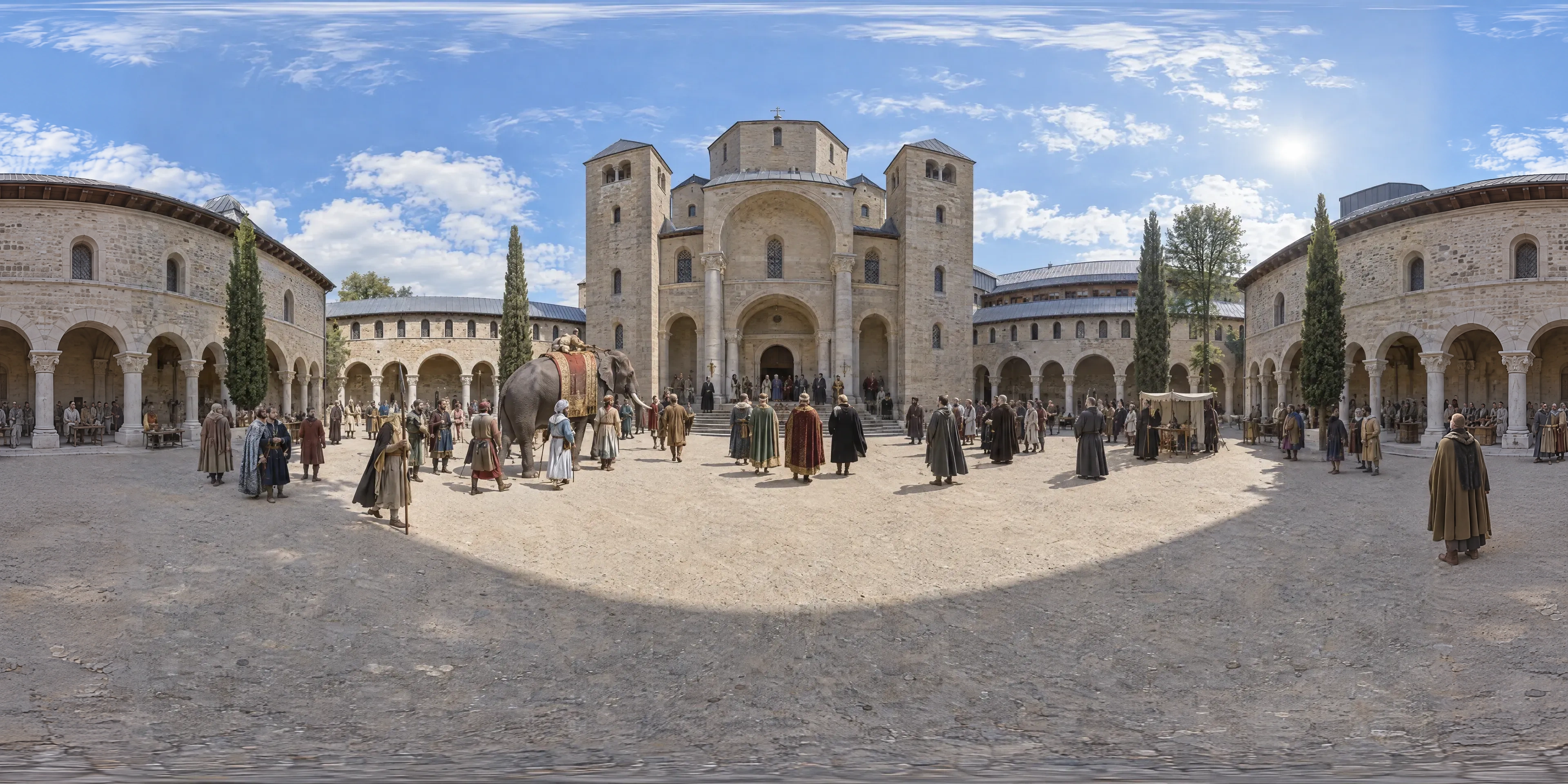
On 20 July 802 the envoy Isaac reaches Aachen with Abul Abbas, an elephant sent by Caliph Harun al-Rashid to Charlemagne, crowned emperor in Rome nineteen months earlier. The emperor's palace chapel, an octagon modelled on Ravenna's San Vitale and grander than any stone building north of the Alps, is all but finished.
- Year
- 802
- Where
- Rhineland, North Rhine-Westphalia · DE
- Era
- Medieval
- Coordinates
- 50.775, 6.083
The moment
An elephant crossed the Alps
On 20 July 802 a Jewish envoy named Isaac reached Aachen with a gift for Charlemagne from Harun al-Rashid, the caliph in Baghdad: an elephant. The Royal Frankish Annals, the court's own chronicle, give its name as Abul Abbas.
Isaac had set out as one of three envoys, with Lantfrid and Sigimund. Only he came back. He travelled through North Africa with the animal, landed at Porto Venere near Genoa in October 801, spent the winter in Vercelli and crossed the Alps in the spring.
The annals say he brought everything to the emperor at Aachen. They do not say where the handover took place, and picturing it in the forecourt of the palace chapel is a plausible staging, not a recorded scene.
Abul Abbas lived eight more years. In 810, travelling with a campaign against the Danes, he died suddenly at a place called Lippeham, near the Rhine.
A church from Ravenna
Charlemagne had been crowned emperor in Rome nineteen months before, on Christmas Day 800, and Aachen was his capital. At its heart stood his palace chapel, credited to Odo of Metz.
It was an octagon modelled on San Vitale in Ravenna, about 31 metres high and wrapped in a sixteen-sided ambulatory. Its rubble-stone walls were plain outside except for pilaster strips, and for more than two hundred years nothing north of the Alps matched its span and height.
In front lay an atrium about 42 metres long and 28 wide, lined with two-storey arcades, and a tall westwork with a great niche above the entrance. A long two-storey gallery ran north to the royal hall.
Consecrated three days earlier, perhaps
The date of the dedication is not secure. The one usually assumed is 17 July 802, three days before the elephant arrived. The tradition of a consecration by Pope Leo III in 805 goes back to a legend of the fourteenth century.
Most of what surrounds the octagon today came later: the Gothic choir hall of 1355 to 1414, the ring of side chapels, the Baroque roof on the dome and the neo-Gothic west tower of 1879 to 1884.
Six hundred years of German kings
Charlemagne was buried in his chapel in 814. From Otto I in 936 until 1531, some thirty German kings were crowned here and took their seat on his marble throne.
He belongs to two nations. Germans call him Karl der Große and the French Charlemagne, and both claim him as a founder, though his Frankish empire came before either country existed. He is often called the father of Europe.
In 1978 Aachen Cathedral became the first German monument on UNESCO's World Heritage List, one of the first twelve sites anywhere. For Germans it is the founding monument of their history: for six centuries, becoming king usually meant coming to one man's octagon.
Sources
Further reading
Tagged
- germany
- aachen
- charlemagne
- carolingian
- early-medieval
- palatine-chapel
- abul-abbas
- unesco
Published
See also

960s
Malá Strana below Prague Castle
Around 965 the traveller Ibrahim ibn Yaqub finds Prague the richest trading place of the region: Rus and Slav merchants from Kraków and Muslim and Jewish traders from the east meet in the settlement below the Přemyslid castle, where saddles, bridles and shields are made and slaves, tin and furs are sold.

1250s
Cliff Palace, Mesa Verde
Around 1250, the Ancestral Puebloans build Cliff Palace into a sandstone alcove high in a Colorado canyon wall: over a hundred and fifty rooms and two dozen round ceremonial kivas tucked beneath an overhang, the largest cliff dwelling in North America.

12th century AD
Kealakekua / Big Island, Hawaii
Around 1200 AD, a Polynesian double-hulled voyaging canoe from the Marquesas Islands makes landfall on the unpopulated Big Island of Hawaii after navigating 4,000 km of open Pacific.