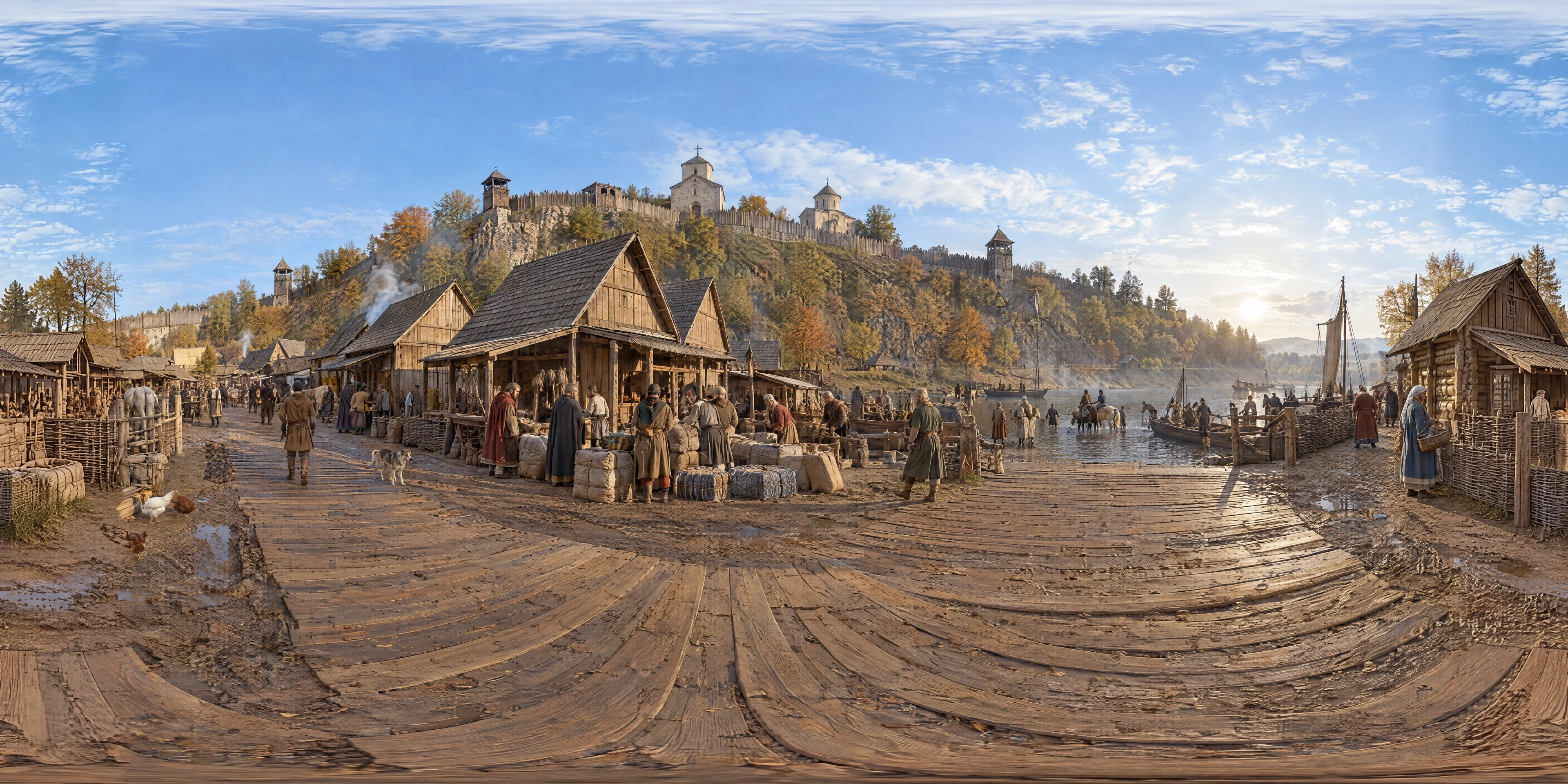
Malá Strana below Prague Castle
Around 965 the traveller Ibrahim ibn Yaqub finds Prague the richest trading place of the region: Rus and Slav merchants from Kraków and Muslim and Jewish traders from the east meet in the settlement below the Přemyslid castle, where saddles, bridles and shields are made and slaves, tin and furs are sold.
- Year
- 960s
- Where
- Bohemia · CZ
- Era
- Medieval
- Coordinates
- 50.087, 14.406
The moment
The first description of Prague came from Spain
The oldest written account of Prague was left by Ibrahim ibn Yaqub, a traveller from Tortosa, near the mouth of the Ebro in Umayyad Spain. He came from a Jewish background; whether he was a practising Jew or a Muslim of Jewish origin is still debated.
He crossed Central Europe on behalf of the caliph of Córdoba, al-Hakam II, and met the emperor Otto I. The journey is dated either to 961 or to 965 or 966. His own book is lost, and what survives are excerpts copied by later writers, above all the eleventh-century geographer al-Bakri.
Ten cloth kerchiefs to a denarius
Ibrahim called Prague a city "built of stone and lime" and the greatest place of trade in the region. Rus merchants came there, and Slavs from Kraków, and Muslim, Jewish and Turkic traders from the east.
They bought enslaved people, tin and furs. Local craftsmen made saddles, bridles and shields.
Money, he noted, came partly in cloth: small, light kerchiefs, ten to a denarius. A denarius bought enough grain to feed a person for a month, or ten hens. He named the ruler as Boleslav I, lord of Prague, of Bohemia and of Kraków.
Stone and lime, or timber
Archaeology does not quite agree with him. Excavations below the castle find timber buildings: houses with clay-daubed walls and steep roofs, workshops, fenced yards.
The main road of the trading settlement ran down to the river along the line of today's Mostecká street in the Lesser Town, and it was laid in timber, up to 20 metres wide. There was no bridge: the Vltava was crossed by ford and by boat, and the first stone bridge came two centuries later.
Above the settlement, on its long rocky ridge, the Přemyslid castle was earth ramparts topped with palisades and wooden towers, three of them serving as gates. Its only stone buildings were three small churches: the Virgin Mary, St George, and Duke Wenceslas's round rotunda of St Vitus, which held his relics. The ducal hall itself was wooden.
Why Czech schoolbooks quote him
Ibrahim's line about stone and lime is a fixture of Czech schoolbooks. It is the first time anyone describes the city at all, and it catches the young Přemyslid state at a commercial height, a place where Kraków merchants and a visitor from al-Andalus crossed paths.
Some of it is still uncertain. The exact site of the market is unproven, and the stone city he describes has never been found.
Some of it is hard reading. The same passage lists enslaved people among the goods on sale, next to the tin and the furs, and the first portrait of Prague is also a record of that trade.
Sources
Further reading
Tagged
- czechia
- prague
- bohemia
- premyslids
- early-medieval
- trade
- prague-castle
- everyday-life
Published
See also

1357
Charles Bridge, Prague
In 1357 Emperor Charles IV lays the foundation stone of a new stone bridge on the Old Town bank near St Clement's, fifteen years after ice and floodwater wrecked the Judith Bridge. Tradition sets the moment at 5:31 on 9 July, a palindrome of odd numbers; the bridge will take 45 years to finish.

1410
Old Town Square, Prague
On 9 October 1410 the Old Town councillors reward the clockmaker Mikuláš of Kadaň for the astronomical dial he has built on the town hall tower, the heart of today's Prague orloj. Below it the market square trades as usual in the year Wycliffe's books are burned in Prague and Jan Hus is excommunicated.

1881
National Theatre, Prague
On the afternoon of 12 August 1881, two months after its opening, the National Theatre, built over thirteen years from the pennies of a whole nation, catches fire and loses its copper dome, auditorium and stage. Within 47 days the Czechs collect a million gulden to rebuild it, and it reopens in 1883.