Bayon temple, Angkor Thom
Around 1200 AD, a royal procession of the Khmer king Jayavarman VII winds through the Bayon temple at the heart of Angkor Thom, surrounded by the smiling stone faces that crown its 54 towers.
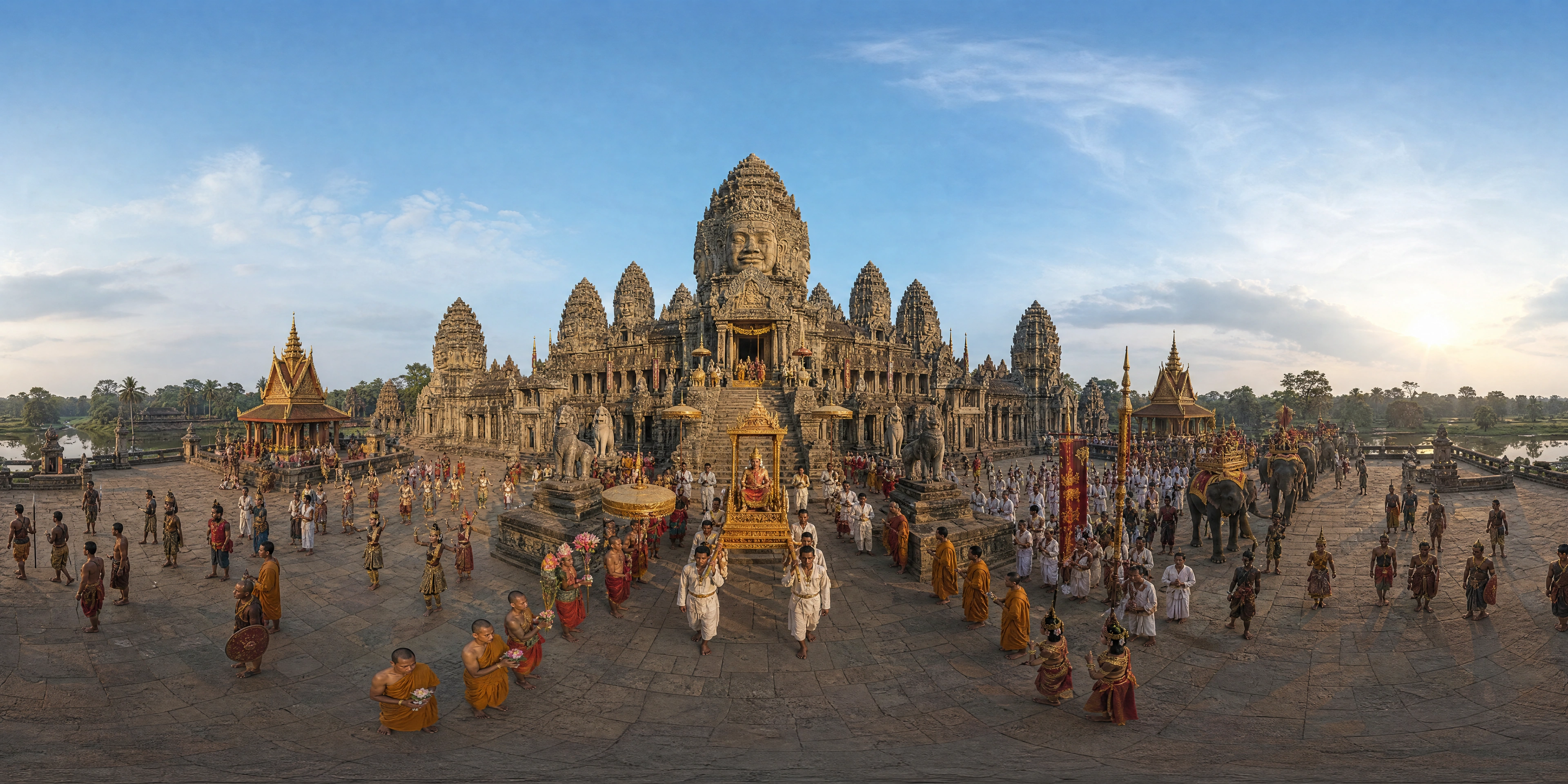
- Year
- 1200s
- Where
- Angkor, Khmer Empire · KH
- Era
- Medieval
- Coordinates
- 13.441, 103.859
The moment
A temple full of faces
The Bayon, at the geographic centre of Angkor Thom (the walled royal city built by King Jayavarman VII around 1190), is unmistakable for one reason.
Its towers are carved with massive serene smiling stone faces, identical and repeated, gazing outward in all four directions.
Fifty-four towers in total. Over two hundred faces. Each face is between two and four metres tall, with broad lips, almond eyes, and the slightest hint of a smile: the kind of half-smile that the French art historian Henri Marchal called le sourire d'Angkor, the Angkor smile.
Who is the face?
Two answers compete.
The orthodox interpretation, favoured by most art historians, is that the face is Avalokiteshvara, the bodhisattva of compassion in Mahayana Buddhism, the deity Jayavarman VII personally adopted as his protector.
The alternative is that the face is Jayavarman VII himself, with the bodhisattva identification added as theological cover for a colossal sequence of royal portraits.
The two readings are not mutually exclusive. In the Khmer devaraja tradition, the king was understood as a divine incarnation.
The most prolific Khmer king
Jayavarman VII took the Khmer throne around 1181 at age 56 and ruled for almost forty years.
In addition to the Bayon, he built the city wall of Angkor Thom (12 kilometres of laterite blocks), the temples of Ta Prohm, Preah Khan, and Banteay Kdei, 102 royal hospitals across the empire, over a hundred rest-houses for travelling pilgrims, and an extensive system of laterite-paved roads.
His building programme was the largest of any Khmer king.
Three religions in two centuries
Jayavarman VII was the only major Khmer king to be a devout Mahayana Buddhist. His predecessors and successors were Hindus. The Bayon was built as a Mahayana temple.
Within a generation of Jayavarman's death his successor Jayavarman VIII systematically defaced the Buddhist imagery. Thousands of carved Buddha figures in niches around the Bayon were chiselled out and the niches recarved as Hindu lingams.
When Khmer royal patronage shifted again to Theravada Buddhism in the late thirteenth century, the Bayon was once more converted. The building's complex layered iconography reflects three religions in two centuries.
Further reading
Tagged
- khmer
- angkor
- bayon
- jayavarman-vii
- buddhist
- southeast-asia
Published
See also

1150s
Angkor Wat at dawn
Around 1150, Angkor Wat is newly finished: the largest religious monument ever built, five lotus-bud towers rising beyond a vast moat in the Khmer capital, a temple-mountain to the god Vishnu that still draws crowds to its dawn today.

537
Hagia Sophia, Constantinople
On December 27, 537 AD, Emperor Justinian I dedicates the newly built Hagia Sophia in Constantinople: its 32-meter dome rising on pendentives in a structural feat that defines Byzantine architecture.

10th century AD
El Castillo, Chichén Itzá
Around 1000, El Castillo dominates the Maya city of Chichén Itzá: a four-sided step-pyramid to the feathered serpent Kukulcán with 365 stairs, built so that twice a year the equinox sun throws a serpent of shadow rippling down its edge.