Roman Civil Town of Aquincum
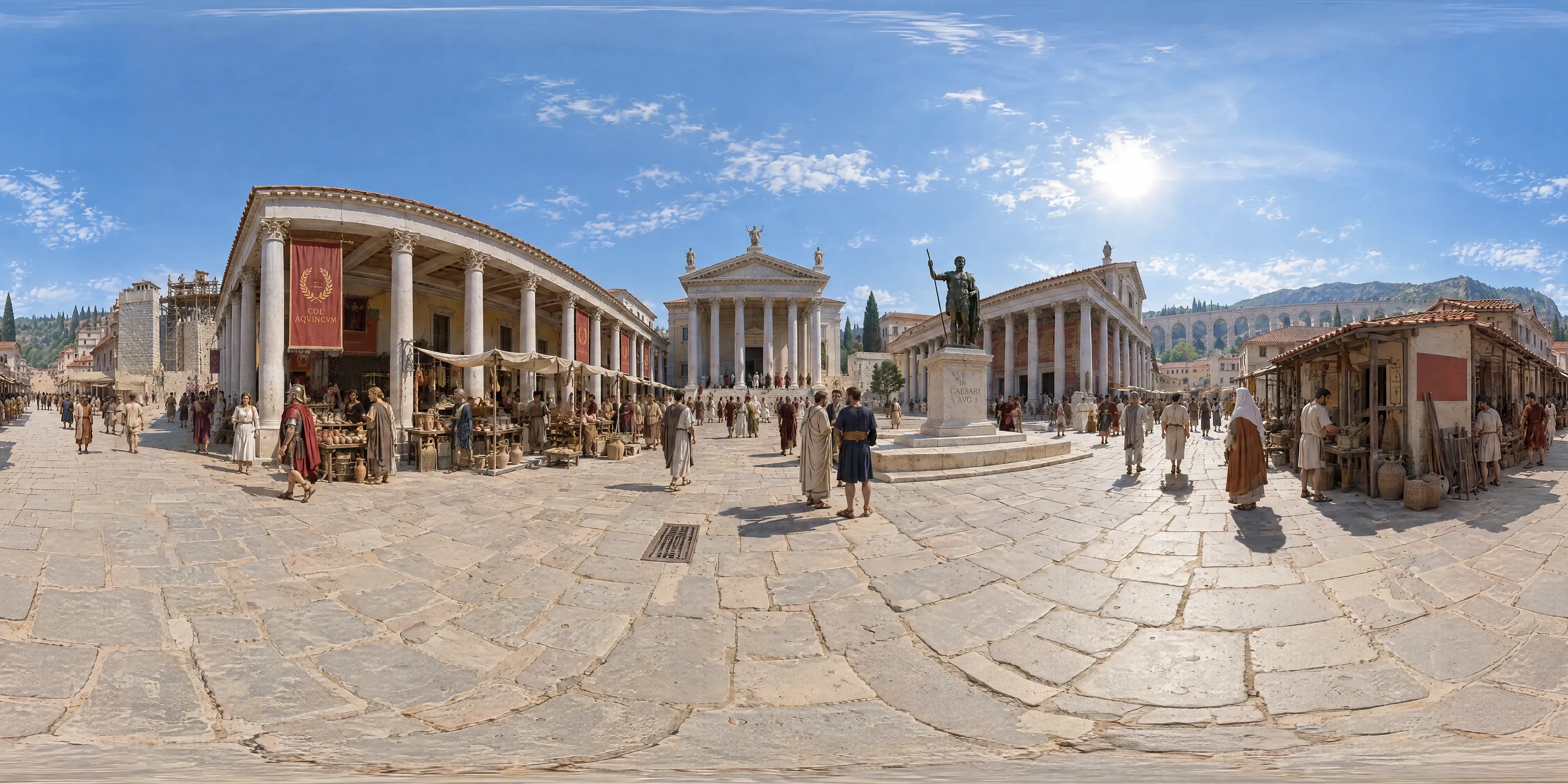
Around AD 200, a few years after Septimius Severus raised it to a colonia, the civil town of Aquincum on the Danube frontier is heading for its heyday of 10,000 to 12,000 people. It has a forum with a podium temple, public baths and a market hall fed by spring water carried on stone arches, and lies just north of the legionary fortress guarding Pannonia Inferior.
- Year
- 200s
- Where
- Pannonia Inferior · HU
- Era
- Classical antiquity
- Coordinates
- 47.564, 19.049
The moment
A colonia beside a legion
Around AD 200 the civil town of Aquincum stood on the right bank of the Danube, in what is now Óbuda, the northern district of Budapest. Just to the south lay the fortress of the Second Legion Adiutrix, stationed on this stretch of the frontier since the late first century.
The town had climbed the ranks quickly. Hadrian made it a municipium in 124, and in 194 Septimius Severus raised it to a colonia. Aquincum was also the seat of the governor of Pannonia Inferior. Early in the third century the civil town reached its peak, with 10,000 to 12,000 people.
Not everyone in the town was an incomer. The local Eravisci were Celts, and their women kept a dress of their own: tall, turban-like headdresses, woollen overgarments pinned at the shoulders with large winged brooches, and thick twisted torques. Other women wore the Roman tunic and palla.
Spring water on stone arches
The two main streets met at the forum, paved with dressed stone. Its podium temple honoured the Capitoline Triad of Jupiter, Juno and Minerva, and the council house and basilica beside it were rebuilt with a Corinthian portico.
Along the main north-south street stood the great public baths. South of them was the macellum, the market hall: a colonnaded court of shops around a small round building with half-columns. Spring water came in from the north along the arches of an aqueduct.
The craftsmen's quarter was tightly packed. Its houses measured about 15 by 17 metres, with shops at the front and workshops behind, and wagon wheels cut ruts into the street. In the colonia years a stone wall with rectangular towers about 90 metres apart began to rise around the town. How far it had got by 200 is not known.
An organ for the fire brigade
The town's most famous find belongs to the next generation. In AD 228 Gaius Julius Viatorinus, an official of the civil town, gave a portable organ to the guild of textile dealers, who also served as Aquincum's firefighters. Their hall stood inside the walls, by the south gate.
In the middle of the third century a fire destroyed the hall, and the organ fell into the cellar beneath it. It lay under the rubble until 1931, when foundation work for an electricity converter station turned up nearly 400 of its pieces, whole and broken.
Where Budapest's story starts
For Hungarians, Aquincum is the opening chapter of the capital's history, the Roman ancestor of Budapest. Excavation began in 1875. Today the ruin field of the civil town, with its streets, baths and market hall laid bare, is a staple of school trips, and a working replica of the organ stands in the Aquincum Museum.
The town itself faded out. By the fifth century the civil town was deserted, its people gone to the settlement around the fortress or deeper into the province. What remains is its plan in stone, a Roman street grid beside the traffic of Szentendrei út in modern Óbuda.
Sources
Further reading
Tagged
- hungary
- budapest
- aquincum
- pannonia
- roman-empire
- antiquity
- danube
- everyday-life
Published
See also

193
Legionary Fortress of Carnuntum
On 9 April 193, twelve days after the murder of Emperor Pertinax in Rome, the Pannonian legions proclaim their governor Lucius Septimius Severus emperor at Carnuntum, capital of Upper Pannonia on the Danube frontier. He wins the civil war that follows, founds the Severan dynasty and raises Carnuntum to the rank of a colony.

310s
Porta Nigra, Trier
Around 310, while Constantine the Great holds court in Trier and raises a vast palace hall, the city's monumental north gate has already stood for 140 years, never quite finished. Augusta Treverorum is now one of the capitals of the Roman West and seat of the praetorian prefect of the Gauls.

79
Pompeii
On a late October afternoon in 79 AD, Mount Vesuvius unleashes a Plinian eruption that buries Pompeii under meters of pumice and ash within hours.