Arch of Constantine, Rome
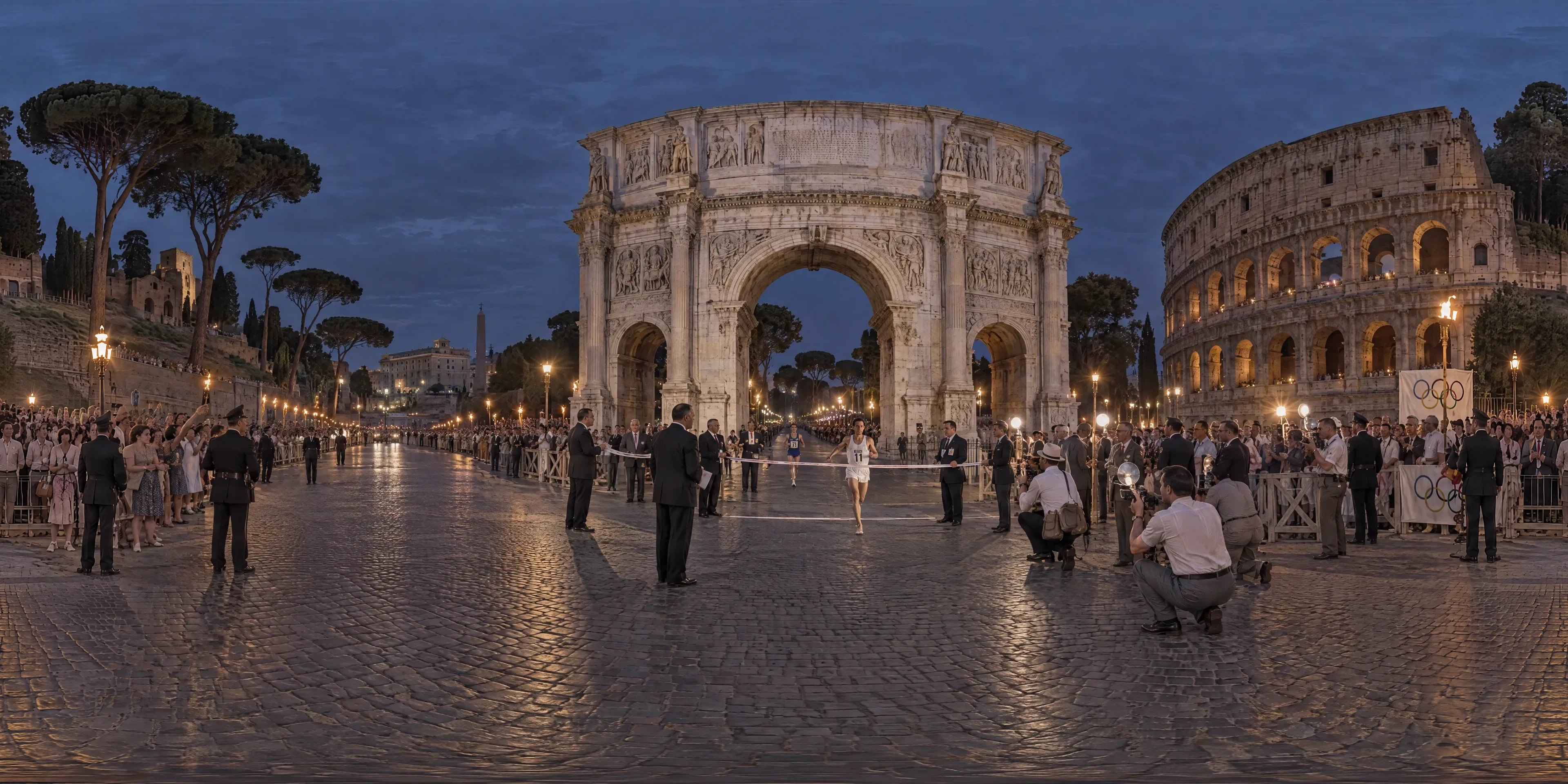
At about 7.45 pm on 10 September 1960, after running the Appian Way barefoot between torches held by Italian soldiers, Ethiopia's Abebe Bikila breaks the tape under the Arch of Constantine in a world-best time. Rome's first Olympics showed off an Italy reborn after the war, and Bikila won in the capital of the country that had invaded his own.
- Year
- 1960
- Where
- Lazio · IT
- Era
- modern_postwar
- Coordinates
- 41.889, 12.491
The moment
A marathon that finished in the dark
The Olympic marathon in Rome on 10 September 1960 was run into the night. Along the Appian Way the runners passed between torches held by Italian soldiers, and the finish lay under the Arch of Constantine, beside the Colosseum.
At about a quarter to eight in the evening, more than an hour after sunset, a slight runner wearing number 11 broke the tape: Abebe Bikila of Ethiopia, in 2 hours 15 minutes 16.2 seconds, a world best. Rhadi Ben Abdesselam of Morocco came in 25 seconds behind.
Bikila had run the whole distance barefoot.
Why he ran without shoes
He had bought new running shoes, but they did not fit and gave him blisters, so he raced without them. It was a practical decision.
Bikila was born on 7 August 1932 in Jato, in the Shewa region of Ethiopia, which made him 28 on the night he won. He served in the Imperial Guard, and a Swedish coach employed by the Ethiopian government, Onni Niskanen, noticed him on daily training runs and prepared him for the marathon.
The obelisk on the route
The course passed a monument with a painful history. At Porta Capena stood the 24-metre Obelisk of Axum, taken from Ethiopia by Fascist Italy in 1937 and set up in front of the building of the Ministry of Italian Africa.
The leading runners passed it twice, and near it, on the second pass, Bikila made his decisive move. He won in the capital of the country that had invaded his own.
The obelisk went home to Ethiopia in 2005.
A victory for two countries
For Ethiopia it was the first Olympic gold, and Bikila was the first Black African Olympic champion in an individual event. Four years later, in Tokyo, he won again, this time in shoes, in a world-best 2:12:11.2, only weeks after an appendectomy.
His life ended early. A car accident on 22 March 1969 left him paralysed, and he died on 25 October 1973.
For Italy, the 1960 Games were the showcase of a country remaking itself in its post-war economic miracle, and Bikila's barefoot finish under a triumphal arch is still their best-known picture. The arch had been raised for a Roman emperor; that night it framed the victory of an Ethiopian soldier running on bare feet.
Sources
Further reading
Tagged
- italy
- rome
- olympics
- 1960
- marathon
- ethiopia
- arch-of-constantine
- colosseum
Published
See also

1966
Piazza Santa Croce, Florence
On 5 November 1966, the morning after the Arno burst into Florence, Piazza Santa Croce lies under a crust of mud and heating oil, wrecked cars are heaped against the palaces and Dante's statue stands smeared to its pedestal as residents and the first volunteers begin to dig. The flood ravaged thousands of artworks and books, and the young 'angeli del fango' who came to save them became a national legend.

1989
Brandenburg Gate, Berlin
On the night of November 9–10, 1989, East and West Berliners climb the Berlin Wall in front of the Brandenburg Gate, chipping at the concrete with hammers and dancing on top: the symbolic collapse of the Iron Curtain.

1979
Victory Square, Warsaw
On the afternoon of Saturday 2 June 1979, on his first visit home as pope, John Paul II says Mass for about half a million people on Victory Square in communist Warsaw and prays that the Holy Spirit will renew the face of the earth, adding "this land". The words are remembered as the spark of the Solidarity movement.