Victory Square, Warsaw
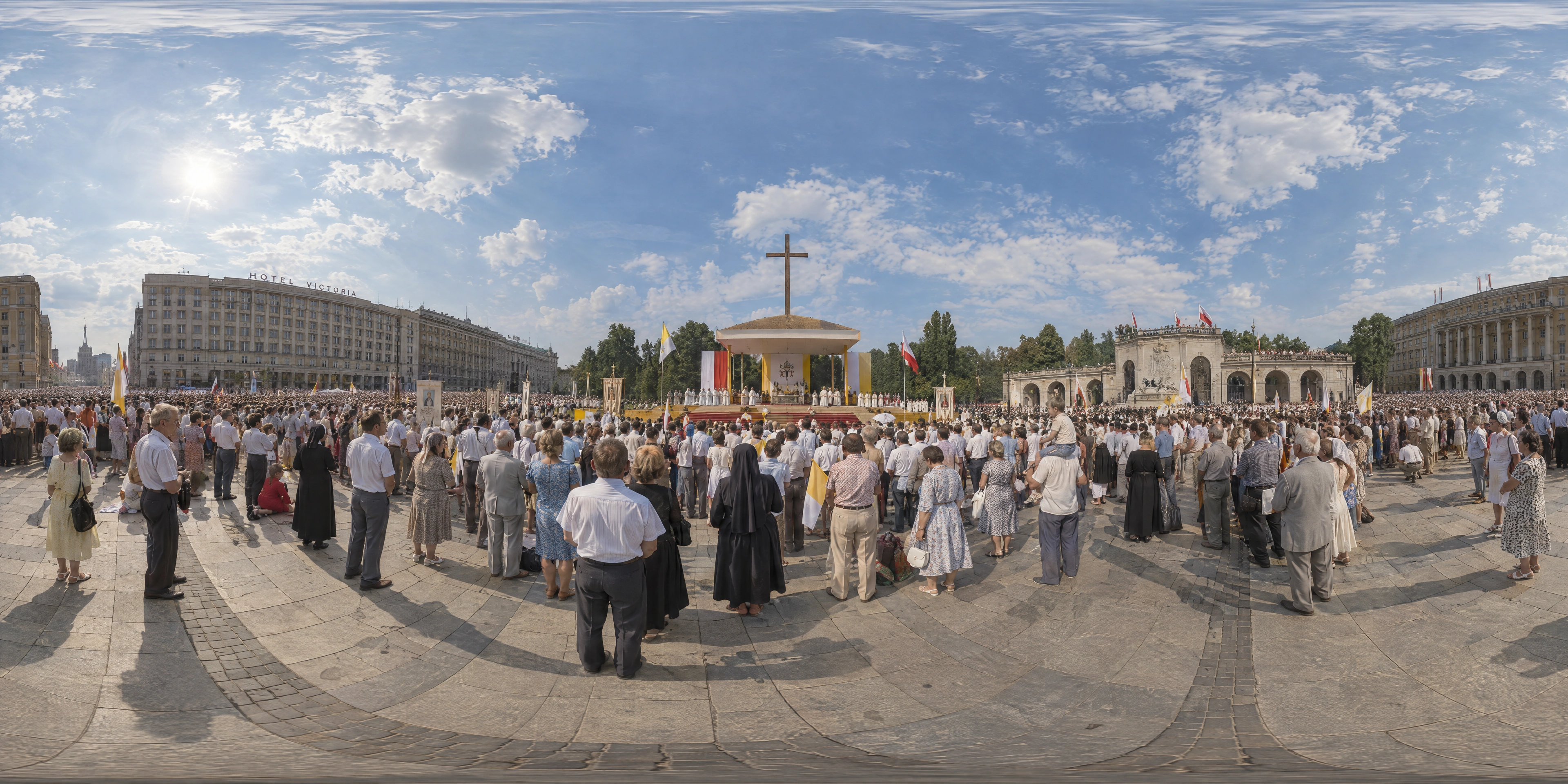
On the afternoon of Saturday 2 June 1979, on his first visit home as pope, John Paul II says Mass for about half a million people on Victory Square in communist Warsaw and prays that the Holy Spirit will renew the face of the earth, adding "this land". The words are remembered as the spark of the Solidarity movement.
- Year
- 1979
- Where
- Masovia · PL
- Era
- modern_postwar
- Coordinates
- 52.241, 21.012
The moment
Brezhnev advised against letting him in
The communist authorities dreaded the visit. They expected a Polish pope to stir up Poles' hopes of freedom, and the timing, planned around the 900th anniversary of the martyrdom of St Stanislaus, worried them most. The Soviet leader Leonid Brezhnev suggested keeping John Paul II out of Poland altogether.
The party leader, Edward Gierek, would not refuse. Brezhnev gave way with a warning: do as you think best, as long as you and your party do not regret it later.
An open car and half a million people
The pope's plane landed at Warsaw's Okęcie airport at 10:07 on Saturday 2 June 1979, the eve of Pentecost. After the official welcome he visited the cathedral and then Gierek at the Belweder palace.
In the afternoon he rode in an open car through cheering crowds to Victory Square, the great paved square in the city centre. About half a million people filled it to the edges.
At its eastern end stood the altar and a tall wooden cross, beside the long front of the rebuilt Hotel Europejski. At the western end, the surviving arcades of the destroyed Saxon Palace framed the Tomb of the Unknown Soldier. To the north ran the rebuilt Grand Theatre and, at the north-west corner, the new slab of the Hotel Victoria of 1976.
Two words added to a prayer
The homily built to a single appeal. Speaking "as a son of Polish land" and as pope, on the eve of Pentecost, he called out: "Let your Spirit descend. Let your Spirit descend and renew the face of the earth." Then he added two more words: "This land."
In Polish the same word, ziemia, means both earth and land. A year later those last two sentences became one of the first slogans of Solidarity.
The authorities had tried to keep the crowds down. The security service intercepted and destroyed tickets for the papal Masses in Warsaw and Kraków, and in Kraków alone it used 480 secret informers, several dozen of them clergy. The pilgrimage went on for nine days, to Gniezno, Częstochowa, Kraków, Wadowice, Auschwitz-Birkenau and Nowy Targ.
Why Poles still quote one sentence
For Poles, the election of a Polish pope ranks among the defining events of the last century; in a 2018 CBOS poll, 15 per cent named it the most important. His Warsaw homily is quoted in every history of the fall of communism, and in Poland religious and political memory remain intertwined.
The cross did not stay. The authorities removed it soon after the Mass; it was taken first to St Anne's church and then, with the altar, to a new parish in the Służewiec district. The square was renamed Piłsudski Square in 1990, and since 2009 a permanent papal cross has stood there.
How tall the 1979 cross was is not settled: sources give anything from 9 to 15 metres. The design of the altar and the weather that afternoon are not reliably recorded.
Sources
Further reading
Tagged
- poland
- warsaw
- john-paul-ii
- papal-mass
- communism
- 1979
- solidarity
- 20th-century
Published
See also

1944
PAST Building, Warsaw
On the morning of 20 August 1944, after a night assault that began at 2:30, Home Army soldiers of the Kiliński Battalion take the PAST telephone exchange, the German stronghold in central Warsaw, setting it ablaze with improvised flamethrowers from fire pumps and capturing over a hundred Germans. The white-and-red flag goes up over the burning tower.

1956
Stalin Monument, Budapest
On the evening of 23 October 1956, the first day of the Hungarian Revolution, a huge crowd pulls down the eight-metre bronze Stalin on Stalin Square in Budapest: after hours of work with cables, lorries and cutting torches it falls at 21:37, leaving only the boots on the tribune. It is the revolution's first common act and becomes its emblem.

1955
Upper Belvedere, Vienna
Around noon on Sunday 15 May 1955, just after the State Treaty is signed in the Marble Hall of the Upper Belvedere, Foreign Minister Leopold Figl steps onto the balcony with the Allied foreign ministers and holds up the signed treaty to the crowd waiting in the palace garden. After ten years of occupation, Austria is free.