Piazza Santa Croce, Florence
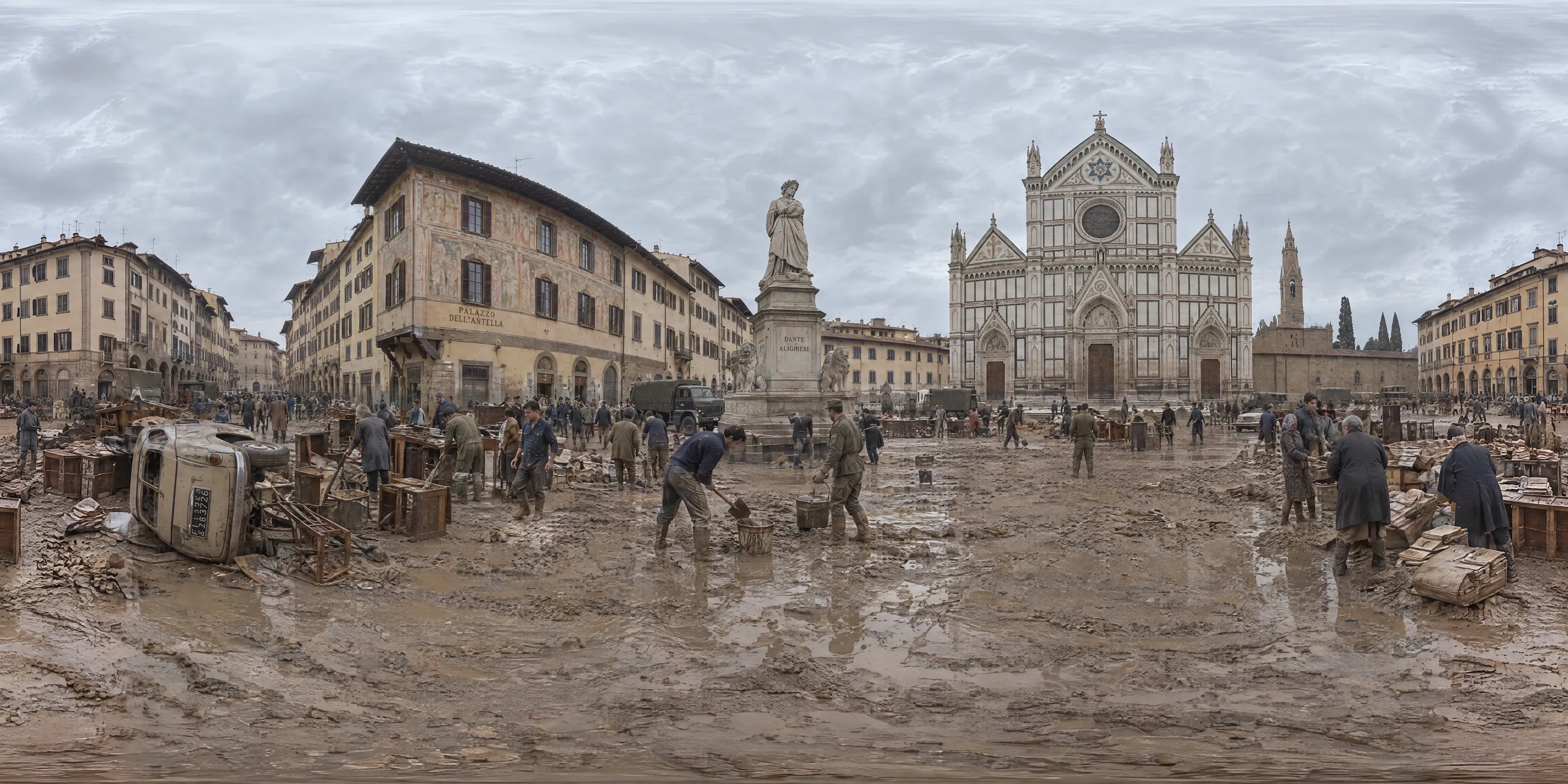
On 5 November 1966, the morning after the Arno burst into Florence, Piazza Santa Croce lies under a crust of mud and heating oil, wrecked cars are heaped against the palaces and Dante's statue stands smeared to its pedestal as residents and the first volunteers begin to dig. The flood ravaged thousands of artworks and books, and the young 'angeli del fango' who came to save them became a national legend.
- Year
- 1966
- Where
- Tuscany · IT
- Era
- modern_postwar
- Coordinates
- 43.769, 11.260
The moment
The river came in before dawn
On 4 November 1966 the Arno broke into Florence. The water reached the outskirts at about four in the morning, and by a quarter to ten the Piazza del Duomo was under water.
The Santa Croce district was hit hardest. There the water rose more than six metres.
It was not only water. The flood burst the tanks of the city's central heating systems, and the oil mixed with the water and the mud, staining everything it touched.
The morning after in Piazza Santa Croce
By the morning of 5 November the water had drained from the square and left a crust of mud, oil and debris behind. Wrecked cars lay heaped against the palaces, and sodden furniture, timber and mattresses were strewn across the ground.
In the middle of the square stood Enrico Pazzi's marble statue of Dante, put up in 1865, smeared with mud and oil to its pedestal; it was moved to the church steps only between 1968 and 1971. Behind it rose the white, green and pink marble neo-Gothic façade of Santa Croce, completed in the 1860s, with a dark line of oil across its lower stones.
How deep the mud lay, which cars stood where, and the exact height of the oil line are not recorded. Residents and the first volunteers began to dig.
Books, paintings and a crucifix
The cultural losses ran into the millions. At the National Central Library about 1,300,000 items, a third of its holdings, were damaged, and across the city some three to four million books and manuscripts were affected.
Thousands of works of art were soaked in mud and oil. The most famous casualty belonged to Santa Croce itself: the great painted Crucifix by Cimabue, whose restoration took ten years and made it a symbol of the flood.
Help came from abroad as well as from Italy. The Committee to Rescue Italian Art alone raised about 2.5 million dollars for the work.
The mud angels
The people remembered most are the volunteers. Young people from Italy and abroad came to Florence unpaid to pull books and paintings out of the mud, and they became known as the angeli del fango, the mud angels.
The flood was also a human tragedy. Counts of the dead vary between sources, from 35 to 101.
It remains Florence's great modern trauma and a symbol of solidarity, Italian and international. Plaques on the city's walls now mark how high the water rose, and in Santa Croce they sit far above head height.
Sources
Further reading
Tagged
- italy
- florence
- tuscany
- flood
- 1966
- santa-croce
- disaster
- mud-angels
Published
See also

1370s
Leaning Tower of Pisa
Around 1370, the bell tower of Pisa is finally finished after two centuries, and it already leans, its marble tiers curving as builders fought the soft ground, beside the great cathedral and round baptistery on the green cathedral square.

1960
Arch of Constantine, Rome
At about 7.45 pm on 10 September 1960, after running the Appian Way barefoot between torches held by Italian soldiers, Ethiopia's Abebe Bikila breaks the tape under the Arch of Constantine in a world-best time. Rome's first Olympics showed off an Italy reborn after the war, and Bikila won in the capital of the country that had invaded his own.

1989
Brandenburg Gate, Berlin
On the night of November 9–10, 1989, East and West Berliners climb the Berlin Wall in front of the Brandenburg Gate, chipping at the concrete with hammers and dancing on top: the symbolic collapse of the Iron Curtain.