The Arenal, Seville
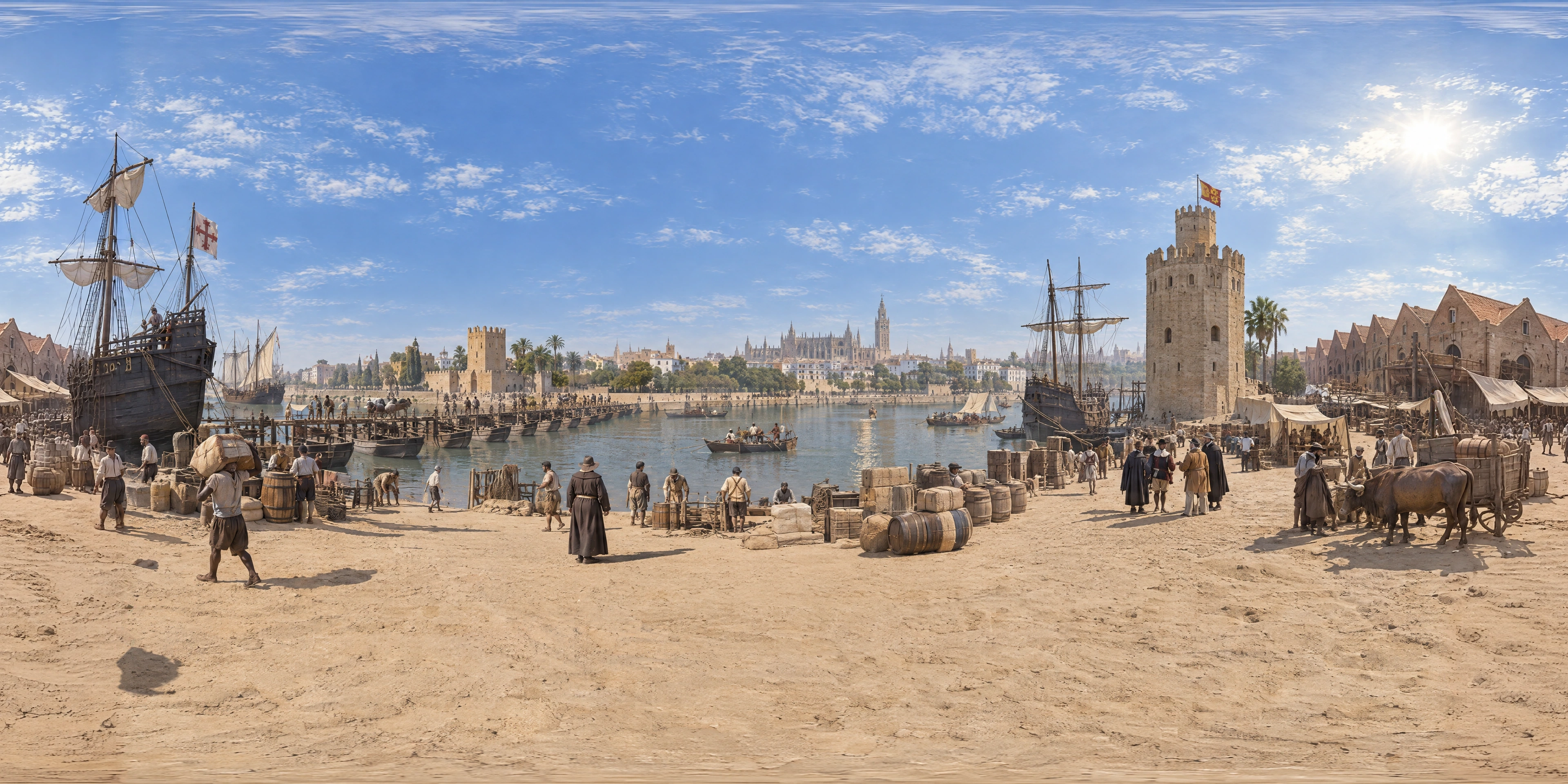
In the 1590s the Arenal, the sandy riverbank outside Seville's walls, is the gateway to an empire: ships of the Indies fleets load and unload beside the Torre del Oro, while the Giralda, crowned since 1568 with its Renaissance belfry, looks down on the city that holds Castile's monopoly of trade with the Americas.
- Year
- 1590s
- Where
- Andalusia (Crown of Castile) · ES
- Era
- Renaissance
- Coordinates
- 37.385, -5.999
The moment
The empire came ashore on a strip of sand
In the 1590s the Arenal, the broad strip of sand between Seville's Almohad walls and the river Guadalquivir, was where the trade of the Indies came ashore. Barrels, bales and chests crossed it on oxcarts and porters' backs, between the ships on the bank and the city gates.
Seville held the monopoly. From 1503 the Crown channelled all trade with the Americas through the city, where the Casa de Contratación, created that year, controlled the ships, their cargoes and their passengers. The monopoly lasted until 1717, when it passed to Cádiz.
The city grew with it. Seville had about 50,000 inhabitants at the start of the sixteenth century and about 120,000 at its end.
The Tower of Gold had only two storeys
Downstream stood the Torre del Oro. Its twelve-sided lower stage was built in 1220 for the Almohad governor Abu l-Ula, and a smaller twelve-sided stage was added in the fourteenth century under Peter of Castile. In the 1590s there was nothing above it. The round top with its lantern and golden dome dates from 1760, after the Lisbon earthquake of 1755 had damaged the tower.
Upstream, the city's only bridge was the Puente de Barcas, a line of boats chained together under timber walkways. It crossed to Triana, where the castle of San Jorge served as the seat of the Inquisition.
Over the walls rose the cathedral and the Giralda, the Almohad minaret crowned since 1568 with Hernán Ruiz's Renaissance belfry and the bronze weathervane called the Giraldillo.
Silver, slaves and a jailed tax collector
The Arenal's crowd was a cross-section of the city: sailors, caulkers, merchants in black, friars and water-sellers. Among the workers handling the cargo were enslaved Africans. Seville's wealth rested on colonial extraction in the Americas, and the city had one of the largest enslaved populations in Europe.
Not every fortune survived the port. In 1597 Miguel de Cervantes, then a royal tax collector, was jailed in the city's Cárcel Real after a banker holding the money he had collected went bankrupt. He spent about seven months there. The prologue to Don Quixote suggests the story was begotten in a prison, and a stone placed in 1905 claims it was this one.
Why Spaniards call it the Puerto de Indias
Spanish pupils learn this riverbank as the Puerto de Indias, the port of the Indies, the engine of the Golden Age and the place where American silver entered Europe.
The merchants who worked it left a building behind. They had long done business on the cathedral steps, and even inside in bad weather, until Philip II gave them an exchange of their own, then rising beside the cathedral to a design by Juan de Herrera, the architect of El Escorial. Since 1785 it has housed the Archivo General de Indias, the archive of Spain's American empire.
The bank itself is harder to find. The sand now lies under the Paseo de Cristóbal Colón, and the tower still stands at the water's edge.
Sources
Further reading
Tagged
- spain
- seville
- andalusia
- golden-age
- port
- carrera-de-indias
- trade
- everyday-life
Published
See also

1492
Banks of the Genil, Granada
In the early morning of 2 January 1492, beside a small domed oratory on the banks of the Genil, Boabdil, the last Nasrid sultan, surrenders the keys of Granada to King Ferdinand, who has them received by the Count of Tendilla and Gutierre de Cárdenas. Almost eight centuries of Muslim rule in the peninsula end as the Christian banner rises over the Alhambra.

1492
Guanahani (San Salvador Island), Bahamas
At dawn on 12 October 1492, Christopher Columbus and about 40 Spanish sailors land at a Lucayan-Taíno island in the Bahamas they will rename *San Salvador*: the encounter that begins five centuries of Atlantic exchange and the destruction of indigenous Caribbean populations.

1410
Old Town Square, Prague
On 9 October 1410 the Old Town councillors reward the clockmaker Mikuláš of Kadaň for the astronomical dial he has built on the town hall tower, the heart of today's Prague orloj. Below it the market square trades as usual in the year Wycliffe's books are burned in Prague and Jan Hus is excommunicated.