Banks of the Genil, Granada
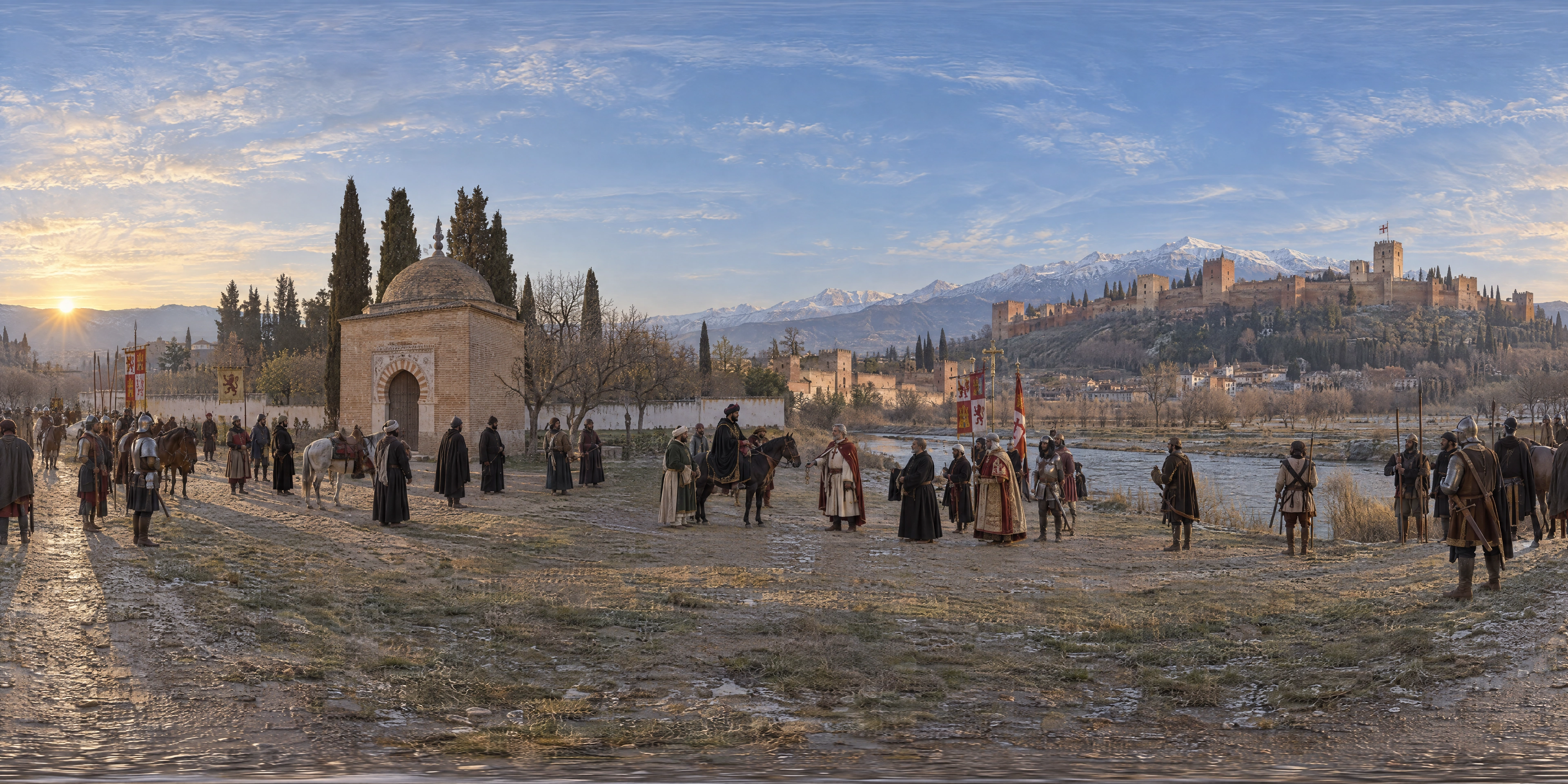
In the early morning of 2 January 1492, beside a small domed oratory on the banks of the Genil, Boabdil, the last Nasrid sultan, surrenders the keys of Granada to King Ferdinand, who has them received by the Count of Tendilla and Gutierre de Cárdenas. Almost eight centuries of Muslim rule in the peninsula end as the Christian banner rises over the Alhambra.
- Year
- 1492
- Where
- Nasrid Kingdom of Granada (Andalusia) · ES
- Era
- Renaissance
- Coordinates
- 37.166, -3.600
The moment
The keys changed hands at a riverside oratory
Early on Monday 2 January 1492, on the left bank of the Genil just south of the walls of Granada, Boabdil, the last Nasrid sultan, handed over the keys of his city. King Ferdinand had them received by the Count of Tendilla and Gutierre de Cárdenas.
The best-known account places the meeting beside a small Muslim oratory, a morabito built under the Almohads in 1218. It is a square of lime-mortar walls 8.4 metres a side under a brick dome, with a pointed horseshoe arch framed in brick, and it stood next to the walled garden palace of the Alcázar Genil.
In 1615 the oratory was rebuilt as a Christian hermitage and dedicated to Saints Fabian and Sebastian. As the Ermita de San Sebastián it still stands, a plaque recalls the handover, and it has been a national monument since 1931.
The surrender was signed five weeks earlier
The ceremony only sealed what had been agreed. On 25 November 1491, at Santa Fe, the camp-town the Catholic Monarchs had raised on the plain during the siege, Boabdil signed the Capitulations of Granada: 77 articles that guaranteed Granada's Muslims their faith, their property and their own law.
The accounts of the morning differ. They disagree on the hour, on whether Queen Isabella was at the river, and on the exact spot, which some place in the garden of the Alcázar Genil. All agree that the Christian banner was raised over the Alhambra.
The promises did not hold for long. Forced conversions set off the revolt of the Alpujarras in 1499, and in 1502 the Muslims of Castile were ordered to convert or leave. Boabdil, given a lordship in the Alpujarras, crossed to Fez in 1493 and died in exile.
Almost eight centuries ended in one morning
Spanish history books close the Reconquista on this day. Muslim rule in the peninsula had begun in 711, and Granada was its last state.
The year that followed is Spain's annus mirabilis. In the Alhambra the monarchs signed the decree expelling Spain's Jews, and at Santa Fe they agreed the contract that sent Columbus west. The pomegranate at the foot of Spain's coat of arms, the granada of the city's name, was added to the royal arms after the conquest.
A holiday that divides the city
Granada still marks 2 January as the Día de la Toma, the Day of the Taking. Its central rite is the tremolación del pendón, the waving of the royal banner from the balcony of the city hall in the Plaza del Carmen.
The day is contested. Supporters, mostly on the right and the far right, defend it as a civic tradition. Left-wing and Andalusist groups, and parts of the city's Muslim community, see a celebration of conquest and of the expulsions that followed, and some have asked the mayor to use the balcony instead for a call to coexistence.
Most years both sides gather in the same square, a few metres apart.
Sources
Further reading
Tagged
- spain
- granada
- andalusia
- reconquista
- nasrid
- catholic-monarchs
- boabdil
- 1492
Published
See also

1492
Guanahani (San Salvador Island), Bahamas
At dawn on 12 October 1492, Christopher Columbus and about 40 Spanish sailors land at a Lucayan-Taíno island in the Bahamas they will rename *San Salvador*: the encounter that begins five centuries of Atlantic exchange and the destruction of indigenous Caribbean populations.

15th century AD
Great Wall of China, Jinshanling
Around 1500, Ming China rebuilds the Great Wall in brick and stone across the mountain ridges north of Beijing: a battlemented rampart with watchtowers that climbs and plunges over the peaks as far as the eye can see, the most ambitious fortification ever built.

1410
Grunwald Battlefield
On the hot morning of 15 July 1410 the armies of King Władysław Jagiełło and Grand Duke Vytautas wait at the edge of the woods facing the Teutonic Order across the fields of Grunwald, until two heralds ride over with two naked swords from Grand Master Ulrich von Jungingen, a taunt to come out and fight. By evening the Order's army is broken and its Grand Master dead.