Old Town Square, Prague
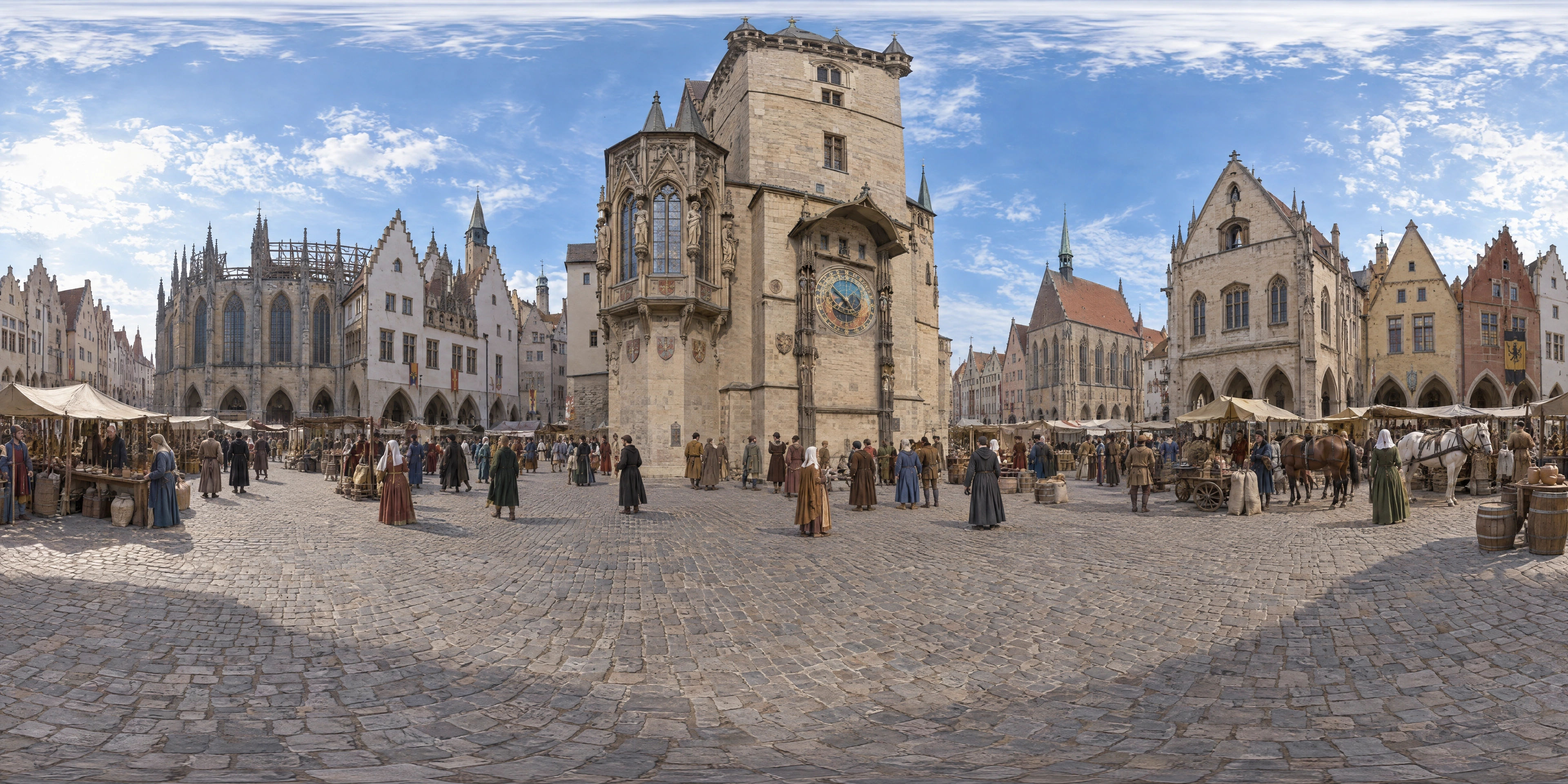
On 9 October 1410 the Old Town councillors reward the clockmaker Mikuláš of Kadaň for the astronomical dial he has built on the town hall tower, the heart of today's Prague orloj. Below it the market square trades as usual in the year Wycliffe's books are burned in Prague and Jan Hus is excommunicated.
- Year
- 1410
- Where
- Bohemia · CZ
- Era
- Renaissance
- Coordinates
- 50.087, 14.421
The moment
The clock's first record is a reward
The Prague orloj has a birthday because of a council decision. On 9 October 1410 the councillors of the Old Town rewarded the clockmaker Mikuláš of Kadaň for the astronomical dial he had built on their town hall tower.
The letter survives only as a later copy, but it is the first recorded mention of the clock. Mikuláš did not work alone: the design is credited to him together with Jan Šindel, a mathematician and astronomer of the Prague university.
A bare dial on a plain tower
In 1410 the clock was a dial and little else. A painted astrolabe face, with pointers for the sun and the moon, was set into the plain masonry of the tower the town had raised in 1364.
Nearly everything visitors film today came later. The calendar dial below was added around 1490, and its painted face is by Josef Mánes, from 1866.
The apostles who parade past the windows arrived after a repair in 1787 to 1791. In 1410 there was no sculpted frame and no rooster either.
A popular legend credits the clock to a Master Hanuš in 1490, and has the councillors blind him so that he could build no other. The 1410 record ends the argument: by 1490 the orloj was eighty years old.
Týn had no towers yet
The skyline around the clock was not the one on today's postcards. To the east, behind the pointed arcades of the Týn school, the church of Our Lady before Týn stood unfinished, three aisles built, the main nave probably still without its vault or roof.
It had no west gable and neither of the two towers that now dominate the Old Town: those came between 1463 and 1511. Beside it rose the tall Gothic front of the House at the Stone Bell, and to the north-west stood the older Gothic church of St Nicholas, long before its Baroque rebuilding and dome.
Beside the town hall tower, the council chapel pushed its five-sided Gothic oriel out over the square. Below, the main market of Prague went about its business among tall, narrow Gothic houses with steep roofs and arcades.
A clock on the eve of revolution
The orloj is one of the best-known symbols of Prague, and Czech school trips stand beneath it on the hour. Its first year also falls at a turning point: in 1410 Wycliffe's books were burned in Prague and Jan Hus was excommunicated.
Within a decade the city would be at war over his ideas, and the Hussite era is still taught as one of the defining periods of Czech history. The clock went on keeping time above the square through all of it.
It was badly damaged in the last days of the Second World War. On 7 and 8 May 1945, during the Prague uprising, German forces fired on the Old Town Square, and the wooden figures and the calendar dial burned. The orloj was running again in 1948.
Sources
Further reading
Tagged
- czechia
- prague
- bohemia
- medieval
- astronomical-clock
- old-town-square
- jan-hus
- everyday-life
Published
See also

1357
Charles Bridge, Prague
In 1357 Emperor Charles IV lays the foundation stone of a new stone bridge on the Old Town bank near St Clement's, fifteen years after ice and floodwater wrecked the Judith Bridge. Tradition sets the moment at 5:31 on 9 July, a palindrome of odd numbers; the bridge will take 45 years to finish.

1881
National Theatre, Prague
On the afternoon of 12 August 1881, two months after its opening, the National Theatre, built over thirteen years from the pennies of a whole nation, catches fire and loses its copper dome, auditorium and stage. Within 47 days the Czechs collect a million gulden to rebuild it, and it reopens in 1883.

1939
Lower Wenceslas Square, Prague
On the morning of 15 March 1939, in a heavy fall of wet snow, German columns roll down Wenceslas Square as Hitler's troops occupy what remains of Czechoslovakia. Thousands of Praguers watch from the pavements, weeping, booing and singing the national anthem; that evening Hitler reaches Prague Castle, and the next day he proclaims the Protectorate of Bohemia and Moravia.