Berlage Bridge, Amsterdam
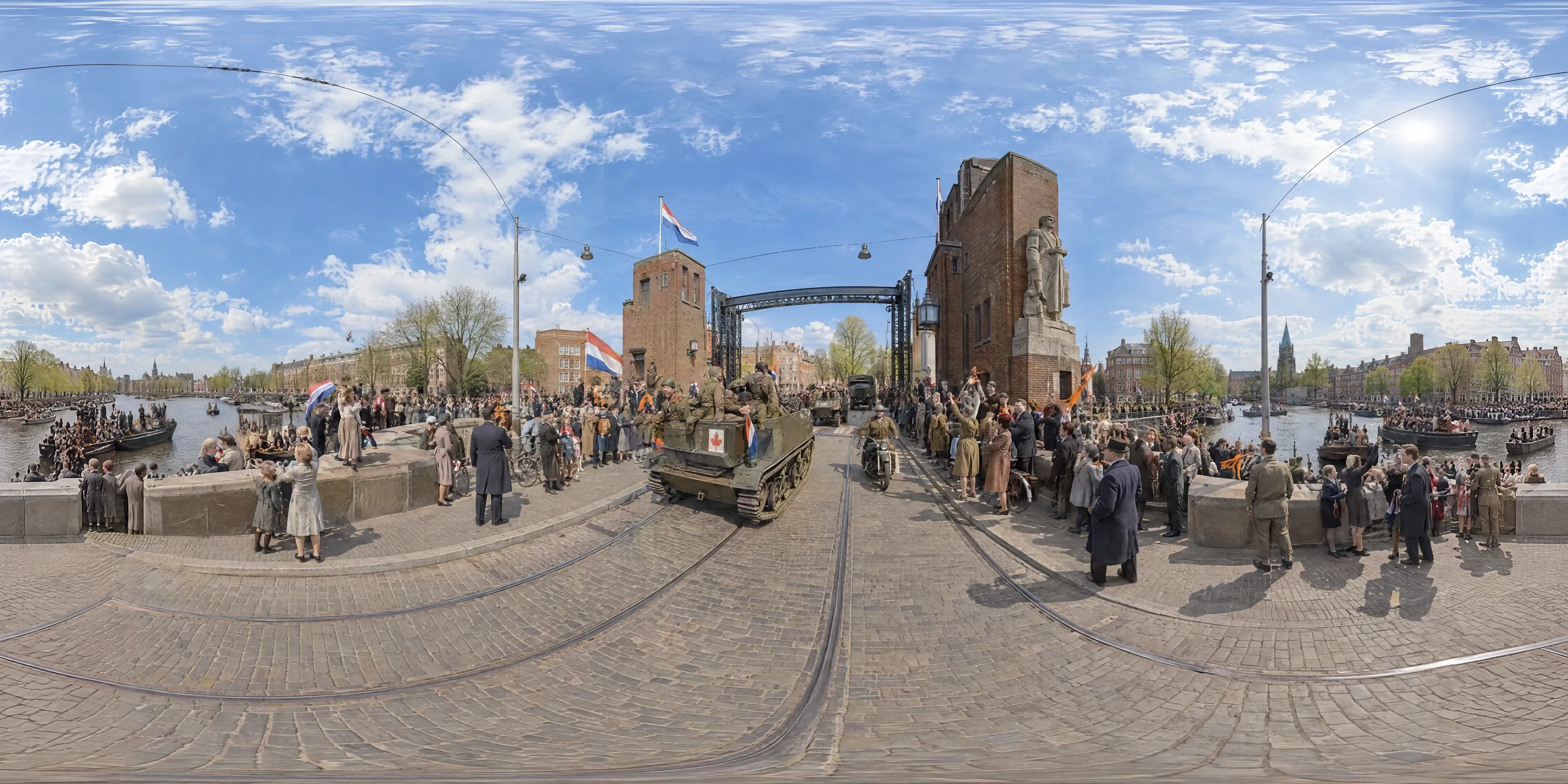
On Tuesday 8 May 1945, three days after the German capitulation in the Netherlands, the first Canadian columns roll into Amsterdam over the Berlage Bridge. After the Hunger Winter, thin but jubilant crowds swarm the vehicles, wave orange and red-white-blue flags and ride along on the carriers and on motorbikes.
- Year
- 1945
- Where
- North Holland · NL
- Era
- modern_postwar
- Coordinates
- 52.347, 4.911
The moment
Liberation crossed the Amstel three days after the surrender
On 5 May 1945, at Hotel De Wereld in Wageningen, the Canadian general Charles Foulkes and the German command agreed the surrender of the German forces in the Netherlands. Amsterdam still had to wait for its liberators.
They came on Tuesday 8 May. The first Canadian columns drove in from Diemen through the Watergraafsmeer and crossed the Amstel by the Berlagebrug. Crowds swarmed over the carriers and trucks, young men rode alongside on motorbikes, and orange flags and red, white and blue tricolours were everywhere. The photographer Charles Breijer recorded the scene on the bridge.
A bridge opened the day the Zuiderzee was closed
The Berlagebrug opened on 28 May 1932, the same day the last gap in the Afsluitdijk was closed. A brick bascule bridge 80 metres long and 24 metres wide, it was the largest bridge in Amsterdam at the time. H. P. Berlage designed its form, and the engineer Cornelis Biemond its structure. Berlage had drawn a bridge on this spot as early as 1915, in his plan for the new south of the city.
Its square brick tower carries a four-metre ceramic figure by Hildo Krop, the Genius of Amsterdam, rising from the water under a golden imperial crown and rays of sun. Behind the bridge ran the Amstellaan, lined with the brick apartment blocks of that plan.
The crowd on the bridge had just lived through a famine
The people on the bridge were hungry. In the Hunger Winter of 1944 to 1945 at least 20,000 people in the Netherlands died of hunger and cold, and the faces in the photographs are thin, the coats worn and patched.
The joy did not cancel the losses. Amsterdam had lost most of its Jewish population in the Holocaust. And on 7 May, the day before the Canadians arrived, German soldiers fired on a celebrating crowd on the Dam; 32 people died, by the count most often given.
The avenue that changed its name twice
The Amstellaan kept its name for one more year. On 8 May 1946, the first anniversary of the Canadian entry, it became the Stalinlaan, alongside avenues renamed for Churchill and Roosevelt. After Soviet tanks crushed the Hungarian uprising, it was renamed again on 14 November 1956. It has been the Vrijheidslaan, Freedom Avenue, ever since.
Liberation Day, 5 May, is a Dutch national holiday, and for generations of Dutch families the Canadian columns of May 1945 are the image of freedom regained. The Netherlands still sends tulip bulbs to Ottawa every year in thanks.
Sources
Further reading
Tagged
- netherlands
- amsterdam
- liberation
- world-war-ii
- canadian-army
- amstel
- amsterdam-school
- 1945
Published
See also

1945
Czech Radio Building, Vinohradská, Prague
On Saturday 5 May 1945 the Prague Uprising breaks out at the radio building on Vinohradská: at 12:15 the staff hoist the Czechoslovak and American flags, the station broadcasts desperate calls for help, and at six in the evening the SS inside surrender. That night about 100,000 Praguers raise some 1,600 barricades across the city.

1955
Upper Belvedere, Vienna
Around noon on Sunday 15 May 1955, just after the State Treaty is signed in the Marble Hall of the Upper Belvedere, Foreign Minister Leopold Figl steps onto the balcony with the Allied foreign ministers and holds up the signed treaty to the crowd waiting in the palace garden. After ten years of occupation, Austria is free.

1948
Tempelhof Airport, West Berlin
For 462 days between June 1948 and September 1949, British and American transport aircraft fly food and coal into blockaded West Berlin: one plane landing at Tempelhof every 90 seconds at the peak.