Czech Radio Building, Vinohradská, Prague
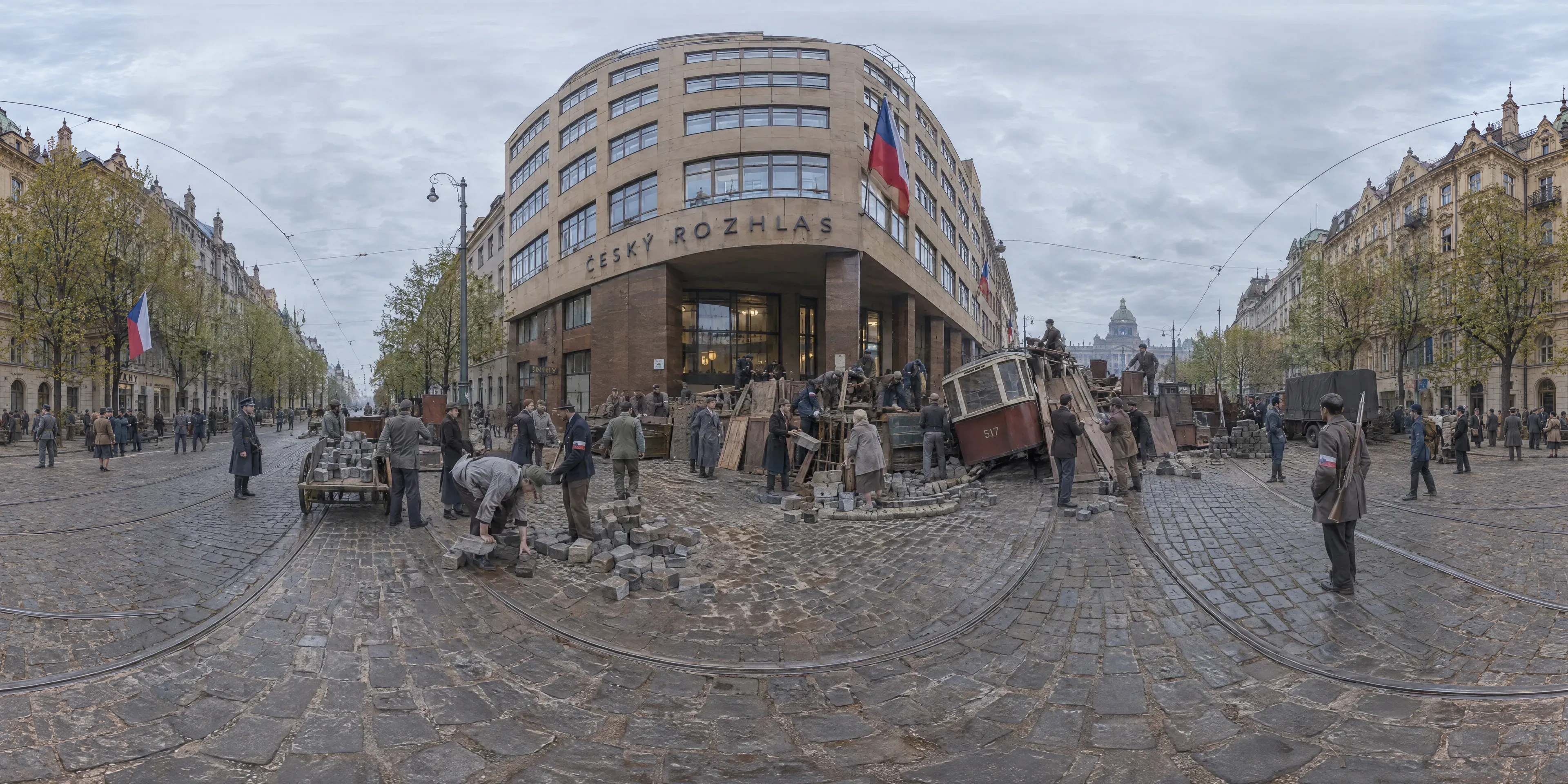
On Saturday 5 May 1945 the Prague Uprising breaks out at the radio building on Vinohradská: at 12:15 the staff hoist the Czechoslovak and American flags, the station broadcasts desperate calls for help, and at six in the evening the SS inside surrender. That night about 100,000 Praguers raise some 1,600 barricades across the city.
- Year
- 1945
- Where
- Bohemia · CZ
- Era
- modern_postwar
- Coordinates
- 50.079, 14.434
The moment
The uprising began at the microphone
On Saturday 5 May 1945, with the war in its last days, the Prague Uprising broke out at the radio building on Vinohradská avenue. The staff defied the occupation on air, and when the SS guards moved against them, the station called for help.
"Voláme vše české na pomoc Českému rozhlasu", the announcers repeated: we call on everything Czech to come to the aid of Czech Radio. Police, gendarmes and armed civilians answered.
At 12:15 the staff hoisted the Czechoslovak flag and the American Stars and Stripes on the building. The SS unit that had fought its way inside, room by room, surrendered at six in the evening.
A building on Schwerinova
The avenue was then officially called Schwerinova, one of the occupation's German names. The radio building at No. 12 was a functionalist block of 1929 to 1931, its main wing seven storeys high, about 200 metres from the dome of the National Museum.
The fight for it went on for four days, and about 170 Czechs died in it. On 6 May a German jet bombed the building.
A thousand six hundred barricades in one night
The rising spread across the city. In the night of 5 to 6 May tens of thousands of Praguers, about 100,000 by one count, built some 1,600 barricades out of paving stones, planks, furniture and overturned tram cars; by the end there were more than 2,000.
Some 30,000 insurgents, mostly untrained, faced around 40,000 German troops. On 6 May the 1st Division of the Russian Liberation Army under General Sergei Bunyachenko, a unit that had fought on the German side, changed sides and joined the uprising.
On 8 May the Czech National Council negotiated with General Rudolf Toussaint: German forces could withdraw west through Prague if they surrendered their weapons. The Red Army reached the outskirts at four in the morning of 9 May, after most of the German troops had gone.
A rising remembered in pieces
Between about 1,700 and 2,900 Czech insurgents were killed across the city. The uprising was also followed by violence against German civilians, and at least a thousand of them died.
The communist regime then rewrote the story. It inflated the role of the Red Army, played down the Vlasov troops and the western Allies, and purged many of the resistance leaders.
What survives unedited is the voice. Czechs mark 5 May as a significant day, and on anniversaries Czech Radio airs the calls for help again, from the same building on the avenue now called Vinohradská.
Sources
Further reading
Tagged
- czechia
- prague
- ww2
- prague-uprising
- czech-radio
- barricades
- vinohrady
- 20th-century
Published
See also

1948
Kinsky Palace, Old Town Square, Prague
On Saturday 21 February 1948, the day after the non-communist ministers resign, Klement Gottwald speaks from the balcony of the Kinsky Palace to more than 100,000 people standing in hard frost. Four days later President Beneš gives way and the communists take power for 41 years; the photo from this balcony, with Vladimír Clementis later airbrushed out, went round the world.

1968
National Museum, Wenceslas Square, Prague
On the morning of 21 August 1968, hours after Warsaw Pact armies invaded to crush the Prague Spring, Soviet tanks coming from Vinohradská rake the facade of the National Museum with machine-gun fire. Praguers fill the upper square, surround the tanks to argue with their crews and cover the statue of St Wenceslas with flags and slogans.

1969
Jan Palach Square, Prague
On 25 January 1969 some 200,000 people follow the coffin of Jan Palach in complete silence. The 20-year-old student had set himself on fire on Wenceslas Square on 16 January in protest against the resignation that followed the Soviet invasion; the procession halts before his Faculty of Arts, on a square students have already renamed after him.