Upper Belvedere, Vienna
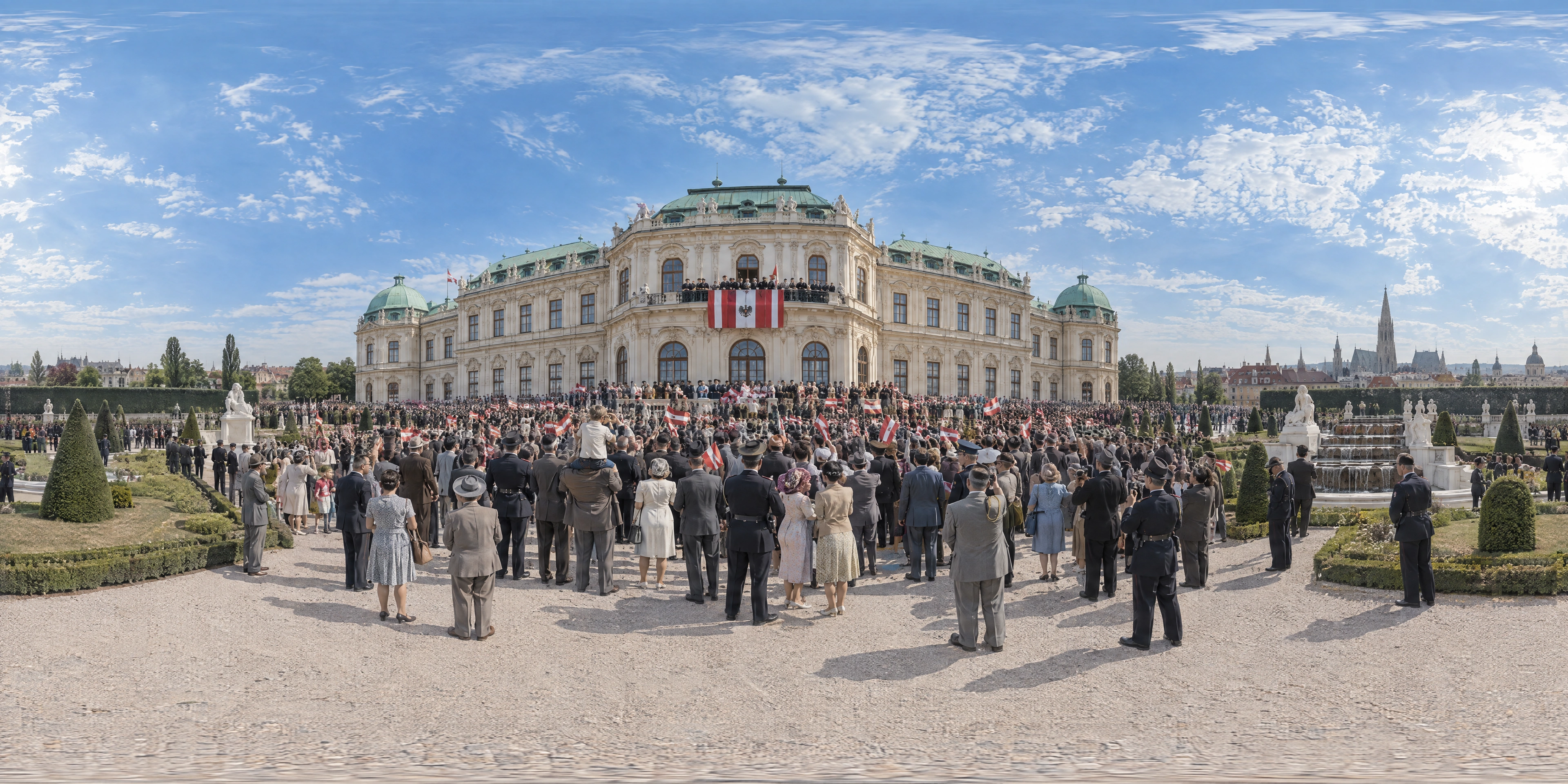
Around noon on Sunday 15 May 1955, just after the State Treaty is signed in the Marble Hall of the Upper Belvedere, Foreign Minister Leopold Figl steps onto the balcony with the Allied foreign ministers and holds up the signed treaty to the crowd waiting in the palace garden. After ten years of occupation, Austria is free.
- Year
- 1955
- Where
- Vienna · AT
- Era
- modern_postwar
- Coordinates
- 48.192, 16.381
The moment
Signed at half past eleven
On Sunday 15 May 1955, at 11:30 in the morning, the Austrian State Treaty was signed in the Marble Hall of the Upper Belvedere in Vienna. The foreign ministers of the four occupying powers signed it: Vyacheslav Molotov for the Soviet Union, John Foster Dulles for the United States, Harold Macmillan for Britain and Antoine Pinay for France, together with Austria's foreign minister, Leopold Figl, and the four high commissioners.
The treaty ended ten years of occupation and restored Austria's full sovereignty. Since 1945 Austria had been divided into four zones and Vienna into four sectors, with the city centre run by all four powers together.
The day before, the text had changed in Austria's favour. A clause on Austria's share of responsibility for the war was struck from the preamble.
Austria is free, said indoors
Figl's famous words, "Österreich ist frei", Austria is free, were spoken inside, in the Marble Hall. They were not spoken on the balcony, as newsreels later suggested, and as many Austrians still picture it.
What happened on the balcony was unplanned. Around noon Figl stepped out with the Allied foreign ministers, Chancellor Julius Raab and Vice-Chancellor Adolf Schärf, and held up the signed treaty, open, to the crowd waiting in the palace garden. The crowd cheered and chanted "Staatsvertrag". The photograph of that moment became the image of the day.
Prince Eugene's palace
The setting was Baroque. The Upper Belvedere was built from 1717 to 1723 by Johann Lucas von Hildebrandt for Prince Eugene of Savoy: a long, richly articulated front with a taller central block, corner pavilions and curved copper roofs.
Its garden falls away in terraces, with clipped hedges, sphinx statues and a cascade, toward the Lower Belvedere. Beyond it the Gothic south tower of St Stephen's rises over the roofs of the inner city.
Why 26 October followed
On 25 October 1955 the last Allied troops left Austrian soil. The next day parliament passed the constitutional law by which Austria, of its own free will, declared its permanent neutrality. Neutrality was not written into the treaty itself; it came separately, as a law Austria passed on its own. 26 October is now the National Day.
For Austrians the State Treaty and the balcony are the founding images of the Second Republic. Almost every Austrian knows the photograph of Figl holding up the open treaty, even if the words they hear over it were spoken in the room behind him.
Sources
Further reading
Tagged
- austria
- vienna
- state-treaty
- second-republic
- belvedere
- neutrality
- cold-war
- 20th-century
Published
See also

1968
National Museum, Wenceslas Square, Prague
On the morning of 21 August 1968, hours after Warsaw Pact armies invaded to crush the Prague Spring, Soviet tanks coming from Vinohradská rake the facade of the National Museum with machine-gun fire. Praguers fill the upper square, surround the tanks to argue with their crews and cover the statue of St Wenceslas with flags and slogans.

1956
Stalin Monument, Budapest
On the evening of 23 October 1956, the first day of the Hungarian Revolution, a huge crowd pulls down the eight-metre bronze Stalin on Stalin Square in Budapest: after hours of work with cables, lorries and cutting torches it falls at 21:37, leaving only the boots on the tribune. It is the revolution's first common act and becomes its emblem.

1989
Brandenburg Gate, Berlin
On the night of November 9–10, 1989, East and West Berliners climb the Berlin Wall in front of the Brandenburg Gate, chipping at the concrete with hammers and dancing on top: the symbolic collapse of the Iron Curtain.