Borobudur, Central Java
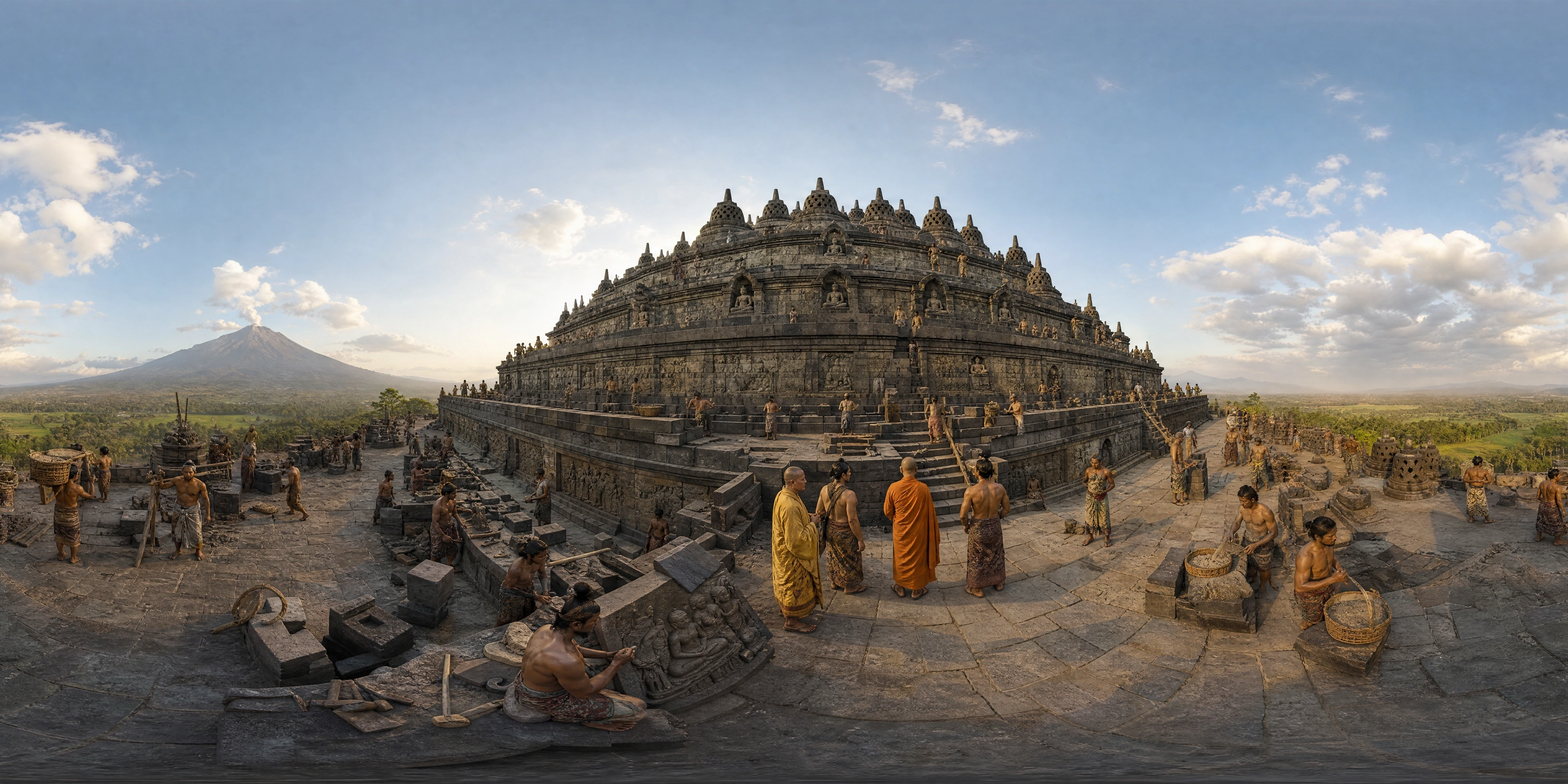
In the late 8th century, the Sailendra dynasty of central Java builds Borobudur: a stepped andesite stupa-mountain of nine levels, the largest Buddhist monument in the world.
- Year
- 770s
- Where
- Central Java, Sailendra kingdom · ID
- Era
- Medieval
- Coordinates
- -7.608, 110.204
The moment
A mountain made by hand
Borobudur is not built. It is sculpted.
The Sailendra-dynasty architects of central Java between roughly 778 and 825 took an existing natural hill and faced it on all sides with two million cubic feet of dressed andesite stone, transforming it into a nine-level stepped pyramid 35 metres tall and 118 metres on each side at the base.
Every block was cut by hand without mortar. The joints are tight enough that a sheet of paper cannot be slid between them. There is no internal chamber, no tomb, no relic casket. The monument is solid stone, designed as something to walk on rather than enter.
Two thousand six hundred and seventy-two stories
The five lower square terraces are carved on both inner and outer walls with 2 672 narrative bas-relief panels.
The largest and most complete collection of Buddhist narrative art in the world.
The panels are organised as four sequential pilgrim paths. The lowest level depicts the Kamadhatu (world of desire), but this entire bottom level was concealed under a stone retaining wall during construction itself and only photographed when the wall was temporarily removed in the 1890s. The Rupadhatu levels above show the life of the Buddha. The three uppermost circular terraces hold 72 bell-shaped perforated stupas, each one originally containing a meditating Buddha visible through diamond-shaped openings.
Buried, then forgotten, then found
Borobudur was abandoned around 1100, probably in response to a series of volcanic eruptions of nearby Mount Merapi and the Sailendra court's shift of capital eastward.
The monument disappeared from local memory for at least three centuries.
In 1814, the British lieutenant-governor of Java, Thomas Stamford Raffles (the same man who founded Singapore five years later), heard rumours of a great ruin in the jungle and dispatched a Dutch engineer named Hermann Cornelius to investigate. Cornelius's team spent two months clearing trees and ash from the upper terraces before the full scale of the monument became visible. A major UNESCO-led reconstruction between 1973 and 1983 restored it to roughly its medieval state.
A pilgrimage in stone
The intended use of Borobudur was as a giant three-dimensional mandala for ritual circumambulation. A pilgrim entered at the east gate, walked clockwise around the lowest terrace, then ascended to each higher terrace and walked its circumference, climbing through the textual narrative of the Buddha's journey toward enlightenment.
The full pilgrimage covered five kilometres of walking.
At the summit, a single large central stupa contained either a relic or, by some interpretations, was deliberately empty: a representation of the achievement of nirvana. The stupa is empty today. Whether it always was, or whether someone removed its contents during the seven centuries of abandonment, cannot be determined.
Further reading
Tagged
- indonesia
- java
- borobudur
- buddhist
- sailendra
- southeast-asia
Published · Updated
See also

1357
Charles Bridge, Prague
In 1357 Emperor Charles IV lays the foundation stone of a new stone bridge on the Old Town bank near St Clement's, fifteen years after ice and floodwater wrecked the Judith Bridge. Tradition sets the moment at 5:31 on 9 July, a palindrome of odd numbers; the bridge will take 45 years to finish.

537
Hagia Sophia, Constantinople
On December 27, 537 AD, Emperor Justinian I dedicates the newly built Hagia Sophia in Constantinople: its 32-meter dome rising on pendentives in a structural feat that defines Byzantine architecture.

1253
Basilica of Saint Francis, Assisi
On 25 May 1253 Pope Innocent IV consecrates the new basilica raised over the tomb of Francis of Assisi, just 27 years after the saint's death, before crowds of grey-robed friars and townspeople. Later painted by Cimabue and Giotto, it became the spiritual heart of the country whose patron saint Francis is.