Basilica of Saint Francis, Assisi
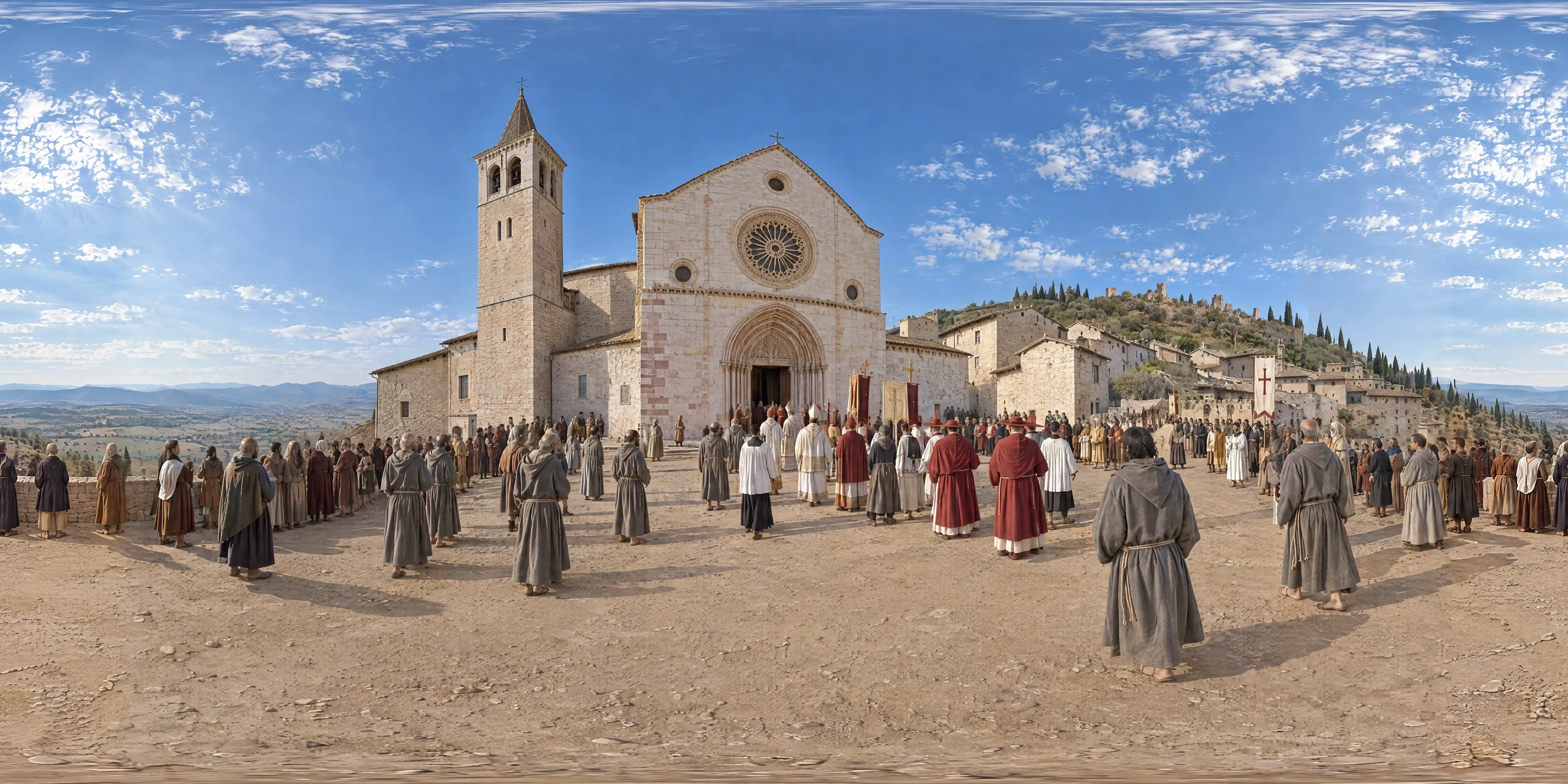
On 25 May 1253 Pope Innocent IV consecrates the new basilica raised over the tomb of Francis of Assisi, just 27 years after the saint's death, before crowds of grey-robed friars and townspeople. Later painted by Cimabue and Giotto, it became the spiritual heart of the country whose patron saint Francis is.
- Year
- 1253
- Where
- Umbria · IT
- Era
- Medieval
- Coordinates
- 43.075, 12.607
The moment
Begun the day after a canonisation
Francis of Assisi died in 1226. On 16 July 1228 Pope Gregory IX made him a saint, and on the next day he laid the foundation stone of a church to hold his body, on the hilltop at the western edge of Assisi.
The work was run by Brother Elias of Cortona, and it moved fast. The lower church was ready in 1230, when the saint's remains were carried to it in a solemn procession on 25 May; the upper church, begun after 1239, was finished in 1253.
Consecrated twenty-three years to the day
On 25 May 1253, twenty-three years to the day after the procession, Pope Innocent IV consecrated the basilica. The upper church showed the square a plain gabled façade of pink and white Subasio limestone, a large rose window framed by the symbols of the four Evangelists, and a deep Gothic portal.
Beside it stood the square Romanesque bell tower, finished in 1239 and still topped by a pointed spire that no longer exists; its exact form is not recorded. Above the town, the fortress of the Rocca Maggiore lay in ruins, wrecked by the townspeople in 1198.
The friars who filled the square wore habits of undyed grey wool, not the brown of later centuries, and many went barefoot. Even the cardinals' red hats were new: Innocent IV had granted them in 1245.
Painted later, shaken later
The frescoes that made the basilica famous came in the following decades. The walls were painted by masters of the Roman and Tuscan schools, among them Cimabue, Simone Martini and Pietro Lorenzetti. The frescoes of the upper church traditionally given to Giotto are the most famous of all, though the attribution is disputed.
The body of Francis disappeared from view. Buried beneath the floor of the lower church, it was rediscovered only in 1818.
On 26 September 1997 two earthquakes struck Umbria, and an aftershock brought down part of the vault of the upper church, killing four people. The frescoes of the collapsed sections were almost entirely destroyed. The church reopened after two years of restoration.
Why 4 October is a holiday again
Francis is the patron saint of Italy, and his basilica is one of the country's great pilgrimage shrines, a UNESCO World Heritage Site since 2000.
His feast day, 4 October, was a national holiday until 1977, when the state abolished it for economic reasons. In October 2025 parliament voted by a large majority to restore it from 2026, the 800th anniversary of his death.
The consecration of 1253 is where that devotion took architectural form. Clare of Assisi died that August. The basilica of Santa Chiara, the porticoes of the lower square and the loggia beside the façade all came after the day the pope blessed the church.
Sources
Further reading
Tagged
- italy
- assisi
- umbria
- saint-francis
- medieval
- basilica
- franciscans
- papacy
Published
See also

1357
Charles Bridge, Prague
In 1357 Emperor Charles IV lays the foundation stone of a new stone bridge on the Old Town bank near St Clement's, fifteen years after ice and floodwater wrecked the Judith Bridge. Tradition sets the moment at 5:31 on 9 July, a palindrome of odd numbers; the bridge will take 45 years to finish.

1370s
Leaning Tower of Pisa
Around 1370, the bell tower of Pisa is finally finished after two centuries, and it already leans, its marble tiers curving as builders fought the soft ground, beside the great cathedral and round baptistery on the green cathedral square.

987
Great Mosque of Córdoba
In 987 Almanzor, the all-powerful chamberlain of Caliph Hisham II, begins the third and largest enlargement of the Great Mosque of Córdoba, eight new aisles to the east that make it the largest mosque anywhere outside Abbasid Iraq. From the courtyard, open arches reveal the forest of red-and-white double arches inside.