Castle Church, Wittenberg
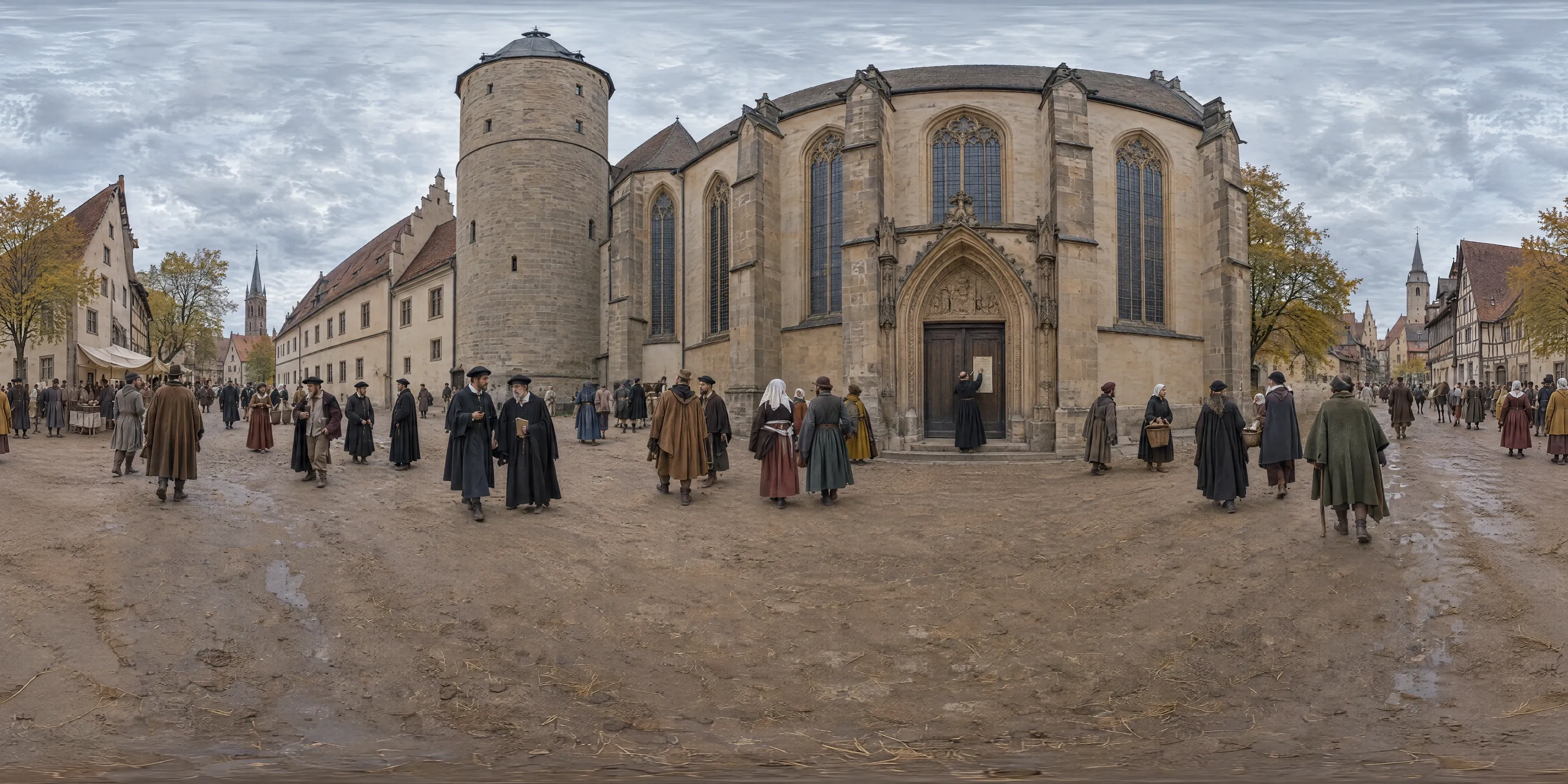
On Wednesday 31 October 1517, the eve of All Saints, the Augustinian friar and theology professor Martin Luther sends his 95 theses against the trade in indulgences to the Archbishop of Mainz and, by tradition, nails them to the wooden door of Wittenberg's Castle Church. The dispute they start becomes the Reformation.
- Year
- 1517
- Where
- Saxony-Anhalt (Electorate of Saxony) · DE
- Era
- Renaissance
- Coordinates
- 51.867, 12.638
The moment
A letter for certain, a hammer perhaps
On Wednesday 31 October 1517, the eve of All Saints, the Augustinian friar and theology professor Martin Luther wrote to Albrecht, Archbishop of Mainz. With the letter went 95 theses in Latin against the trade in indulgences. That much is certain.
Whether Luther also nailed them to the door of the Castle Church is another matter. The Catholic historian Erwin Iserloh doubted it in 1961, and historians have been divided ever since.
The famous account comes from Philipp Melanchthon, who wrote in 1546, after Luther's death, that the theses were posted on the church by the castle on the eve of All Saints. Melanchthon only reached Wittenberg in August 1518. A note by Luther's assistant Georg Rörer, written around 1540 and found in Jena in 2006, also mentions the posting, but Rörer was no eyewitness either.
The door was the university's notice board
If Luther did post the theses, the door was the obvious place. The university used the wooden doors of the Castle Church for its notices, and theses offered for academic debate belonged there.
The church was new. Consecrated on 17 January 1503, it formed the north wing of the castle of Elector Frederick the Wise: a late Gothic hall with tall pointed windows between stepped buttresses under a steep roof. Its main portal had a sandstone frame carved with the year 1499.
Wittenberg itself was small. About 2,000 people lived in the university town on the Elbe, many of them in clay-walled houses under thatched roofs.
Nothing on the door is original
The door Luther may or may not have used is gone. In 1760, during the Seven Years' War, Wittenberg was bombarded and the Castle Church burned. None of the wooden portals survived.
In their place hang bronze doors bearing the Latin text of the theses, commissioned by the Prussian king Frederick William IV and mounted in 1858, 375 years after Luther's birth. The statues of the electors above the portal date from 1845. The tower's domed crown and its mosaic band with the words of "Ein feste Burg" came with a restoration completed in 1892.
Luther himself lies inside, buried near the pulpit in 1546. Melanchthon is buried in the church too.
Why 31 October is a holiday
Reformation Day, 31 October, is a public holiday in nine German states. In 2017, the five-hundredth anniversary, it was a holiday across the whole country.
The dispute Luther started that day became the Reformation and split Western Christianity. Catholic and Protestant traditions still tell the story differently, and the door is part of that difference: for some a founding image, for others a legend.
Luther remains one of the most present figures in German memory. In ZDF's television poll of the greatest Germans he came second, behind only Konrad Adenauer.
Sources
Further reading
Tagged
- germany
- wittenberg
- martin-luther
- reformation
- 95-theses
- renaissance
- castle-church
- saxony-anhalt
Published
See also

1543
Cathedral Hill, Frombork
In late May 1543 Nicolaus Copernicus, a 70-year-old canon of the Warmian chapter, dies at Frombork; by tradition the first printed copy of his De revolutionibus, the book that sets the Earth moving around the Sun, reached him on his last day. The walled cathedral hill, beside which he lived and watched the sky for more than thirty years, looks out over the Vistula Lagoon.

1444
Florence Cathedral, Florence
In 1444, Brunelleschi's revolutionary double-shell brick dome over Santa Maria del Fiore in Florence approaches completion: the largest masonry dome in the world, raised without scaffolding.

15th century AD
Great Wall of China, Jinshanling
Around 1500, Ming China rebuilds the Great Wall in brick and stone across the mountain ridges north of Beijing: a battlemented rampart with watchtowers that climbs and plunges over the peaks as far as the eye can see, the most ambitious fortification ever built.