Iztapalapa causeway, Tenochtitlán
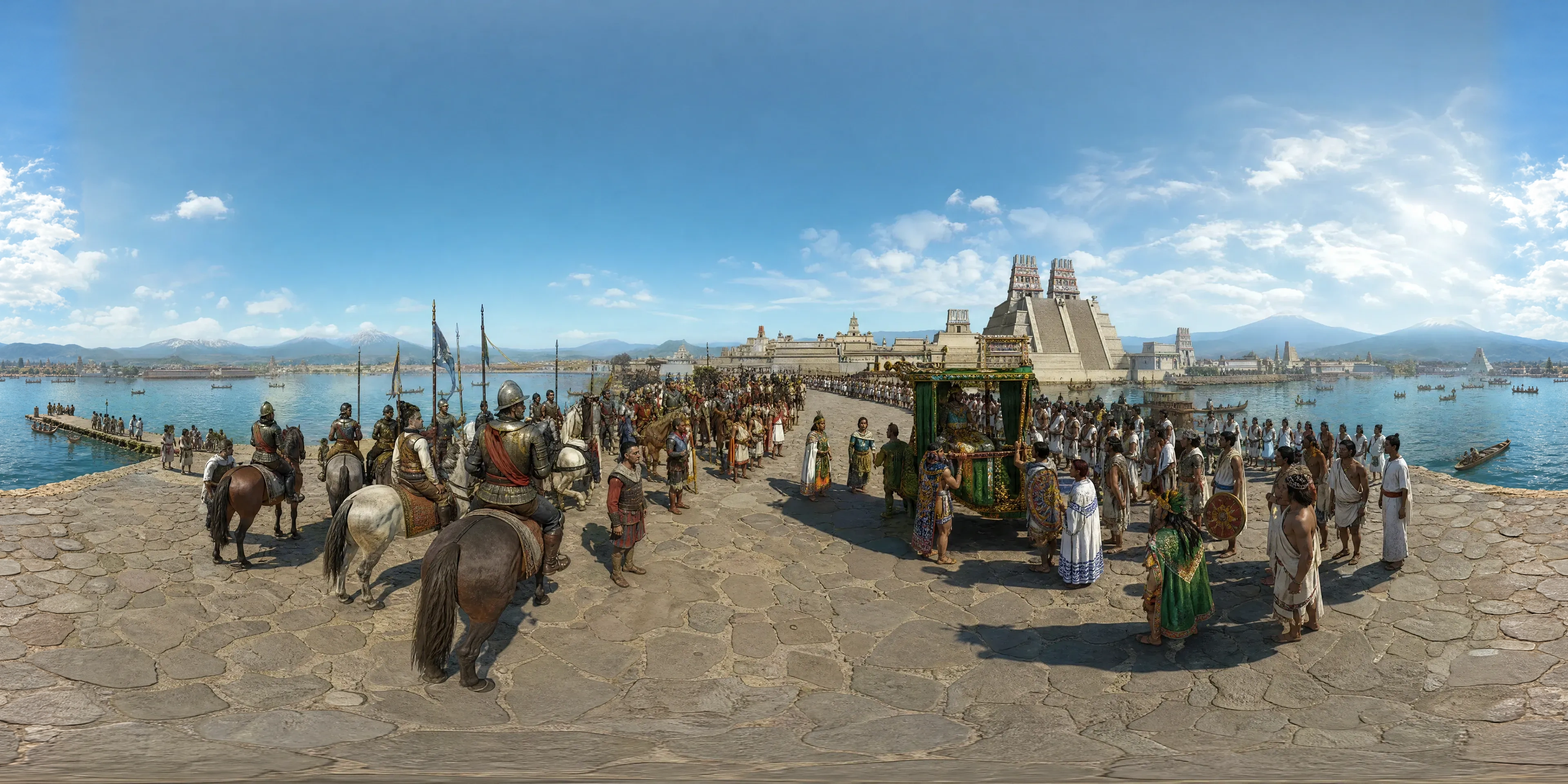
On November 8, 1519, Hernán Cortés and 400 Spanish conquistadors meet the Aztec emperor Moctezuma II on the southern causeway of Tenochtitlán, the meeting of two civilizations that have never seen each other.
- Year
- 1519
- Where
- Valley of Mexico, Aztec Empire · MX
- Era
- Renaissance
- Coordinates
- 19.435, -99.139
The moment
A meeting that should not have happened
When Hernán Cortés landed on the Mexican coast in April 1519 he commanded 11 ships, 530 European soldiers, 13 horses, and 14 cannons.
He had no authorisation from his nominal superior, the governor of Cuba. He was, technically, in mutiny.
He scuttled his own ships at Veracruz in July 1519 to prevent his men from returning, and then marched 400 kilometres inland to the Aztec capital. The Aztec empire of Moctezuma II, Huey Tlatoani of the Triple Alliance, had a population of roughly 25 million. Its capital Tenochtitlán was a city of perhaps 200 000, larger than any city in Europe at that date except Paris.
Cortés's force should have been crushed at any moment in the march. It was not, because Moctezuma chose hospitality.
Why Moctezuma did not destroy him
Moctezuma sent ambassadors with gifts to meet Cortés on the road, including a large gold sun-disc and a large silver moon-disc. The gifts were intended to demonstrate Aztec wealth and discourage further advance. Cortés interpreted them as evidence of even greater wealth to come and pressed onward.
Modern scholarship has rejected the older interpretation that Moctezuma believed Cortés was the returning god Quetzalcoatl; that story appears only in post-conquest sources written under Spanish supervision.
Moctezuma's actual calculation was probably strategic. He wanted to bring this strange new force into the capital where it could be observed, contained, and if necessary destroyed.
The calculation failed.
What Tenochtitlán looked like
Tenochtitlán was a planned city built on a series of artificial islands in the brackish Lake Texcoco at 2 240 metres altitude.
Three broad stone-paved causeways connected the city to the lakeshore. At its centre rose the twin shrines of the Templo Mayor, a stepped double pyramid 60 metres tall with two altars at the top, one to Huitzilopochtli (the war god, southern half) and one to Tlaloc (the rain god, northern half). The temple platform was decorated in red and blue paint. The steps were stained dark with the blood of the roughly 20 000 sacrificial victims dispatched in the dedication ceremony of 1487.
The conquistador Bernal Díaz del Castillo, who wrote his memoir of the conquest 50 years later, recorded the moment:
When we saw all those cities and villages built in the water... we said that it was like the enchantments of the Amadis... some of our soldiers asked whether it was not all a dream.
Two years to the end
Cortés took Moctezuma hostage within a week of entering the city, ruling Tenochtitlán through the captive emperor for six months.
In June 1520 an Aztec uprising killed Moctezuma (whether by Spanish hand or by his own people's stones is disputed) and forced Cortés to flee the city in the disaster known as the Noche Triste.
He returned thirteen months later with a much larger force augmented by 80 000 Tlaxcalan allies and besieged the city for 93 days. Tenochtitlán fell on 13 August 1521.
The Spanish systematically demolished the pyramids and built Mexico City on the rubble. The modern Zócalo sits directly on top of the Templo Mayor's foundations, which were rediscovered only when electricians digging beneath the cathedral in 1978 hit an enormous carved stone disk of the goddess Coyolxauhqui.
Further reading
Tagged
- mexico
- aztec
- conquest
- cortes
- moctezuma
- tenochtitlan
Published · Updated
See also

15th century AD
Great Wall of China, Jinshanling
Around 1500, Ming China rebuilds the Great Wall in brick and stone across the mountain ridges north of Beijing: a battlemented rampart with watchtowers that climbs and plunges over the peaks as far as the eye can see, the most ambitious fortification ever built.

1410
Grunwald Battlefield
On the hot morning of 15 July 1410 the armies of King Władysław Jagiełło and Grand Duke Vytautas wait at the edge of the woods facing the Teutonic Order across the fields of Grunwald, until two heralds ride over with two naked swords from Grand Master Ulrich von Jungingen, a taunt to come out and fight. By evening the Order's army is broken and its Grand Master dead.

1492
Guanahani (San Salvador Island), Bahamas
At dawn on 12 October 1492, Christopher Columbus and about 40 Spanish sailors land at a Lucayan-Taíno island in the Bahamas they will rename *San Salvador*: the encounter that begins five centuries of Atlantic exchange and the destruction of indigenous Caribbean populations.